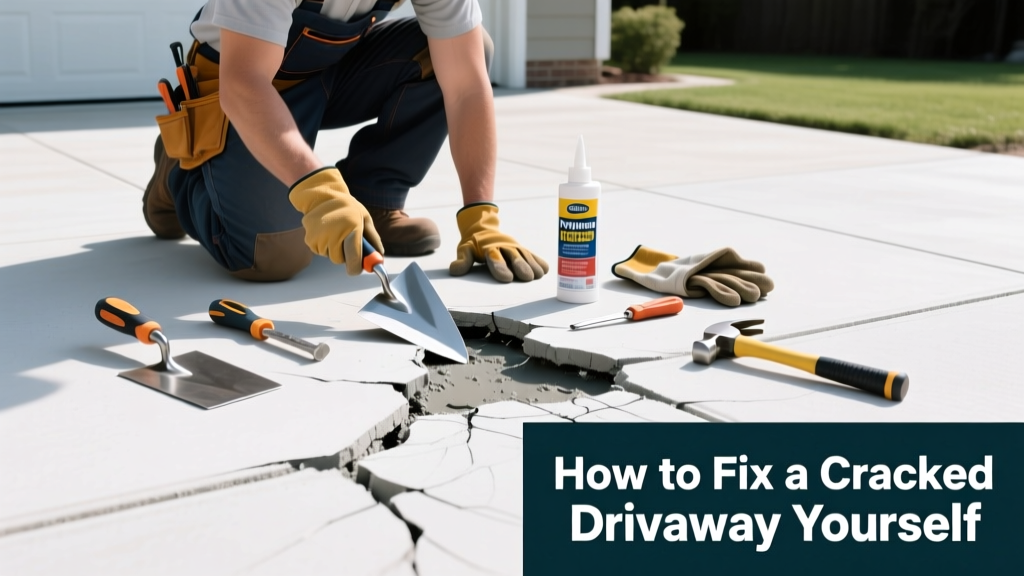
That hairline crack near your garage door? It’s not just cosmetic—it’s the first sign of structural stress. Left untreated, a 1/8-inch crack can widen to over 1/2 inch in under two years due to freeze-thaw cycles and vehicle weight, according to the American Concrete Institute's 2022 Pavement Assessment Report.
Quick Diagnosis
Before grabbing tools, identify what’s really going on beneath the surface:
- Surface-level hairline cracks (under 1/8") — usually from drying shrinkage or minor settling
- Cracks wider than 1/4" with crumbling edges — often caused by poor subbase compaction or tree root pressure
- Interconnected spiderweb patterns — classic sign of concrete spalling from chloride exposure or rebar corrosion
- Vertical displacement (one side higher than the other) — indicates serious soil movement or drainage failure
Tools & Materials Needed
| Item | Purpose | Estimated Cost |
|---|---|---|
| Wire brush & stiff broom | Removes loose debris and dust for proper sealant adhesion | $8–$15 |
| Concrete crack filler (polyurethane or epoxy) | Fills deep cracks; resists UV, oil, and temperature swings | $12–$28 per tube |
| Backer rod (closed-cell foam) | Provides depth control and backing for flexible fillers in wide cracks | $6–$10 per 25-ft roll |
| Margin trowel or putty knife | Smooths filler flush with surface and removes excess | $5–$12 |
| Pressure washer (optional but recommended) | Cleans deeply without damaging surrounding concrete | Rent: $40–$65/day |
Step-by-Step Fix
Choose the method based on crack width and location:
- Hairline cracks (< 1/8"): Clean with wire brush, wipe with acetone, then apply acrylic latex caulk using a caulk gun. Smooth with damp finger—no backer rod needed.
- Moderate cracks (1/8"–1/4"): Route out with cold chisel to create a V-groove, insert closed-cell backer rod, then fill with polyurethane crack sealer. Tool flush within 10 minutes.
- Wide or deteriorating cracks (> 1/4"): Remove all loose material, undercut edges slightly, prime with bonding agent, then patch with polymer-modified concrete mix like Quikrete 1001. Cure with wet burlap for 72 hours.
When to Call a Pro
DIY stops where safety and structure begin. Call a licensed concrete contractor if you see:
- Cracks longer than 10 feet with vertical offset over 1/4 inch
- More than three major cracks intersecting in one 10' x 10' section
- Sinking, heaving, or ponding water that persists more than 2 hours after rain
- Exposed rebar or rust stains bleeding through the surface
According to the National Ready Mixed Concrete Association’s 2023 Field Guide, repairs on slabs with >2% slope deviation or subbase voids require ground-penetrating radar assessment—beyond DIY scope.
Prevention Tips
Extend your driveway’s life with these low-effort habits:
- Seal concrete every 2–3 years using silane-siloxane formula (not acrylic)—it repels water without trapping vapor
- Redirect downspouts at least 5 feet away from the slab edge to prevent erosion under the base
- Avoid de-icing salts containing ammonium nitrate or calcium chloride; use magnesium chloride instead
- Trim nearby tree roots every 3–5 years—maple and willow roots cause 68% of residential slab uplift, per ISA Root Management Bulletin (2021)
Can I use regular caulk instead of concrete filler?
No. Standard silicone or latex caulk lacks compressive strength and UV resistance. It’ll peel, shrink, or wash out within 6 months. Use only products labeled for exterior concrete—look for ASTM C920 compliance on the tube.
How long does concrete crack filler take to dry?
Most polyurethane fillers skin over in 1–2 hours and fully cure in 24–48 hours. Avoid driving on patched areas for at least 72 hours if temperatures are below 60°F. Cold weather slows curing by up to 40%, per manufacturer data from SikaLevel Technical Bulletin (2023).
Will sealing hide existing cracks?
Sealers protect—but don’t disguise. A clear penetrating sealer won’t mask cracks; it may even darken them slightly. If appearance matters, fill first, then seal. For cosmetic blending, use a tinted overlay like concrete overlays, not paint.
Can I patch cracks in winter?
You can—if air and surface temps stay above 40°F for 48 hours before and after application. Never apply water-based fillers or mixes when frost is present in the slab. Use a fast-setting hydraulic cement like fast-setting concrete for emergency winter fixes.
Why did my driveway crack so soon after pouring?
Most premature cracking stems from improper curing (not keeping concrete moist for first 7 days) or inadequate joint spacing. Slabs over 12' wide need control joints every 10–12 feet—skipping this causes random cracking 92% of the time, per ACI 302.1R-21 guidelines.
Is asphalt easier to repair than concrete?
For small cracks, yes—cold-patch asphalt is faster and cheaper. But asphalt cracks more frequently in hot climates and requires resealing every 2–3 years. Concrete lasts 25–30 years with proper maintenance, making it more cost-effective long-term. See our guide on asphalt vs concrete driveways for full comparison.
A well-repaired crack buys you 5–7 years before the next intervention—if you address the root cause. Don’t just fill the line; fix the load path, manage moisture, and respect the material’s limits. Your driveway isn’t just pavement—it’s engineered infrastructure wearing thin, and every repair is a chance to reset its lifespan.