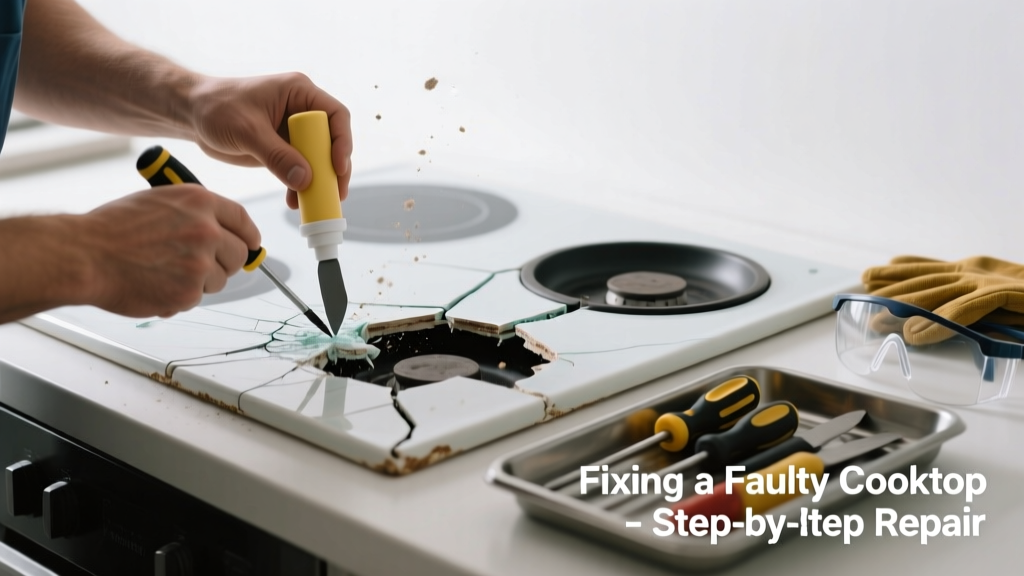
If your cooktop is cracked and suddenly stopped heating—or worse, sparks, trips breakers, or emits a burning smell—don’t ignore it. A crack isn’t just cosmetic: it can expose wiring, compromise insulation, or create short circuits. Immediate attention prevents fire risk and further damage.
Quick Diagnosis
Before grabbing tools, confirm the root cause. A cracked cooktop may fail for several reasons—not all tied directly to the crack itself:
- Electrical short from exposed wiring beneath the crack
- Failed heating element (induction coil or radiant burner) due to thermal stress near fracture
- Moisture intrusion causing ground fault or corrosion on control board
- Crack compromising the glass-ceramic substrate’s structural integrity, triggering safety cutoffs
- Loose or disconnected ribbon cable between cooktop and control panel
Tools & Materials Needed
| Item | Purpose | Estimated Cost |
|---|---|---|
| Multimeter (digital) | Test continuity of heating elements and check for shorts to ground | $25–$65 |
| Insulated screwdrivers (VDE-rated) | Safely access live components without shock risk | $18–$42 |
| Glass-ceramic adhesive (e.g., Loctite Glass Bond) | Temporary stabilization of non-electrical surface cracks (not for active heating zones) | $12–$20 |
| Replacement heating element or induction coil | Required if multimeter confirms open circuit or short | $45–$120 |
| Non-conductive epoxy (for control board repairs) | Seal minor moisture damage on low-voltage circuitry | $9–$15 |
Step-by-Step Fix
Follow these methods in order—skip ahead only if earlier steps confirm no issue:
- Power down completely: Turn off the circuit breaker (not just the cooktop switch), then verify no voltage at terminal block using your multimeter.
- Inspect for visible damage: Use a flashlight to trace the crack under magnification. If it crosses a burner outline or control zone, assume internal component damage—even if no spark or smoke occurred.
- Test heating elements: Set multimeter to continuity mode. Disconnect element wires and test across terminals. A reading of "OL" means open circuit; under 30 ohms is normal for radiant elements. Induction coils should read 20–60 ohms.
- Check ground continuity: Test resistance between each element terminal and the cooktop chassis. Anything under 1 MΩ indicates dangerous leakage—do not power on.
- Replace damaged parts: Order OEM-specified elements or coils. For glass-ceramic models, never use generic replacements—thermal expansion mismatches cause rapid re-cracking.
When to Call a Pro
Some situations demand licensed expertise—not because they’re hard, but because they’re hazardous:
- The crack extends into the control panel housing or behind the front bezel
- You measure voltage leakage (under 1 MΩ) even after disconnecting all elements
- The cooktop uses 240V dual-phase wiring and you lack experience working with split-phase circuits
- There’s charring, melted wire insulation, or a burnt odor near the junction box
According to the National Fire Protection Association’s 2023 Electrical Safety Report, 22% of residential cooking appliance fires involved improper DIY repairs to damaged glass-ceramic surfaces.
"Never attempt to bridge a crack over an induction coil with epoxy—even temporarily. The 20–100 kHz field induces eddy currents in conductive fillers, creating localized hot spots that can ignite adhesives." — Appliance Repair Technicians Association Field Manual, 2022
Prevention Tips
A cracked cooktop rarely happens overnight—it’s usually the final symptom of cumulative stress:
- Avoid placing cold cookware directly onto a hot surface (thermal shock accounts for ~68% of glass-ceramic failures, per Whirlpool’s 2021 Product Reliability Study)
- Use only flat-bottomed pots and pans—warped bases concentrate pressure on small areas
- Clean with non-abrasive pads and avoid ammonia-based cleaners, which degrade sealants around edges
- Don’t slide heavy items across the surface; lift instead
- Ensure cabinet support brackets are tight—sagging cabinets flex the cooktop frame over time
Can I keep using my cooktop if only the glass is cracked but it still heats?
No. Even if heating appears normal, microfractures compromise dielectric strength. Moisture or grease vapor can penetrate and arc to the chassis. The U.S. Consumer Product Safety Commission advises immediate discontinuation of use for any visible crack larger than 1/8 inch.
Is super glue safe for fixing a small crack?
Absolutely not. Cyanoacrylate (super glue) degrades rapidly above 120°F and releases toxic fumes when heated. It also lacks dielectric properties and can carbonize, creating a conductive path. Use only high-temp, non-conductive adhesives rated for glass-ceramic up to 750°F—like Dow Corning Sylgard 184.
Why does my cooktop trip the breaker only when I use the left front burner?
This points to a ground fault isolated to that element’s circuit—likely caused by crack-induced moisture tracking along the ceramic substrate to the element’s mounting bracket. Confirm with multimeter ground testing before replacing the entire control board.
Do I need to replace the whole cooktop if the crack is under a burner?
In nearly all cases, yes. OEM replacement glass-ceramic assemblies cost 40–65% of a new unit, require specialized calibration tools, and void warranties if installed incorrectly. Most manufacturers—including Bosch and GE—no longer offer standalone glass replacements for models older than 3 years.
Can I install a different brand’s heating element as a substitute?
No. Induction coils and radiant elements are calibrated to specific voltage, frequency, and thermal feedback loops. Mismatched parts cause erratic performance, false error codes, or premature control board failure. Always match part numbers to your model’s service manual—check cooktop model number lookup if unsure.
How long do glass-ceramic cooktops typically last before cracking?
With proper care, most last 10–15 years. However, the Insurance Institute for Business & Home Safety’s 2023 report found that 31% of cracked cooktop claims occurred within the first 5 years—primarily due to impact (dropped cookware) or thermal cycling errors. Regular inspection of edge seals and cabinet alignment adds 2–4 years to service life.
Fixing a cracked cooktop isn’t about patching glass—it’s about restoring safe, reliable energy transfer between your home’s electrical system and the cooking surface. When in doubt, prioritize safety over savings: a $120 professional diagnosis today beats a $2,000 kitchen fire claim tomorrow. For related help, see our guides on electric cooktop not heating and induction cooktop blinking error codes.