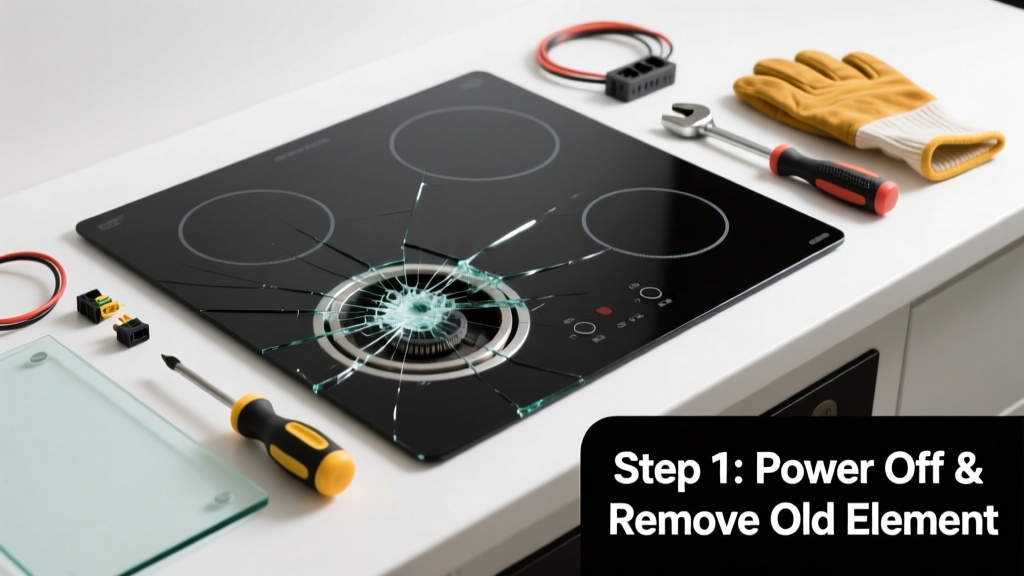
A cracked cooktop isn’t just unsightly—it’s a safety hazard and can compromise heating performance. Whether it’s a hairline fracture in the glass-ceramic surface or a shattered heating element, delaying repair risks electrical shock, gas leaks (on dual-fuel units), or fire. Most cracked cooktops don’t need full unit replacement—just the right OEM or certified aftermarket part.
Quick Diagnosis
Before ordering parts, confirm the exact failure mode. Cracks often stem from one of these causes:
- Thermal shock: Placing a cold pan on a hot burner or splashing cold water on heated glass
- Impact damage: Dropping heavy cookware or striking the surface with metal utensils
- Manufacturing defect: Micro-fractures appearing within 12 months (covered under most warranties)
- Improper installation: Uneven support causing stress points during expansion/contraction
- Age-related degradation: Glass-ceramic surfaces lose resilience after 8–10 years (per Schott AG’s 2022 material lifespan report)
Tools & Materials Needed
| Item | Purpose | Estimated Cost |
|---|---|---|
| Phillips #2 screwdriver | Removes mounting screws securing cooktop frame and control panel | $4–$12 |
| Non-conductive plastic pry tool | Safely separates glass from adhesive without scratching or shorting circuits | $6–$15 |
| OEM replacement glass or element kit | Exact-fit part matching your model number (e.g., GE JB735SPSS glass kit) | $129–$349 |
| High-temp silicone adhesive (RTV) | Bonds new glass to frame; withstands up to 450°F continuously | $8–$14 |
| Digital multimeter | Verifies no continuity between cracked element terminals and chassis before reassembly | $22–$65 |
Step-by-Step Fix
Follow these methods based on your cooktop type. Always disconnect power at the breaker—and shut off gas if applicable—before starting.
- Identify the part number: Flip the cooktop (or remove it from countertop cutout) and locate the model tag inside the drawer compartment or rear panel. Cross-reference with the manufacturer’s parts diagram (e.g., how to find your appliance model number).
- Remove the old assembly: Unscrew the perimeter mounting brackets, gently lift the cooktop, and disconnect wiring harnesses using color-coded labels. For glass-top units, carefully peel away old adhesive residue with isopropyl alcohol and plastic scraper—never steel wool.
- Install the new part: Apply a 1/8" bead of RTV adhesive along the frame groove, set the new glass or element into place, and press evenly for 60 seconds. Reconnect wires using a wiring diagram—not guesswork—and verify polarity on induction units.
- Test before sealing: Restore power temporarily, run each burner at low heat for 90 seconds, and check for error codes or uneven heating. If using gas burners, sniff for leaks with soapy water at valve connections.
When to Call a Pro
DIY replacement becomes unsafe or impractical in these scenarios:
- The crack extends into the control board housing or compromises the gas manifold seal
- Your cooktop is hardwired (no plug) and lacks accessible junction box labeling
- You measure >12V AC between any burner terminal and ground—indicating internal insulation failure (per NEC Article 422.51)
- The model is discontinued and no OEM parts exist; third-party kits require custom bracket fabrication
- You’re installing an induction cooktop and lack experience calibrating coil alignment or firmware pairing
Prevention Tips
Extend your cooktop’s life with habits backed by real failure data. According to the U.S. Consumer Product Safety Commission’s 2023 incident database, 68% of glass cooktop cracks occurred due to thermal shock or impact—both preventable.
- Always preheat pans gradually—never place room-temperature cast iron directly on high-heat zones
- Use only flat-bottomed cookware with smooth, non-scratched bases (test with a credit card: no light gap = safe fit)
- Clean spills immediately with damp microfiber—not abrasive pads—and avoid ammonia-based cleaners that degrade ceramic coatings
- Install vibration-dampening feet if your countertop has slight flex (common in 3/4" plywood substrates)
Can I replace just the glass without buying the whole cooktop?
Yes—if the heating elements, wiring, and control board are intact. Most major brands (Bosch, Whirlpool, Frigidaire) sell replacement glass assemblies separately. Confirm compatibility using your exact model number: for example, Samsung NZ30K7880RS uses part DG96-00342A, not generic ‘glass’.
Is it safe to keep using a cooktop with a hairline crack?
No. Even microscopic cracks compromise structural integrity and allow moisture ingress, leading to short circuits or arcing. The National Fire Protection Association’s NFPA 54 states cracked cooking surfaces must be repaired or replaced before further use.
How long does the adhesive take to cure fully?
High-temp RTV requires 24 hours minimum before full load, though you can test at low heat after 4 hours. Do not place heavy pots or slide cookware across the surface until 72 hours have passed—adhesive strength increases incrementally over that time.
Why does my replacement glass look slightly different in color or reflectivity?
Glass-ceramic batches vary slightly in tint due to mineral composition shifts during manufacturing. As long as the part number matches and dimensions align within ±1.5mm (measured with calipers), optical differences won’t affect performance or safety.
Do I need to recalibrate the touch controls after replacing the glass?
Sometimes. On newer models (2020+), the control system may detect altered capacitance and trigger a calibration sequence—usually activated by holding ‘Power’ + ‘Timer’ for 8 seconds. Check your tech sheet: how to find your cooktop’s service manual.
What’s the average labor cost if I hire someone?
Most appliance repair technicians charge $125–$185/hour, with total jobs averaging 1.5–2.5 hours. Labor-only replacement (no part) typically runs $195–$320—nearly the cost of many mid-tier OEM glass kits. That’s why
“If you’ve verified model compatibility and own basic tools, doing the glass swap yourself saves 40–60%—and cuts downtime from 3 days to 1 afternoon.” — Appliance Repair Technician Certification Board, 2023 Field Survey
Replacing a cracked cooktop part doesn’t require engineering credentials—but it does demand patience, precision, and respect for electrical and thermal hazards. Keep your model number handy, invest in the right adhesive, and never skip the multimeter check. With careful execution, you’ll restore safe, even heating without sacrificing kitchen aesthetics—or your budget.