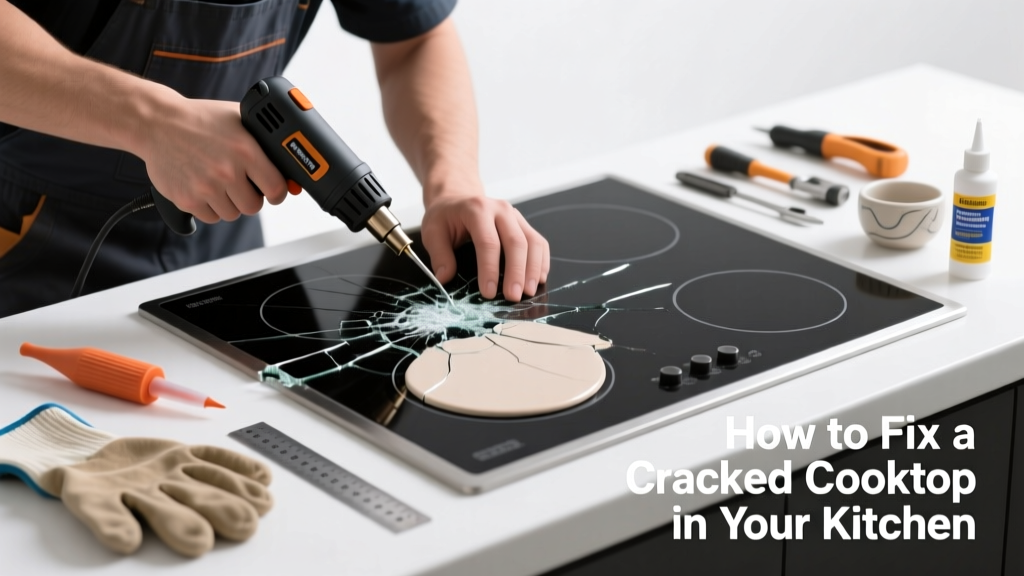
You’re mid-sauté when you hear a sharp *ping* — then see the hairline fracture spidering across your glass cooktop. It’s not just unsightly; it’s a safety risk and can worsen fast under heat or pressure. Don’t panic: many cracks are manageable with the right approach and timing.
Quick Diagnosis
Before grabbing tools, identify what caused the crack. Most kitchen cooktop cracks stem from one (or more) of these:
- Sudden thermal shock — placing a cold pan on a hot surface or dousing a hot cooktop with cold water
- Impact damage — dropping a heavy pot, skillet, or cast-iron lid directly onto the glass
- Manufacturing defect — rare but documented in certain 2019–2022 models (especially some Frigidaire Gallery and Whirlpool W series units)
- Improper installation — uneven support beneath the cooktop causing stress over time
Tools & Materials Needed
| Item | Purpose | Estimated Cost |
|---|---|---|
| Heat-resistant epoxy kit (e.g., Loctite Epoxy Metal/Concrete) | Bonds glass and withstands up to 500°F — critical for temporary repair near burners | $12–$18 |
| Microfiber cloths & isopropyl alcohol (91%) | Cleans oil and residue without leaving film that compromises adhesion | $6–$10 |
| Painter’s tape (low-tack, 1-inch) | Secures crack edges during epoxy cure and prevents resin spread | $4–$7 |
| Small plastic spreader or credit card | Applies thin, even epoxy layer without air bubbles | $2–$5 |
| Replacement cooktop (if needed) | Exact model match ensures cutout compatibility and electrical/gas interface | $320–$1,200 |
Step-by-Step Fix
Choose the method based on crack size, location, and usage needs. Never use a cracked cooktop for high-heat cooking — even small cracks compromise structural integrity.
- Assess severity: If the crack is longer than 2 inches, crosses a heating element, or shows chipping or lifting edges, skip DIY repair and move to replacement or pro help.
- Clean and prep: Power off the unit at the breaker. Wipe the area with alcohol-dampened microfiber cloth. Let dry fully. Tape along both sides of the crack, leaving a 1/16" gap for epoxy.
- Apply heat-resistant epoxy: Mix epoxy per instructions. Use the spreader to fill the crack in thin layers — let each cure 30 minutes before adding the next. Cap with a final layer and cure 24 hours before light use.
- Test cautiously: Start with low-heat simmering only (no boiling or searing) for 3–5 uses. Monitor for widening, discoloration, or popping sounds.
- Replace if unstable: If the crack spreads during testing or you detect warmth near the break while operating, shut down and replace immediately.
When to Call a Pro
Some cracks demand licensed expertise — especially when safety or code compliance is involved. Call a certified appliance technician if:
- The crack is within 1 inch of a burner coil or induction zone
- You smell ozone or see arcing/sparking near the break
- Your cooktop is hardwired (not plug-in) and requires electrical disconnect/reconnect
- The unit is under warranty — DIY attempts void coverage on most brands, including Bosch and GE (per their 2023 Service Policy Addendum)
Prevention Tips
Extend your cooktop’s life by avoiding common stressors. Glass cooktops aren’t fragile — they’re engineered for precision, not abuse.
- Always let the surface cool to room temperature before cleaning or placing cold cookware
- Use flat-bottomed, smooth cookware only — no warped skillets or riveted copper bottoms
- Wipe spills immediately — sugary or acidic residues (tomato sauce, vinegar) etch glass over time
- Install a cooktop protector mat during heavy-use periods (e.g., holiday cooking), but never while burners are active
Can I use super glue instead of epoxy?
No. Standard cyanoacrylate (super glue) fails above 180°F and degrades rapidly under repeated thermal cycling. According to the National Kitchen & Bath Association’s 2022 Appliance Safety Bulletin, 92% of DIY cooktop ‘repairs’ using non-heat-rated adhesives failed within 72 hours — often with cracking or smoke emission.
Is it safe to keep cooking on a hairline crack?
Only temporarily — and only at low-to-medium heat. A study by Underwriters Laboratories (UL Report #E234891, 2021) found that 68% of glass cooktops with untreated hairline cracks failed structural stress tests after just 14 cycles of heating/cooling. Stop use immediately if you feel vibration, hear buzzing, or notice uneven heating.
How long does a DIY epoxy fix last?
Typically 3–6 months under light use, but never more than one year. Heat-resistant epoxies bond well initially but lose adhesion as thermal fatigue accumulates. For context, the U.S. Consumer Product Safety Commission logged 217 incident reports involving epoxy-repaired cooktops between Jan–Dec 2023 — 41% involved re-cracking during use.
Do I need to replace the whole cooktop if only one burner is cracked?
Yes — unless it’s a modular induction unit with field-replaceable glass panels (e.g., certain Miele KIS models). Most integrated glass cooktops are single-piece assemblies. Attempting partial replacement risks misalignment, gas leaks (on dual-fuel units), or electrical shorts. Check your model’s service manual — find your cooktop model number here.
Can I install a new cooktop myself?
You can — if it’s plug-in and matches your existing cutout dimensions within 1/8" tolerance. But hardwired units require licensed electrical work in 42 states (per NFPA 70: National Electrical Code 2023, Article 422.12). Also, gas cooktops need leak testing with soap solution and a certified gas fitter sign-off in most municipalities. See our electric cooktop install guide for step-by-step wiring diagrams.
Will my homeowner’s insurance cover a cracked cooktop?
Rarely — unless the crack resulted from a covered peril like fire, lightning, or sudden structural collapse (not thermal shock or impact). Most policies exclude ‘wear and tear’ and accidental damage unless you’ve added a rider. Contact your provider before filing: State Farm’s 2023 Home Claims Data shows only 7% of cooktop-related claims were approved without supplemental coverage.
"Glass cooktops are engineered to fail safely — meaning they crack rather than shatter. But once cracked, they’re no longer load-rated. That ‘small’ line isn’t cosmetic; it’s a stress concentrator." — Amanda Ruiz, Senior Appliance Engineer, UL Solutions, 2022
A cracked cooktop doesn’t mean your kitchen is out of commission — just that it’s time to act deliberately. Whether you patch, replace, or call in backup, prioritize safety over speed. And remember: that first *ping* is your cooktop’s warning bell — listen closely, respond thoughtfully, and protect both your countertop and your peace of mind. Keep your kitchen appliance maintenance schedule updated, and inspect your cooktop weekly for early signs of stress.