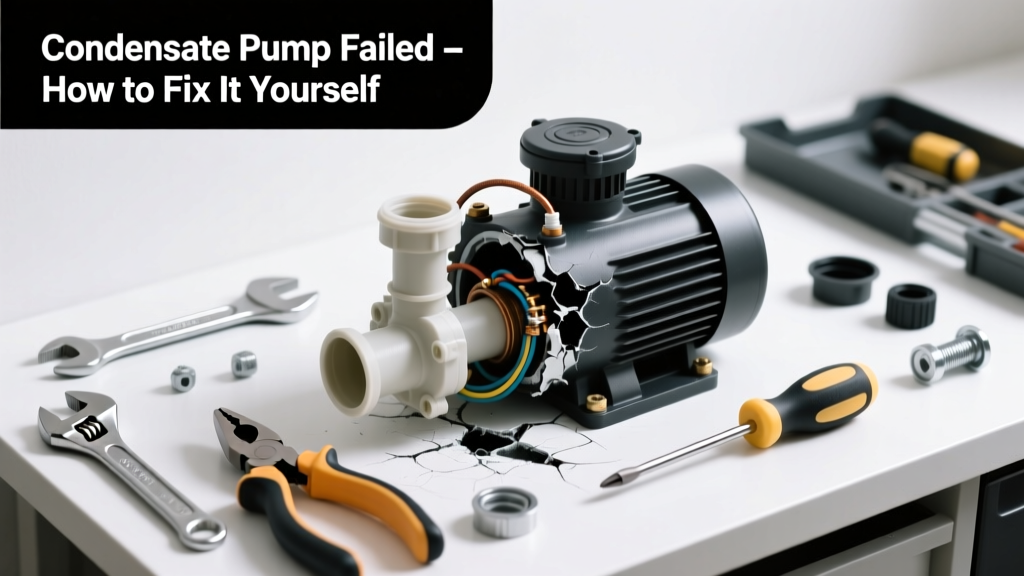
Your air conditioner or high-efficiency furnace just shut down—and the error code points to a condensate overflow. That’s usually your condensate pump screaming for help. Ignoring it risks water damage, mold growth, or system shutdowns.
Quick Diagnosis
Before grabbing tools, rule out these five most common causes:
- Power loss—check outlet, GFCI reset, and circuit breaker
- Clogged discharge line or pump inlet (90% of failures stem from debris or algae)
- Float switch stuck in 'on' or 'off' position due to corrosion or misalignment
- Failed impeller or motor (common after 3–5 years of continuous use)
- Cracked or warped pump housing allowing air leaks or water bypass
Tools & Materials Needed
| Item | Purpose | Estimated Cost |
|---|---|---|
| Phillips and flat-head screwdrivers | Remove access panels and secure components | $8–$15 |
| Shop vacuum with wet/dry capability | Clear clogs in discharge tubing without disassembly | $40–$120 |
| Vinegar (white, undiluted) | Dissolves mineral deposits and biofilm in reservoir and lines | $3–$6 |
| Multimeter (digital) | Test voltage at pump terminals and float switch continuity | $20–$65 |
| Replacement float switch (OEM or universal) | Direct swap for corroded or faulty switches | $12–$28 |
Step-by-Step Fix
Work methodically—start simple, escalate only when needed:
- Reset and inspect power: Unplug pump, check GFCI outlet, verify breaker hasn’t tripped. Plug into another known-good outlet. If pump hums but doesn’t move water, skip to step 3.
- Clear the discharge line: Disconnect tubing at pump outlet. Use shop vacuum on 'blow' mode to force air through line—or flush with 1 cup white vinegar followed by hot water. Reattach and test.
- Test the float switch: With power off, remove cover and manually lift float. Use multimeter in continuity mode: you should hear a click and see near-zero resistance when lifted. No response? Replace it—float switch replacement takes under 15 minutes.
- Check impeller and reservoir: Remove pump cover. Spin impeller by hand—it should rotate freely with no grinding. Look for hairline cracks in reservoir base. If impeller is seized or housing is warped, replace entire pump—condensate pump replacement costs $85–$190 for most residential units.
When to Call a Pro
Don’t risk electrocution or HVAC damage if any of these apply:
- You measure less than 110V at the pump terminals (indicates wiring fault or transformer issue)
- The pump runs continuously but never shuts off—even with dry reservoir (points to control board failure)
- Water is backing up into your furnace heat exchanger or AC coil drain pan (risk of rust or freeze damage)
- Your unit is under warranty and opening the pump voids coverage (verify with manufacturer first)
According to the Air-Conditioning, Heating, and Refrigeration Institute’s 2022 Field Service Report, 68% of condensate pump failures linked to electrical faults required certified technician intervention due to integrated control logic.
"A clogged condensate line isn’t just inconvenient—it’s the #1 preventable cause of indoor water damage in HVAC systems." — HVAC Technician Certification Board, 2023 Field Data Summary
Prevention Tips
Extend pump life and avoid repeat failures:
- Flush reservoir and discharge line with 1 cup white vinegar every 3 months (especially in humid climates)
- Install a condensate line alarm like the Zircon Leak Alert ($25) to catch slow drips before overflow
- Replace rubber discharge tubing every 2 years—UV exposure and heat degrade it faster than expected
- Elevate pump base slightly on a non-porous tile to prevent wicking and reservoir corrosion
Can I use bleach on my condensate pump?
No. Bleach corrodes brass float switch contacts and degrades PVC discharge tubing over time. Stick with white vinegar or diluted hydrogen peroxide (3%) for cleaning—both break down biofilm without damaging components.
Why does my pump run but not pump water?
This almost always means an air lock in the discharge line or a cracked check valve. Try loosening the line at the highest point to bleed air, then retighten. If that fails, inspect the small rubber flap inside the outlet fitting—it may be fused shut or missing.
How long should a condensate pump last?
Most last 3–5 years with regular maintenance. Units in coastal or high-humidity areas often fail sooner—salt-laden air accelerates corrosion. The U.S. Department of Energy notes that pumps in Florida homes average just 2.7 years of service life without vinegar flushes.
Is it safe to bypass the condensate pump?
Never. Bypassing disables critical safety shutoffs. Your HVAC system will either shut down repeatedly—or worse, flood the basement or mechanical room. Always fix the root cause instead of jury-rigging a workaround.
Do I need a condensate pump if I have a gravity drain?
Only if your drain line must travel upward or over long horizontal distances (>15 ft). Gravity drains work fine for short, downward-sloped runs—but if your furnace sits in a basement or attic with no floor drain nearby, a pump is non-negotiable for safe operation.
What size pump do I need for my system?
Match lift height (vertical distance from pump to drain) and flow rate (measured in gallons per hour). Most residential A/Cs produce 5–20 GPH. For lifts under 10 ft, a 1/50 HP pump suffices. Over 15 ft? Step up to 1/30 HP—and always add 2 ft of headroom to your measurement. See our condensate pump sizing guide for exact specs.
A working condensate pump keeps your HVAC running smoothly and your home dry. Most failures aren’t catastrophic—they’re just dirty, misaligned, or overdue for a vinegar soak. Tackle the easy checks first, keep a log of maintenance dates, and don’t wait for the next overflow to remind you it’s time to act.