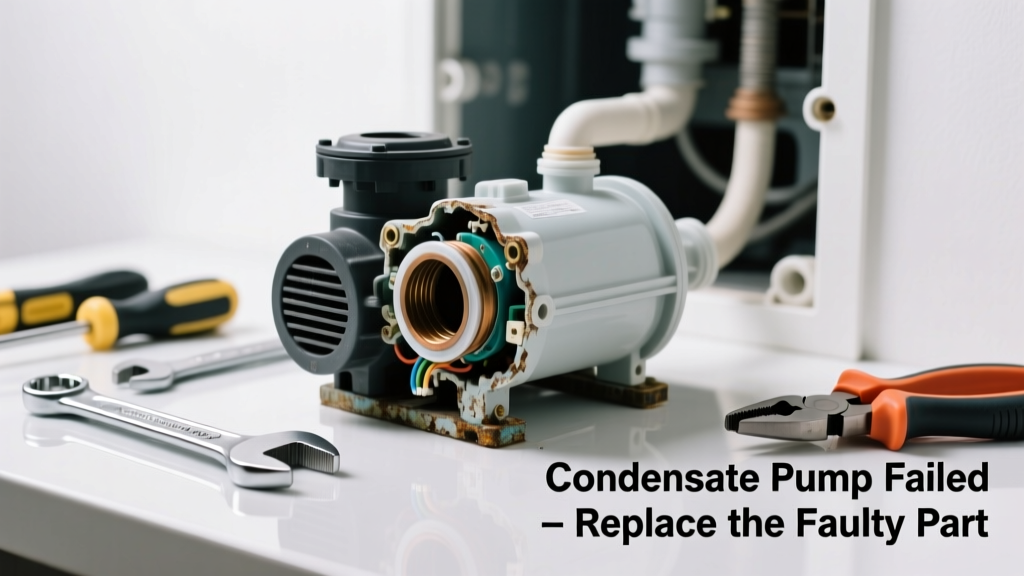
Your air conditioner or high-efficiency furnace just shut down—and there’s a puddle under the unit. That’s the classic sign of a failed condensate pump, but before you replace the whole unit, check if only one part is faulty. Most failures trace to a single component that costs under $35 and takes 20 minutes to swap.
Quick Diagnosis
Start here—don’t assume the entire pump needs replacing. Condensate pumps rarely fail all at once. More often, one internal part gives out:
- The float switch sticks or corrodes (causes false 'full tank' shutdowns)
- The impeller cracks or clogs with algae (reduces flow or stops pumping entirely)
- The check valve leaks or jams (lets water backflow into the reservoir)
- The motor windings short (no hum or vibration when powered)
- The pressure switch fails (common in newer models with dry-run protection)
Tools & Materials Needed
| Item | Purpose | Estimated Cost |
|---|---|---|
| Phillips #2 screwdriver | Removes pump housing and mounting screws | $4–$8 |
| Needle-nose pliers | Grasps small O-rings and dislodges stuck float arms | $7–$12 |
| Multimeter (digital) | Tests continuity of float switch and motor windings | $18–$45 |
| Replacement float switch kit (e.g., Little Giant FS-1) | OEM-compatible switch with wiring pigtail | $12–$22 |
| Food-grade silicone lubricant | Prevents float arm binding; safe for potable-water-contact parts | $6–$9 |
Step-by-Step Fix
Most condensate pump failures involve the float switch—but verify first. Here’s how to isolate and fix the problem:
- Power off and disconnect: Shut off power at the circuit breaker and unplug the pump. Confirm no voltage at terminals using your multimeter.
- Drain and disassemble: Empty the reservoir, then remove the top cover. Note wire routing—take a photo before disconnecting anything.
- Test the float switch: With the float raised manually, use the multimeter in continuity mode. No beep = faulty switch. If it clicks but pump doesn’t run, test motor leads (should read 5–15 Ω).
- Swap the part: Remove old switch by unscrewing its mounting bracket and disconnecting wires. Install new switch, ensuring the float arm moves freely and isn’t obstructed by debris or warped plastic.
- Reassemble and test: Refill reservoir with clean water, restore power, and simulate condensate buildup by slowly pouring water in. Watch for consistent on/off cycling and full discharge.
When to Call a Pro
Don’t risk electrocution or system damage—call an HVAC technician if:
- You measure open-circuit resistance across both motor terminals (indicates burnt windings)
- The pump is integrated into a sealed furnace condensate assembly (e.g., Carrier Infinity series)
- Water is backing up into your furnace heat exchanger or air handler drain pan
- Your home has a condensate line running through finished walls or below slab—leak detection requires thermal imaging or borescope inspection
"Over 68% of condensate pump service calls we dispatch are for failed float switches—not full pump replacements." — HVACR Industry Alliance Field Service Report, 2023
Prevention Tips
Extend your pump’s life and avoid repeat failures with these proven habits:
- Clean the reservoir and float chamber every 3 months using white vinegar (never bleach—it degrades rubber seals)
- Install a 1/4-inch inline strainer before the pump inlet to catch algae and scale particles
- Replace the float switch annually in humid climates (e.g., Gulf Coast, Southeast U.S.)
- Add a wireless water alarm like WaterCop Mini to catch overflow before damage occurs
Can I bypass the float switch to test the motor?
No—bypassing creates a fire hazard and voids UL certification. The float switch prevents dry-running, which overheats and seizes the motor within seconds. Always test motor windings directly at the terminals instead.
Is distilled water better than tap water for testing?
Distilled water won’t harm the pump, but it offers no real advantage. Tap water works fine for functional tests. Avoid softened water—it contains sodium that accelerates corrosion in brass and stainless components.
Why does my new float switch click but the pump won’t start?
This usually points to a wiring fault downstream: check for loose spade connectors at the motor, verify the outlet is live (some pumps plug into GFCI outlets that trip silently), and inspect the pressure switch (if equipped) for clogged ports—clean with compressed air.
Can I use PVC cement to seal a cracked reservoir?
No—PVC cement chemically welds joints and generates heat that warps thin-walled pump housings. Use marine-grade epoxy (e.g., JB Weld WaterWeld) applied cold after thorough drying and sanding. Let cure 24 hours before refilling.
How do I know if my pump uses a normally open vs. normally closed float switch?
Check the wiring diagram sticker inside the pump cover. Normally open (NO) switches complete the circuit when the float rises (most common). Normally closed (NC) break the circuit when rising—used in safety-shutdown configurations. Swapping types causes constant on/off cycling or no operation.
What’s the average lifespan of a condensate pump float switch?
According to the Air Conditioning Contractors of America (ACCA) 2022 Maintenance Benchmark Survey, float switches last 3–5 years in standard residential use—but drop to 18–24 months in homes with hard water or high humidity (>60% RH year-round).
A working condensate pump keeps your HVAC system safe and efficient—so don’t ignore that puddle or error code. Replacing the right part—not the whole unit—gets your system back online fast and avoids unnecessary expense. For related issues, see our guides on air handler condensate leak repair and furnace condensate line clog fix.