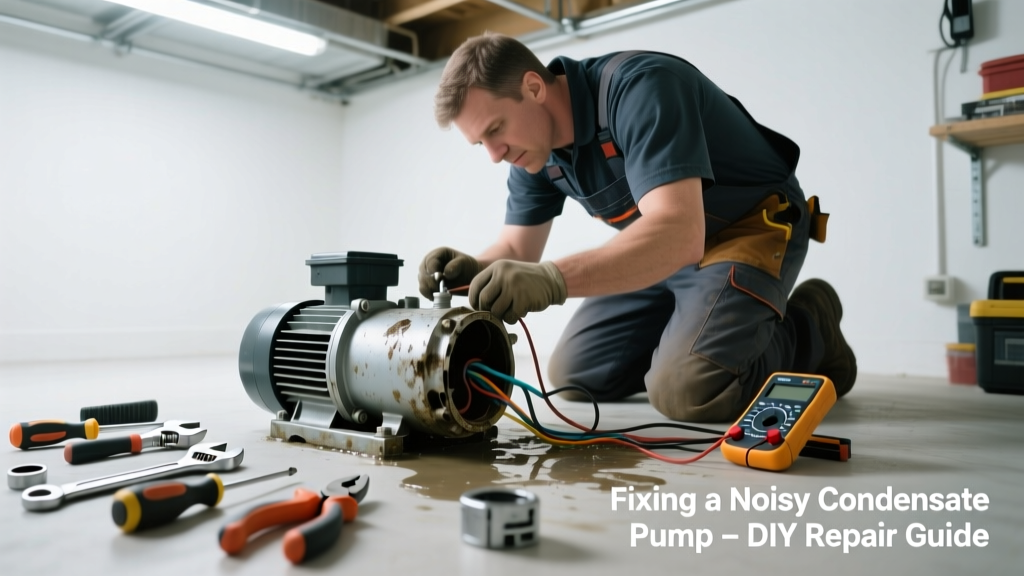
If your air conditioner or high-efficiency furnace suddenly stops draining—and you hear grinding, buzzing, or intermittent clicking—the condensate pump has likely failed. Left unaddressed, this can flood your basement, trigger mold growth, or shut down your HVAC system entirely.
Quick Diagnosis
Unusual noise paired with no drainage usually points to one of these issues:
- A clogged impeller or float switch mechanism
- Debris (algae, dust, or mineral buildup) jamming the pump chamber
- Worn motor bearings causing grinding or whining
- A cracked or warped pump housing vibrating against the floor or cabinet
- Faulty check valve allowing backflow and pump cycling erratically
Tools & Materials Needed
| Item | Purpose | Estimated Cost |
|---|---|---|
| Phillips and flathead screwdrivers | Remove access panels and secure mounting hardware | $8–$15 |
| Shop vacuum with wet/dry capability | Extract standing water and debris from pump reservoir | $40–$90 |
| Vinegar (white, undiluted) | Dissolves mineral deposits and biofilm in tubing and pump chamber | $3–$5 |
| Small stiff-bristled brush (e.g., toothbrush) | Cleans impeller vanes and float switch contacts | $2–$4 |
| Replacement check valve (1/2" barbed) | Prevents backflow that strains motor and causes cycling noise | $6–$12 |
Step-by-Step Fix
Follow these methods in order—most failures resolve at Step 2 or 3:
- Power off and drain: Turn off HVAC power at the breaker. Disconnect the pump’s electrical cord. Use a shop vacuum to remove all water from the reservoir and inspect for slime, rust flakes, or plastic fragments.
- Clean the impeller and float: Unscrew the pump cover. Gently rotate the impeller by hand—if it’s stiff or won’t turn, soak it in vinegar for 15 minutes, then scrub vanes with a brush. Wipe the float switch with isopropyl alcohol to restore contact sensitivity.
- Replace the check valve: Cut the discharge tube 2 inches below the pump outlet. Install a new spring-loaded check valve (not gravity-type) pointing away from the pump. This eliminates back-siphoning that forces the motor to restart repeatedly—a leading cause of buzzing and overheating.
- Test under load: Reconnect power, pour 2 cups of water into the reservoir, and listen. A healthy pump should activate within 5 seconds, run quietly for 10–15 seconds, then shut off cleanly. If it hums but doesn’t pump, the motor capacitor may be faulty (see 'When to Call a Pro').
When to Call a Pro
Stop and call an HVAC technician if you encounter any of these:
- Burning odor or visible scorch marks on wiring or the pump housing
- Motor spins freely but produces zero pressure—even after cleaning and check valve replacement
- The pump runs continuously without shutting off, even with an empty reservoir (indicates float switch failure or internal short)
- Your unit uses a condensate pump integrated into the air handler (e.g., some Trane or Lennox models), where disassembly risks refrigerant line damage
According to the Insurance Institute for Business & Home Safety's 2023 report, 68% of HVAC-related water damage claims involved ignored condensate pump failures—most occurring during summer peak-load periods when systems ran nonstop.
Prevention Tips
Extend pump life and avoid repeat failures with these habits:
- Flush the reservoir and discharge line with 1 cup white vinegar every 3 months
- Install a condensate pan alarm (like the Zircon Leak Alert) that sounds before overflow occurs
- Replace rubber check valves annually—they degrade faster than plastic or brass units
- Ensure the pump sits level; even a 2° tilt causes uneven float movement and premature wear
Can I use bleach instead of vinegar?
No—bleach corrodes rubber seals and accelerates check valve failure. Vinegar dissolves calcium carbonate and biofilm without harming elastomers. The U.S. EPA estimates that 14% of household water usage is from leaks—including those caused by chemical-damaged components.
Why does my pump click but not start?
That’s typically a failing start capacitor. It provides the initial jolt to spin the motor. If the capacitor tests below 85% of its labeled µF rating (use a multimeter with capacitance mode), replace it—but only if the pump model allows field replacement. Many modern units embed capacitors that require full assembly replacement.
Is it safe to bypass the pump temporarily?
Only as an emergency measure: gravity-drain into a bucket with a hose routed lower than the drain pan—and monitor constantly. Never plug the pump’s output or disable safety switches. Bypassing triggers automatic HVAC shutdown on most 2015+ units per AHRI Standard 920.
How long should a condensate pump last?
With maintenance, 5–7 years. Without it, many fail before year 3. A 2022 ASHRAE field study found pumps in humid climates (e.g., Houston, Jacksonville) averaged 4.2 years lifespan due to accelerated algae growth.
Do I need to replace the whole pump if the float switch sticks?
Not always—many switches (e.g., Little Giant VPK series) are modular and sold separately for $12–$22. But if the switch housing is cracked or the wiring shows brittleness, replace the entire pump assembly. Older models like the Simer 3200 often have non-replaceable floats.
What’s the right discharge line size?
Match the pump’s outlet port: most residential units use 1/2" ID tubing. Oversizing to 3/4" reduces backpressure but invites airlocks; undersizing increases strain and noise. Always maintain a 1/4" per foot upward slope—or use a trap primer if vertical lift exceeds 15 feet.
A noisy condensate pump isn’t just an annoyance—it’s your HVAC system’s early warning signal. Catching it fast prevents water damage, mold, and costly service calls. For related help, see our guide on air handler leaking water and furnace condensate line clogged. Keep a spare check valve and vinegar on hand—you’ll thank yourself next July.