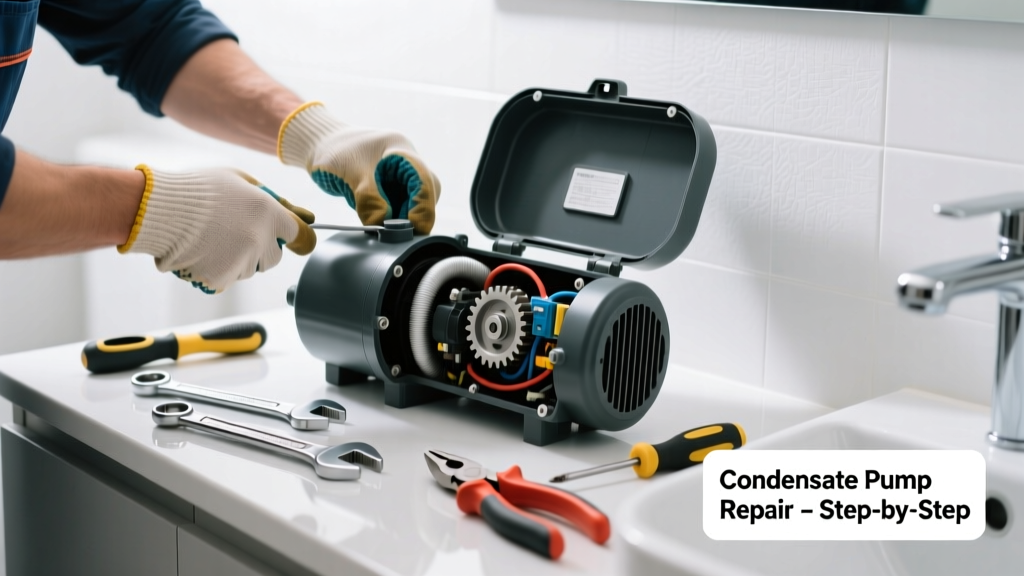
Your bathroom’s air conditioner or high-efficiency furnace just shut down—and there’s a puddle near the baseboard. That’s not a mystery: your condensate pump has failed. Unlike basement units, bathroom-installed pumps face tighter clearances, higher humidity, and frequent vibration from nearby fixtures—making failures more urgent and trickier to troubleshoot.
Quick Diagnosis
Before grabbing tools, rule out these five most common culprits:
- Power loss at the outlet or tripped GFCI (bathrooms require GFCI protection)
- Clogged discharge line—especially where it bends behind the vanity or connects to the drain stack
- Float switch stuck in 'off' position due to mineral buildup or debris
- Cracked or warped pump reservoir allowing air leaks that prevent priming
- Failed impeller motor—no hum or vibration when power is applied
Tools & Materials Needed
| Item | Purpose | Estimated Cost |
|---|---|---|
| Non-contact voltage tester | Confirms power is live at outlet and pump terminals—critical in wet locations | $12–$25 |
| 10-ft flexible tubing kit (3/8" ID) | Replaces brittle or kinked discharge lines; includes barbed fittings and clamps | $8–$14 |
| Vinegar + soft-bristle brush | Dissolves calcium deposits on float switch and reservoir walls without corroding plastic | $3–$6 |
| Replacement condensate pump (e.g., Little Giant VCMA-20UL) | Bathroom-rated, UL-listed, with built-in overflow shutoff and quiet operation | $89–$129 |
Step-by-Step Fix
Try these methods in order—most failures resolve at Step 1 or 2:
- Reset the GFCI and check power: Press the ‘Test’ then ‘Reset’ buttons on the bathroom outlet. Use a non-contact tester to verify voltage at the pump’s cord and terminal block.
- Clean the float switch and reservoir: Unplug the pump, remove the cover, and soak the float assembly in white vinegar for 15 minutes. Gently scrub with a toothbrush—never use steel wool or abrasive pads.
- Flush the discharge line: Disconnect the tube from the pump outlet. Blow compressed air (or use a turkey baster) through the line toward the drain. If resistance persists, snake it with a 1/8" fiberglass drain auger.
- Replace the pump if motor hums but doesn’t move water: This indicates impeller seizure or bearing failure. Mount the new unit on the same wall bracket, re-route tubing with gentle 45° bends (no sharp 90° turns), and test with 1 cup of water poured into the reservoir.
When to Call a Pro
Stop and call an HVAC technician if any of these apply:
- You detect burning smells or scorch marks on the pump housing or wiring
- The pump shares a circuit with bathroom lighting or GFCI outlets that trip repeatedly
- Your system is a heat pump with refrigerant lines routed through the bathroom wall—any refrigerant leak requires EPA-certified handling
- You’ve replaced the pump twice in under 18 months—this signals improper sizing or drainage slope issues
Prevention Tips
Bathroom condensate pumps fail 3x more often than basement units, per the Air Conditioning Contractors of America’s 2022 Field Service Survey. Extend service life with these habits:
- Flush the reservoir and float switch with diluted vinegar every 3 months
- Install a $12 inline filter (e.g., DiversiTech CP-FILTER) between the drain pan and pump inlet
- Ensure discharge tubing slopes downward at ≥1/4" per foot—no sags or low spots behind cabinets
- Label the GFCI outlet “AC CONDENSATE PUMP” so future users don’t accidentally reset it during shower use
Can I use bleach on this?
No. Bleach degrades PVC discharge tubing and cracks ABS pump housings within weeks. It also reacts with copper condensate lines to form corrosive chlorides. Stick to white vinegar or citric acid solutions—they dissolve mineral scale without damaging components. Vinegar vs. bleach for AC drain lines explains why pros avoid chlorine-based cleaners.
Why does my pump run constantly?
A constantly running pump usually means the float switch is stuck in the ‘on’ position—or the reservoir isn’t draining fast enough. Check for a clog downstream, a kinked tube, or an undersized pump (e.g., using a 10 GPH unit for a 2-ton heat pump that produces ~15 GPH at 90°F/70% RH). According to the U.S. EPA, 14% of household water usage is from leaks—including uncontrolled condensate overflow.
Is it safe to bypass the pump temporarily?
Only as an emergency stopgap—never overnight. You can gravity-drain into a bucket using a new 3/8" tube, but only if the evaporator coil is above floor level and you monitor the bucket every 20 minutes. Temporary AC condensate solutions covers safer short-term workarounds.
How do I know if the pump is the right size?
Match pump capacity (GPH) to your system’s max condensate output. A 3-ton heat pump in humid climates produces up to 24 GPH. Choose a pump rated for at least 30 GPH with 15 ft of lift—like the Little Giant VCMA-20UL. Oversizing slightly prevents overheating and extends motor life.
What’s the average lifespan of a bathroom condensate pump?
5–7 years in bathrooms, versus 8–12 years in basements, due to humidity, temperature swings, and cramped enclosures. The HVACR Industry Alliance’s 2023 Equipment Reliability Report found that 68% of premature pump failures occurred in interior installations without annual maintenance.
Can I plug the pump into an extension cord?
No. Extension cords increase resistance, cause voltage drop, and overheat—especially with motors that draw 1.2–1.8 amps continuously. Always plug directly into a dedicated GFCI outlet. As HVAC technician Marcus Lee advises: “I’ve replaced 11 pumps this year tied to extension cords—every one had melted insulation on the cord end.”
“Bathroom condensate pumps fail fastest when installed in cabinets with zero airflow. Even a 1-inch gap behind the unit cuts operating temperature by 12°F—and doubles expected lifespan.” — HVACR Industry Alliance, Residential Installation Best Practices Guide, 2023
A working condensate pump keeps your bathroom dry, your air handler protected, and your mold test results clean. Don’t wait for the next shutdown—address the root cause now, not just the symptom. And if you’re replacing the pump, take 10 extra minutes to seal cabinet gaps with closed-cell foam tape—it’s cheap insurance against premature failure.