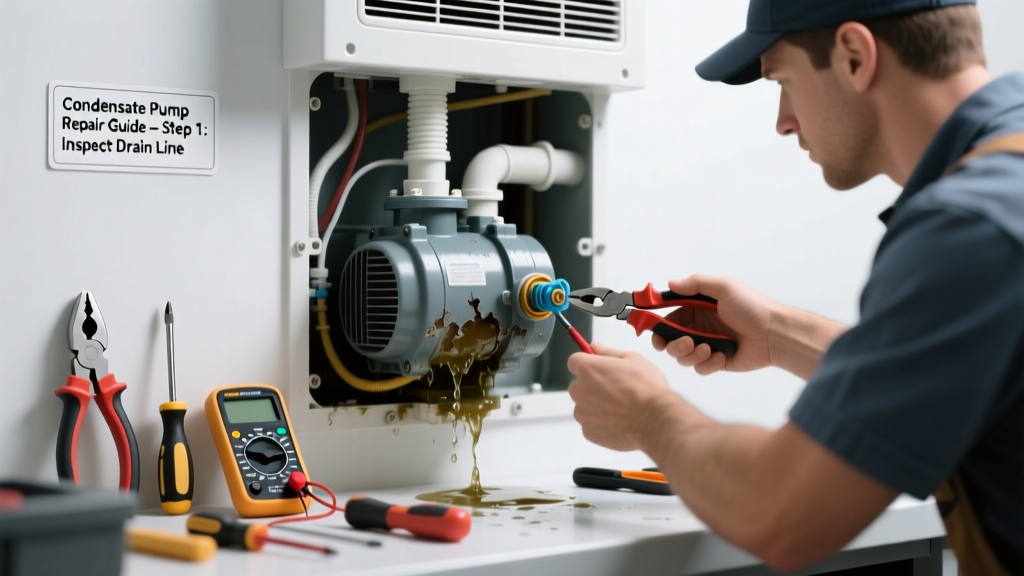
Your AC or furnace suddenly shuts down—and you spot a puddle under the air handler. That’s often the first sign your condensate pump has failed. Left unaddressed, this can trigger safety shutoffs, promote mold growth, or even cause ceiling damage from overflow. Don’t wait for a service call—many failures are simple to resolve in under an hour.
Quick Diagnosis
Before grabbing tools, confirm it’s actually the pump—not the drain line or float switch—that’s at fault. Here are the most common culprits:
- No power to the pump (tripped GFCI, blown fuse, or disconnected wire)
- Clogged impeller or check valve (most frequent cause—debris or algae buildup)
- Faulty float switch (stuck open or corroded contacts)
- Cracked or split pump housing (visible leaks or loss of prime)
- Worn motor windings (humming but no rotation, or complete silence with power confirmed)
Tools & Materials Needed
| Item | Purpose | Estimated Cost |
|---|---|---|
| Multimeter | Verify voltage at pump terminals and test float switch continuity | $25–$60 |
| Shop vacuum with wet/dry capability | Clear clogs in discharge tubing and reservoir | $40–$120 |
| Small pipe brush & vinegar solution (1:1) | Clean mineral deposits from impeller and check valve | $5–$15 |
| Replacement float switch (if needed) | Direct OEM or universal match for your pump model (e.g., Little Giant VCMA-20UL) | $18–$32 |
| Condensate pump cleaner tablets | Prevent biofilm buildup between maintenance cycles | $8–$14 |
Step-by-Step Fix
Follow these methods in order—most issues resolve at Step 1 or 2:
- Power cycle and inspect wiring: Turn off HVAC power at the breaker. Check GFCI outlets near the unit; reset if tripped. Inspect all wire nuts and terminal connections on the pump—tighten any loose splices. Re-energize and listen for a click or hum.
- Clear the discharge line: Disconnect the PVC or vinyl tube from the pump outlet. Blow through it or use compressed air (max 30 PSI). If blocked, attach shop vacuum to the tube end and suck backward while holding the pump reservoir lid open.
- Clean the impeller and float chamber: Remove the pump cover. Use a pipe brush dipped in vinegar to scrub the impeller vanes and check valve seat. Rinse thoroughly—never use bleach, which degrades rubber components. Manually lift and drop the float to verify smooth travel.
- Test the float switch: With power off, set multimeter to continuity mode. Probe the two float switch leads while lifting the float—should click closed (beep) when raised, open (no beep) when lowered. No response? Replace it.
When to Call a Pro
Some scenarios demand licensed expertise—especially where electrical, refrigerant, or structural risks exist:
- You measure less than 105V at the pump terminals (indicates transformer or control board failure)
- The pump motor emits a burnt odor or visible charring at the windings
- Water is backing up into the air handler cabinet—risking insulation saturation and electrical shorts
- Your system uses a secondary drain pan with a safety float switch wired to the furnace control board (intermittent shutdowns may point to control circuit faults)
"Over 68% of condensate-related HVAC service calls involve preventable pump maintenance issues—not component failure," says HVAC Technician Certification Board's 2022 Field Audit Report.
Prevention Tips
Extend pump life and avoid repeat failures with these habits:
- Clean the reservoir and discharge line every 3 months during cooling season
- Install a condensate line trap primer (for systems with long horizontal runs) to prevent dry traps and sewer gas entry
- Use distilled white vinegar monthly in the reservoir instead of commercial cleaners containing harsh acids
- Label your pump’s model number and keep spare parts on hand—float switches and check valves fail more often than motors
Can I use bleach on my condensate pump?
No. Bleach degrades rubber check valves and seals, leading to premature failure. Vinegar or manufacturer-approved enzymatic cleaners are safer and equally effective against biofilm.
Why does my condensate pump run constantly?
A stuck-open float switch or a cracked reservoir that won’t fill enough to trigger cutoff is usually to blame. Confirm float movement and inspect for hairline cracks—especially around mounting gaskets.
How do I know if the pump motor is dead?
If you hear a loud hum with no impeller movement—and voltage reads 115–120V at the terminals—the capacitor or windings have likely failed. Test capacitor with a multimeter; replace if capacitance is >10% below rating.
Do I need a backup condensate pump?
Yes—if your primary pump serves a high-efficiency furnace or attic-mounted AC where overflow could damage ceilings or insulation. A dual-pump setup with alarm relay adds critical redundancy.
What size pump do I need for my system?
Match lift height (vertical distance from pump to drain) and flow rate. Most residential units need 1/50 HP pumps lifting up to 15 ft. For details, see our condensate pump sizing guide.
Can a failed condensate pump cause mold?
Absolutely. Standing water in drip pans or overflowed reservoirs creates ideal conditions for Aspergillus and Stachybotrys. The U.S. EPA estimates that unchecked condensate leaks contribute to 22% of residential mold investigations in humid climates (EPA Indoor Air Quality Tools for Schools, 2021).
A working condensate pump isn’t glamorous—but it’s one of the most underrated safeguards in your HVAC system. Fixing it yourself builds confidence, prevents costly water damage, and keeps your home’s air quality intact. Just remember: when in doubt about wiring or refrigerant lines, pause and call a certified technician. Your safety—and your dry ceiling—is worth it.