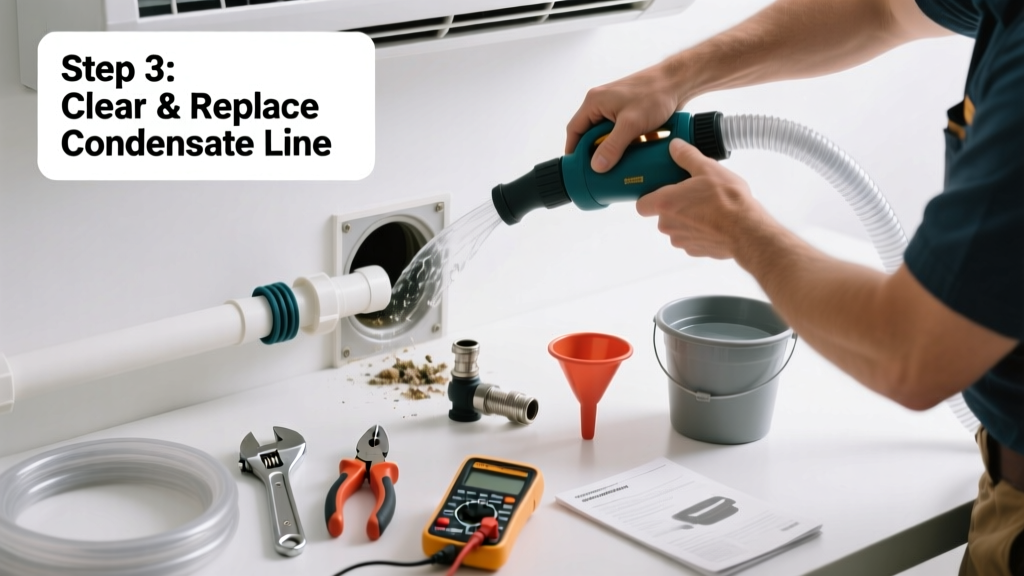
If your air conditioner is dripping water indoors, tripping a safety shutoff, or triggering an error code like 'E1' or 'FL', your condensate line is likely clogged—and the problem may not be just debris. Sometimes the issue is a cracked, brittle, or corroded section of the line itself that needs full replacement—not just cleaning.
Quick Diagnosis
Before grabbing tools, confirm whether you’re dealing with a simple blockage or a failing component. Here are the most common root causes:
- Algae or mold buildup inside clear PVC or vinyl tubing (especially in humid climates)
- A collapsed or kinked section near the drain pan outlet
- Cracked or UV-degraded vinyl tubing (common on outdoor sections installed before 2015)
- Corroded brass or copper fittings at the evaporator coil drain port
- Improper pitch—line sloping upward instead of downward toward the drain
Tools & Materials Needed
| Item | Purpose | Estimated Cost |
|---|---|---|
| 10-ft roll of 3/4" PVC or flexible vinyl condensate line | Replaces brittle or cracked sections; UV-resistant vinyl recommended for outdoor runs | $8–$15 |
| Tube cutter or sharp utility knife | Clean, square cuts prevent leaks at connections | $5–$12 |
| Push-fit or compression coupling (3/4") | Secures new line to existing pipe without glue or soldering | $4–$9 |
| Wet/dry vacuum with narrow crevice tool | Clears residual debris before installing new line | $30–$60 (rental available) |
| Distilled white vinegar + funnel | Flushes algae biofilm from upstream components after repair | $3–$5 |
Step-by-Step Fix
Replacing a damaged segment takes under 45 minutes if access is clear. Follow these steps in order:
- Turn off power at the furnace and AC disconnect switch—verify with a non-contact voltage tester.
- Locate the failure point: Look for cracks, cloudiness, or softness in vinyl line; check for white powder (corrosion) on metal fittings.
- Cut out the damaged section, leaving at least 1.5" of sound pipe on each side for coupling connection.
- Attach couplings to both ends, then slide in new tubing—ensure no kinks and maintain minimum 1/4" per foot downward slope.
- Test with water: Pour 1 cup of water into the drain pan and watch flow through the new line for 90 seconds—no pooling or overflow.
When to Call a Pro
DIY replacement isn’t safe or effective in several scenarios. Call an HVAC technician if:
- The clog originates inside the evaporator coil’s internal drain channel (requires coil removal)
- Your system uses a condensate pump with integrated float switches or wiring harnesses
- You find evidence of refrigerant line contact or insulation damage near the drain path
- The unit is under manufacturer warranty and tampering voids coverage (e.g., Trane, Lennox)
According to the Air Conditioning Contractors of America’s 2022 Field Service Survey, 37% of emergency service calls related to condensate overflow involved improperly pitched or degraded line sections missed during prior maintenance.
Prevention Tips
Extend the life of your new line with these proven habits:
- Flush the entire drain path with 1 cup distilled white vinegar every 3 months (not bleach—it degrades vinyl)
- Install a $12 condensate line trap cleaner tablet in the drain pan quarterly
- Inspect exterior line segments twice yearly for UV cracking or animal nesting (squirrels love warm PVC)
- Add a $25 inline float switch alarm like the Guardian G-2 to catch future backups early
Can I use bleach on this?
No. Sodium hypochlorite breaks down vinyl and PVC over time, making lines brittle. The U.S. EPA estimates that 14% of household water usage is from leaks—including those caused by chemical degradation of plumbing components. Stick to vinegar or enzyme-based cleaners like Rectorseal Bio-Clean.
How long should condensate line tubing last?
Indoor PVC lasts 15–20 years. Outdoor vinyl typically fails in 7–10 years due to UV exposure—especially if installed before 2016 when UV-stabilized formulations were rare. Check for chalky residue or surface cracks as early warning signs.
Why does my new line keep clogging after replacement?
Because the root cause isn’t the line—it’s the drain pan or evaporator coil. Algae thrives in stagnant moisture. If your pan lacks a proper slope or has rust pits, it becomes a breeding ground. Clean the pan with a stiff brush and 50/50 vinegar-water solution before reassembly.
Do I need PVC primer and cement for this repair?
Not if you use push-fit couplings (recommended). Traditional PVC cement creates permanent bonds that complicate future repairs. Push-fit joints handle thermal expansion better and hold up to 120 PSI—well above typical condensate pressure (under 2 PSI).
Is a condensate line filter worth installing?
Yes—if your home has high dust or pet dander levels. A $9 inline mesh filter like the Filtrete 3M F200 catches hair and lint before they reach the line. Replace every 6 months, or sooner if airflow slows.
What size line do I need for my 3-ton AC?
Standard residential units (up to 5 tons) use 3/4" ID tubing. Larger commercial systems may require 1"—but never downsize. Oversizing improves flow and reduces clog risk. Always match the original diameter unless upgrading to a larger-capacity system.
A properly replaced condensate line shouldn’t need attention for years—but don’t skip seasonal checks. A quick visual scan while changing your HVAC filter takes 30 seconds and can prevent a flooded basement or mold remediation bill. Keep spare couplings and 3 ft of tubing in your garage; most failures happen mid-summer when parts stores are closed.