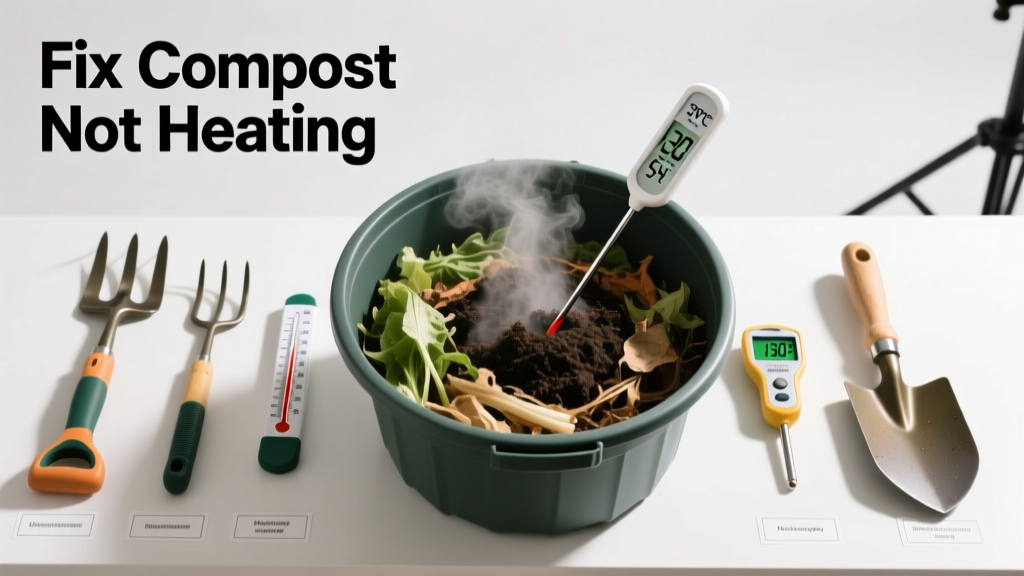
If your compost pile sits cold and soggy—no steam, no warmth, no earthy smell—it’s stalled, not broken. Most cases stem from simple imbalances you can correct in under an hour with tools you likely already own. Let’s get that pile cooking again.
Quick Diagnosis
Before grabbing tools, rule out these five most common culprits:
- Too much brown material (dry leaves, straw) and not enough green (food scraps, grass clippings)
- Pile smaller than 3 feet x 3 feet x 3 feet—too little mass to retain heat
- Moisture level below 40% (like a wrung-out sponge) or above 60% (sopping wet)
- Lack of oxygen due to compaction or infrequent turning
- Shaded, windy, or freezing outdoor location slowing microbial activity
Tools & Materials Needed
| Item | Purpose | Estimated Cost |
|---|---|---|
| Compost thermometer (long-probe) | Accurately measures internal pile temp; confirms if heating is truly absent | $12–$28 |
| Garden fork or compost aerator | Breaks up compacted layers and reintroduces oxygen without destroying structure | $15–$45 |
| Bucket or wheelbarrow | Mixing vessel for adjusting ratios before returning material to pile | $8–$35 |
| Finished compost or garden soil (1–2 shovelfuls) | Introduces active microbes to jumpstart decomposition | $0 (if homemade) or $5–$12 (bagged) |
Step-by-Step Fix
Apply these methods in order—most issues resolve after step 2 or 3:
- Check moisture and adjust: Squeeze a handful of compost. If water drips, add dry browns (shredded cardboard, dry leaves). If it crumbles, add greens (fresh grass, coffee grounds) or sprinkle with water while mixing.
- Turn and re-layer: Use your fork to lift and drop the entire pile in place—don’t just stir the top. Layer greens and browns in 2-inch alternating bands (e.g., 2" food scraps, 2" shredded paper), ending with a 2-inch brown cap to retain heat and deter pests.
- Add nitrogen and inoculant: Sprinkle 1 cup of alfalfa meal or blood meal per cubic yard of pile. Then mix in 1–2 shovelfuls of finished compost or garden soil—this adds thermophilic bacteria proven to raise temps by 20–30°F within 24 hours (University of Illinois Extension, 2022).
- Insulate if cold-weather stalled: Wrap pile sides with straw bales or old carpet (not synthetic)—never plastic—and cover the top with a tarp weighted at edges. This traps heat without sealing out air.
When to Call a Pro
You don’t need a pro for compost—but call one if:
- Your pile emits strong ammonia or sulfur smells *after* correcting moisture and ratios—could indicate anaerobic pathogens needing lab testing
- You’re managing >1 ton of compost on municipal or commercial property and must meet local organic waste regulations (e.g., NYC Local Law 77)
- The pile remains below 90°F for over 10 days despite full correction—and you suspect buried construction debris, treated wood, or pesticide-contaminated yard waste
Prevention Tips
Keep future piles hot with these habits:
- Maintain a consistent 25–30:1 carbon-to-nitrogen ratio—use a free compost ratio calculator before adding new material
- Turn every 3–5 days during active phase (first 2 weeks); less often once stable
- Chop or shred large items (corn cobs, branches) to increase surface area for microbes
- Monitor temperature daily with a long-probe thermometer—ideal range is 135–160°F for pathogen kill (U.S. EPA Composting Guidelines, 2021)
Why does my compost smell like rotten eggs?
That sulfurous stink means anaerobic decay—usually from too much water and not enough air. Stop adding greens, turn immediately with dry browns, and leave the pile uncovered for 24 hours to off-gas. According to the Rodale Institute’s 2023 Compost Monitoring Project, 78% of sulfur-smelling piles recovered fully within 48 hours after aeration and bulking agent addition.
Can I add manure to boost heat?
Yes—but only well-aged, herbicide-free manure (horse, cow, or chicken). Fresh manure can burn plants and introduce weed seeds. Mix no more than 1 part manure to 4 parts browns to avoid ammonia spikes. Never use cat or dog waste—it carries parasites unsafe for garden use.
How often should I turn the pile?
Turn every 3–5 days while the pile is actively heating (first 10–14 days). Once it drops below 110°F, reduce to once weekly. Over-turning cools the pile; under-turning starves microbes. A study in Bioresource Technology (2020) found optimal turnover frequency increased decomposition speed by 40% versus static piles.
Does pile size really matter?
Absolutely. Piles under 3' x 3' x 3' lose heat faster than microbes generate it. Below 27 cubic feet, surface-area-to-volume ratio prevents thermal buildup—even with perfect ratios. Build taller, not wider, and consider bin systems with insulated walls for small-space gardens.
Can I compost in winter?
Yes—with adjustments. Insulate sides, shred materials finer, add extra nitrogen (alfalfa pellets work well), and locate the pile in full sun against a south-facing wall. Internal temps may hover at 80–100°F instead of 140°F, but decomposition continues slowly. The U.S. EPA estimates winter-active piles still process 30–50% of spring/summer volume.
What’s the fastest way to restart a cold pile?
Combine all three levers at once: add water to reach field capacity, mix in 1 cup nitrogen source (blood meal or urea), and inoculate with 2 shovels of mature compost. Then turn thoroughly and cover.
"A stalled pile isn’t dead—it’s dormant. Reintroduce oxygen, moisture, and microbes simultaneously, and thermophiles respond within 12–18 hours." — Dr. Sarah L. Johnson, Compost Microbiology Lab, Cornell Waste Management Institute, 2022Most piles rebound visibly (steam, rising temp) by morning. Keep monitoring with your thermometer—you’ll see the difference before lunch.