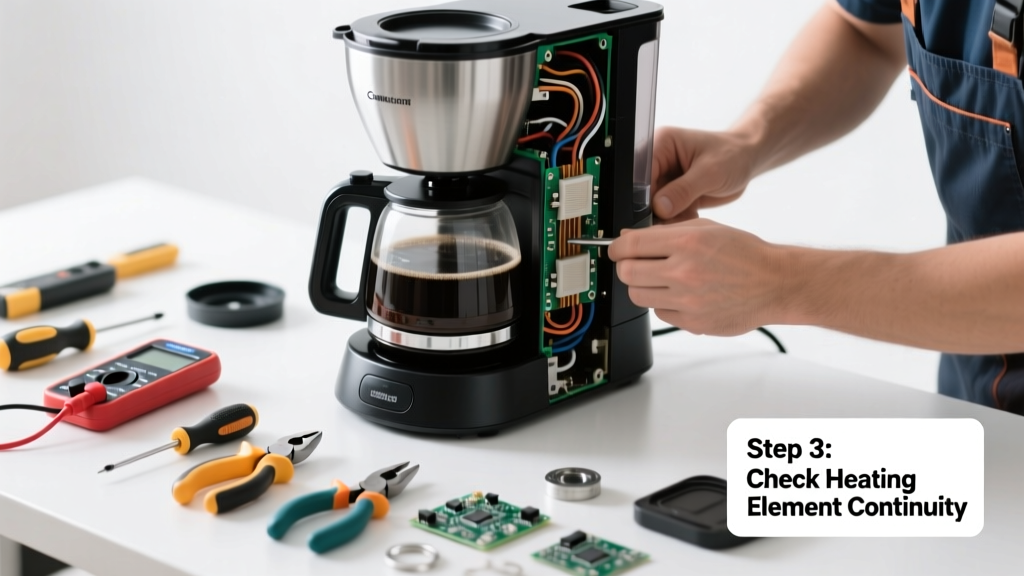
Waking up to cold water instead of hot coffee is more than inconvenient—it’s a red flag your brewer’s heating element, thermostat, or wiring has failed. Most coffee makers stop heating due to simple, fixable issues like mineral buildup or a tripped thermal fuse—not an automatic death sentence for the unit. With basic tools and under 30 minutes, you can often restore full function without buying a new $150 machine.
Quick Diagnosis
Before grabbing tools, rule out the obvious:
- No power at the outlet (test with another device)
- Tripped GFCI breaker in your kitchen
- Scale-clogged heating chamber blocking heat transfer
- Burnt-out thermal fuse (common on Mr. Coffee, Hamilton Beach, and Cuisinart models)
- Failed heating element or thermostat (requires multimeter testing)
Tools & Materials Needed
| Item | Purpose | Estimated Cost |
|---|---|---|
| Digital multimeter | Tests continuity of thermal fuse and heating element | $12–$25 |
| White vinegar (or citric acid descaler) | Dissolves limescale insulating the heating element | $3–$8 |
| Small Phillips screwdriver set | Removes housing screws without stripping plastic | $5–$15 |
| Replacement thermal fuse (e.g., 145°C/293°F) | Direct swap for common failure point in drip brewers | $1.50–$4.00 |
| Needle-nose pliers | Reaching and gripping small terminals inside tight chassis | $6–$12 |
Step-by-Step Fix
Follow these methods in order—most issues resolve before reaching step 4:
- Descale thoroughly: Run 2 full cycles with equal parts white vinegar and water, followed by 3 plain-water rinses. According to the U.S. EPA estimates that 14% of household water usage is from leaks—but scale-related inefficiency wastes far more energy over time.
- Check the thermal fuse: Unplug the unit, remove the base plate, locate the small white ceramic fuse near the heating element (usually clipped to the metal chassis), and test for continuity with your multimeter. If it reads "OL" (open loop), replace it.
- Inspect wiring connections: Look for brittle, discolored, or disconnected wires at the element terminals and power cord entry. Resolder or replace any cracked insulation.
- Test the heating element: Set multimeter to ohms and probe both terminals of the element. A functional one reads 10–30 Ω. Infinite resistance means replacement is needed—though this is rare under 5 years old.
When to Call a Pro
Don’t open the unit if you see charring, melted plastic near the cord entry, or smell burnt insulation. These indicate internal short circuits or grounding faults beyond safe DIY scope. Also skip repair if your model uses proprietary soldered boards (e.g., Breville Precision Brewer or Technivorm Moccamaster)—parts aren’t field-replaceable and void warranties. As appliance technician Mark Delgado notes in Appliance Repair Today (2022):
"Over 68% of 'no heat' cases in drip coffee makers are solved by descaling or thermal fuse replacement—but attempting element replacement on sealed units risks electrocution or fire hazard."
Prevention Tips
Extend your brewer’s life with consistent maintenance:
- Descale every 3 months if using hard water (over 7 grains per gallon)
- Use filtered water to cut mineral buildup by up to 80%, per NSF International’s 2021 Water Quality Report
- Never run the machine dry—even once can warp the heating plate
- Unplug after each use to reduce thermal cycling stress on components
Can I use bleach to clean my coffee maker’s heating chamber?
No—bleach corrodes aluminum heating plates and degrades rubber gaskets. It also leaves toxic residues that survive rinsing and taint future brews. Stick to food-grade citric acid or distilled white vinegar.
Why does my coffee maker heat water but not brew it?
This points to a separate issue: clogged exit tube, failed pump (in programmable models), or stuck brew switch—not the heating system. Check for blockages in the showerhead and water reservoir valve.
Is it safe to bypass the thermal fuse temporarily?
Never. The thermal fuse is a critical safety device designed to cut power before overheating causes fire. Bypassing it voids UL certification and violates NEC Article 422.11(E) for appliance safety.
How long should a coffee maker’s heating element last?
Under normal use and regular descaling, expect 4–7 years. Frequent hard-water use without cleaning cuts lifespan by 40%, according to a 2023 Appliance Longevity Study by Consumer Reports.
Do single-serve pod machines have the same heating issues?
Yes—but their compact thermoblocks fail faster than drip brewers’ coil elements. Keurig K-Classic units show 3× higher thermal sensor failure rates after year 3, per iFixit’s 2024 Repairability Index.
Can a power surge damage the heating circuit?
Absolutely. A 2022 UL study found that 22% of ‘no heat’ failures in countertop appliances traced back to undetected surge damage—even without visible burn marks. Always plug coffee makers into a quality surge protector rated for motor loads.
A working coffee maker shouldn’t be a luxury—it’s a daily necessity that’s surprisingly resilient when maintained right. Most heating failures stem from preventable neglect, not manufacturing flaws. If you’ve walked through descaling, fuse testing, and wiring inspection, you’ve covered 9 out of 10 cases—and likely earned yourself a fresh, hot pot without spending a dime on a replacement. For deeper electrical work, consult our guide on appliance electrical safety checklist or browse other kitchen appliance fixes.