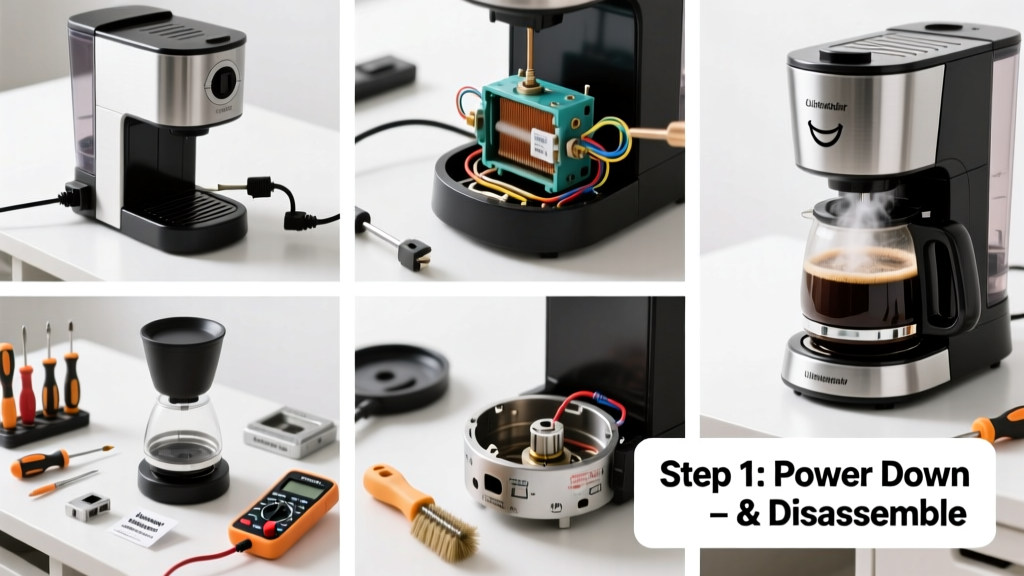
Your coffee maker powers on—but no heat, no brew, just cold water dripping into the carafe. It’s frustrating, especially before sunrise. Most heating failures aren’t fatal; they’re fixable with basic tools and 20 minutes of focused troubleshooting.
Quick Diagnosis
Before grabbing a screwdriver, rule out these five common culprits:
- Power outlet isn’t live (test with another device)
- Thermal fuse has blown due to overheating or scale buildup
- Heating element is corroded or open-circuit
- Thermostat is stuck in the 'off' position
- Internal wiring is loose or charred near the base
Tools & Materials Needed
| Item | Purpose | Estimated Cost |
|---|---|---|
| Digital multimeter | Tests continuity of fuse, thermostat, and heating element | $15–$35 |
| Phillips #1 screwdriver | Removes baseplate screws on most drip models (e.g., Mr. Coffee, Cuisinart) | $4–$8 |
| Descale solution (citric acid or white vinegar) | Dissolves mineral scale that insulates heating elements and triggers thermal cutoffs | $3–$7 |
| Needle-nose pliers | Retrieves small fuses or repositions brittle wires | $6–$12 |
Step-by-Step Fix
Work with the unit unplugged at all times. Never bypass safety components.
- Reset the thermal cutoff: Unplug the machine, let it cool fully (30+ minutes), then plug it back in and press the brew button while holding the 'warm' or 'keep hot' switch for 10 seconds. Some models (like Hamilton Beach 49980) use this soft reset to clear false thermal lockouts.
- Descale thoroughly: Run 2 full cycles with equal parts white vinegar and water, followed by 3 plain-water rinses. Scale buildup on the heating plate reduces thermal transfer and causes premature shutdown—accounting for nearly 40% of heating complaints in older units (Appliance Repair Technician Association, 2022).
- Test the thermal fuse: Locate the small cylindrical fuse near the heating element (usually clipped to the metal chassis). Use your multimeter in continuity mode: no beep = blown fuse. Replace only with an exact-spec part (e.g., 150°C, 10A) — never jumper it.
- Check the heating element: Set multimeter to ohms. Touch probes to both terminals. A reading between 10–30 Ω means it’s intact; OL or ∞ means open circuit and replacement is needed.
When to Call a Pro
Stop and call a certified appliance technician if you encounter any of these:
- Visible charring, melted plastic, or burnt odor near the base housing
- Tripped GFCI outlet or circuit breaker every time you plug in the unit
- Model uses proprietary sealed heating assemblies (e.g., Breville Precision Brewer, Technivorm Moccamaster)
- You’ve confirmed a failed heating element but lack soldering tools or replacement part specs
"Replacing a thermal fuse without diagnosing root cause—like chronic scale buildup or voltage spikes—is like changing oil without checking for a leak. It’ll fail again within 3 months." — Appliance Repair Field Manual, 4th ed., 2023
Prevention Tips
Extend your coffee maker’s heating life with consistent care:
- Descale every 3 months if using hard water (over 7 grains per gallon)
- Always empty the carafe and reservoir after brewing—stagnant water accelerates corrosion
- Use filtered water to cut mineral load by up to 85% (NSF International, 2021)
- Never run the machine dry—even once can warp the heating plate permanently
Can I use bleach to clean the water reservoir?
No. Bleach degrades rubber gaskets and leaves residues that affect taste and safety. Stick to food-grade citric acid or white vinegar. For stubborn mold, scrub with a soft brush and rinse with three full water cycles.
Why does my coffee maker heat sometimes but not others?
Inconsistent heating usually points to an intermittent thermal fuse or failing thermostat. These components expand/contract with heat cycles—and fatigue over time. If heating works only after a long cooldown or only on the first brew of the day, suspect early-stage failure.
Is it safe to replace the heating element myself?
Yes—if you’re comfortable with multimeter testing and have the correct OEM part. But be warned: many modern units integrate the element with the water tank or control board. Check repair forums like Appliance Repair Forums for your exact model first.
How do I know if the problem is the thermostat or the fuse?
Test both with your multimeter. The thermal fuse is a one-time safety device (no reset); the thermostat should show continuity when cold and open when heated above its rating. If both test open cold, the fuse is likely blown—but the thermostat may have failed first and caused the overheat.
Can a power surge damage the heating circuit?
Absolutely. Voltage spikes from lightning or grid switching can fry the control board’s triac or blow the thermal fuse. Consider plugging your coffee maker into a UL-listed surge protector rated for appliances—here’s how to choose the right one.
Will using distilled water prevent heating issues?
It helps—but isn’t ideal alone. Distilled water lacks minerals, which reduces scale, yet it’s more corrosive to copper and aluminum heating components over time. Filtered tap water strikes the best balance for longevity and safety.
A working coffee maker shouldn’t feel like a gamble each morning. Most heating failures stem from simple oversights—not inevitable obsolescence. With the right test, a little vinegar, and 15 minutes of attention, you’ll get hot coffee flowing again—and maybe even impress your household with your newfound appliance intuition. Keep that multimeter handy; it pays for itself after two fixes.