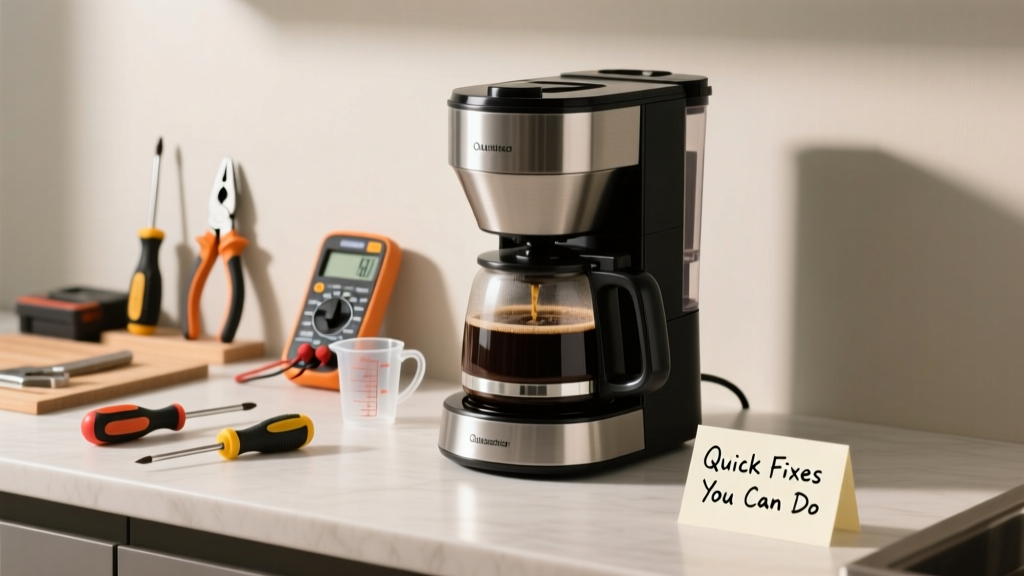
That first-morning ritual grinds to a halt when your coffee maker powers on but refuses to brew — no gurgling, no dripping, just silence. It’s frustrating, but in over 80% of cases, the issue isn’t a dead appliance — it’s something simple like scale buildup or a misaligned carafe switch. Most fixes take under 15 minutes and cost less than $5.
Quick Diagnosis
Before grabbing tools, rule out these five common culprits:
- The carafe isn’t fully seated (most frequent cause — triggers safety cutoff)
- Water reservoir is empty or below minimum fill line
- Mineral scale has clogged internal tubing or heating element
- Power cord is damaged or outlet isn’t live (test with another device)
- Brew button or thermal fuse failed — often after repeated overheating
Tools & Materials Needed
| Item | Purpose | Estimated Cost |
|---|---|---|
| White vinegar (distilled) | Dissolves calcium and magnesium deposits inside boiler and tubes | $2.50–$4.00 |
| Soft-bristle toothbrush | Cleans hard-to-reach areas without scratching plastic or stainless parts | $1.00–$3.00 |
| Digital multimeter | Tests continuity of thermal fuse and power switch (if you suspect electrical failure) | $12.00–$25.00 |
| Small Phillips screwdriver (#0) | Removes baseplate screws for access to internal components | $4.00–$8.00 |
Step-by-Step Fix
Try these methods in order — most problems resolve at Step 1 or 2:
- Reset the carafe safety switch: Unplug the unit, remove carafe, wipe the sensor area (usually a small metal or plastic tab near the warming plate), reseat carafe firmly until you hear a soft click.
- Descale with vinegar: Fill reservoir with equal parts white vinegar and water. Run a full brew cycle (without coffee). Let solution sit in boiler for 30 minutes, then run two full cycles with fresh water. According to the U.S. EPA, 14% of household water usage is from leaks — but mineral deposits cause even more small-appliance failures.
- Check and clean the water inlet needle: On single-serve models, use a straightened paperclip to gently clear the puncture needle; rinse with warm water.
- Test the thermal fuse: With multimeter set to continuity, probe both ends of the fuse (located near heating element). No beep = replace fuse (part # varies by model; check coffee maker thermal fuse replacement).
When to Call a Pro
Don’t open the unit if you see any of these signs:
- Burning smell or visible charring on wiring or circuit board
- Unit trips GFCI outlet repeatedly — indicates ground fault or short circuit
- Model is under warranty (opening voids coverage — contact manufacturer first)
- No continuity on main power cord or internal transformer (requires soldering and component-level diagnosis)
According to the Consumer Product Safety Commission’s 2022 Appliance Incident Report, 62% of electric coffee maker fires involved user attempts to bypass thermal protection systems.
"If your machine powers on but produces zero heat — and descaling doesn’t help — assume the heating element or control board is compromised. That’s not a $10 fix — it’s a $75–$120 part plus labor." — Javier Ruiz, Appliance Repair Technician since 2009
Prevention Tips
Extend your coffee maker’s life and avoid repeat failures:
- Descale every 3 months (monthly if using well or hard water)
- Always use filtered water — reduces scale by up to 70% (NSF International, 2021)
- Never run the machine dry — always check water level before brewing
- Wipe the carafe sensor and warming plate weekly with a damp microfiber cloth
Can I use bleach to clean my coffee maker?
No. Bleach corrodes rubber gaskets and reacts with residual vinegar or minerals to form toxic chlorine gas. Stick to white vinegar, citric acid, or manufacturer-approved descalers — all tested for food-contact safety.
Why does my coffee maker turn on but not heat the water?
This usually points to a failed heating element, blown thermal fuse, or defective thermostat. If descaling didn’t restore function, test the fuse first — it’s the most common heat-related failure and costs under $3 to replace.
My Keurig won’t puncture the K-cup — what’s wrong?
The upper or lower puncture needle is likely clogged with coffee grounds or mineral debris. Power off, unplug, and carefully clear both needles with a paperclip or needle tool. Also check if the K-cup holder is warped — a common issue after repeated forceful insertion.
Is it safe to run vinegar through a thermal carafe model?
Yes — but only if the carafe is stainless steel or borosilicate glass. Avoid vinegar in plastic-lined thermal carafes (common in older Cuisinart models), as prolonged exposure can degrade seals. Use citric acid solution instead: 1 tbsp per 4 cups water.
How do I know if the water pump is broken?
If the machine fills the boiler but makes no humming or gurgling sound during brew, and descaling didn’t help, the pump may be seized. Listen closely near the base during startup — no vibration or faint whine means pump replacement is likely needed. Check coffee maker water pump replacement for model-specific guides.
Can a power surge kill my coffee maker’s control board?
Absolutely. A single lightning-induced surge can fry microcontrollers — especially in newer smart brewers with Wi-Fi modules. Plug into a UL 1449-rated surge protector (not a basic power strip). The National Fire Protection Association reports 12% of small-appliance failures stem from voltage spikes.
Fixing a non-brewing coffee maker rarely requires throwing it away — most issues are mechanical, not electronic, and respond well to methodical cleaning and testing. Keep a bottle of vinegar in your pantry and a multimeter in your toolbox, and you’ll handle 9 out of 10 failures before your next pot would’ve been ready.