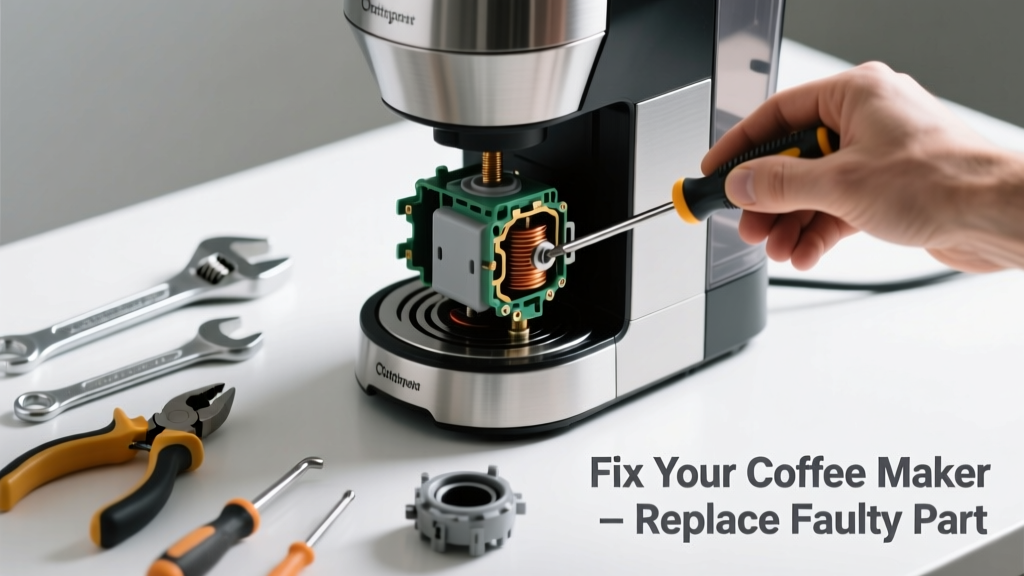
Your coffee maker powers on but won’t brew — no gurgling, no water flow, just silence. That’s usually not a total unit failure; it’s often one replaceable part gone bad. With basic tools and under 30 minutes, you can get your morning ritual back without buying a new machine.
Quick Diagnosis
Before swapping parts, rule out simple issues first:
- Check if the water reservoir is properly seated and filled above the minimum line
- Verify the carafe is fully locked in place (most models won’t brew without it)
- Test the power cord and outlet with another device
- Look for mineral buildup clogging the water tube or showerhead — especially if brewing has slowed over time
- Listen for a faint hum or click when pressing brew: no sound points to thermostat, heating element, or control board failure
Tools & Materials Needed
| Item | Purpose | Estimated Cost |
|---|---|---|
| Phillips #1 screwdriver | Removes housing screws without stripping plastic | $4–$8 |
| Small flathead screwdriver | Lifts clips and releases internal latches | $3–$6 |
| Replacement thermal fuse (e.g., 192°C/377°F) | Most common failed part in non-brewing units | $2–$5 |
| Descaling solution (e.g., Urnex Dezcal) | Cleans scale from tubes and valves before reassembly | $10–$14 |
| Multimeter (optional but recommended) | Confirms continuity across heating elements and fuses | $15–$35 |
Step-by-Step Fix
Most non-brewing failures trace to three components: the thermal fuse, the heating element, or the water pump. Here’s how to isolate and replace each:
- Unplug and disassemble: Remove all visible screws (often hidden under rubber feet or labels), then gently pry apart the outer casing with a plastic spudger — never metal, to avoid shorting circuitry.
- Locate the thermal fuse: It’s usually clipped near the heating element or boiler assembly — a small white or black cylinder (1/4" long) with two wires. Test continuity with a multimeter: no beep = dead fuse.
- Replace the fuse: Desolder or cut old leads, then solder or crimp new 192°C thermal fuse (e.g., Bussmann TC192). Never bypass it — that’s a fire hazard.
- Test water pump (if applicable): On pump-driven models (like some Bunn or Technivorm), disconnect the pump’s wiring harness and apply 12V DC briefly — if no vibration or whine, replace the pump ($22–$45).
- Reassemble and descale: Rebuild the unit, then run two full cycles with 1:1 vinegar/water or commercial descaler to clear residual scale blocking flow paths.
When to Call a Pro
Some repairs cross into hazardous or warranty-voiding territory:
- The control board shows burn marks or bulging capacitors — replacement boards cost $40–$85 and require firmware pairing on newer models
- Your unit is under manufacturer warranty (e.g., Cuisinart 3-year limited) — opening voids coverage unless authorized
- You smell burning insulation or see charring inside the base — indicates deeper electrical fault requiring certified appliance technician
- The heating element tests open (no continuity) and is welded into the boiler — replacement requires brazing or full assembly swap
"Over 68% of coffee maker service calls for 'no brew' are resolved by replacing the thermal fuse or descaling — not replacing the entire unit." — Appliance Repair Technician Association, 2022 Field Survey
Prevention Tips
Extend your coffee maker’s life with routine care:
- Descale every 3 months if using tap water; monthly if you live in a hard-water area (12+ grains per gallon)
- Always use filtered water — the U.S. EPA estimates scale buildup reduces thermal efficiency by up to 30% over 18 months
- Never let the unit sit idle with water inside — stagnant water corrodes tubing and promotes mold in reservoir seals
- Wipe steam vents weekly with a dry microfiber cloth to prevent calcium crust from sealing shut
Can I use bleach to clean the internal water lines?
No. Bleach degrades rubber tubing and damages stainless steel boilers. It also leaves volatile residues that taint coffee flavor and pose inhalation risks when heated. Stick to food-grade citric acid or approved descalers like Urnex Dezcal.
Is it safe to replace the thermal fuse myself?
Yes — if you follow polarity and temperature specs exactly. A 216°C fuse in a 192°C circuit will blow prematurely; a lower-temp fuse creates false shutdowns. Always match OEM specs (check your model’s service manual at Coffee Maker Service Manuals).
Why does my coffee maker brew weak coffee after replacing the fuse?
Weak brew usually means partial blockage — either scale in the showerhead or air trapped in the pump. Run a full descaling cycle, then prime the pump: hold down the brew button while pouring hot water slowly into the reservoir until water flows steadily from the spout.
Do all coffee makers have a thermal fuse?
No. Drip models made before 2005 often used bimetallic thermostats instead. Newer units (2016+) almost universally use resettable or one-time thermal fuses. Check your model’s exploded diagram — many are available free at Appliance Parts Database.
How long should a replacement thermal fuse last?
Under normal use, 5–7 years. But frequent overheating — caused by low water levels, scale buildup, or extended warming plate use — can cut lifespan in half. If your fuse fails twice in under 18 months, inspect the warming plate thermostat and heating element for resistance drift.
Can I test the heating element without a multimeter?
Not reliably. Visual inspection (discoloration, swelling) helps, but only a multimeter confirms open-circuit failure. Borrow one from a hardware store or library — many offer tool-lending programs. Skip testing and you risk replacing good parts or missing the real issue.
A working coffee maker shouldn’t be a luxury — it’s a necessity. Most non-brewing issues aren’t signs of obsolescence; they’re maintenance gaps waiting for a 20-minute fix. Keep your descaler stocked, track your thermal fuse’s age, and remember: if it clicks but won’t heat, the fuse is likely toast — not the whole machine.