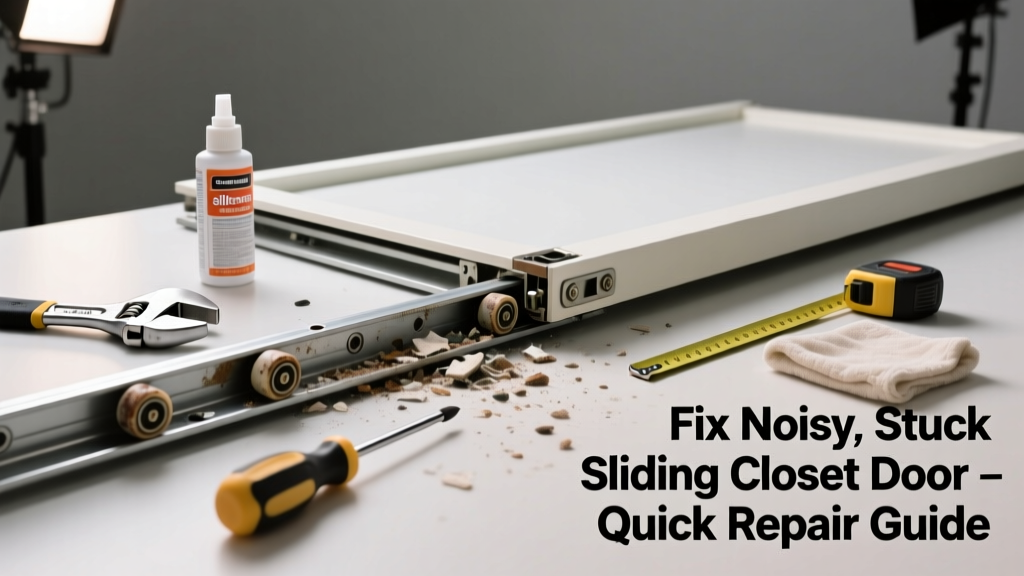
That sudden screech every time you open your bedroom closet? Or the door that lurches, sticks mid-slide, then jerks free with a clunk? It’s not just annoying—it’s a sign something’s misaligned, worn, or contaminated in the track or rollers. Left unaddressed, it worsens fast and can damage the door frame or hardware.
Quick Diagnosis
Before grabbing tools, identify the root cause. Most stuck, noisy sliding doors fall into one of these categories:
- Dirt, dust, or hair buildup clogging the track or roller wheels
- Warped or bent bottom track (especially in older homes with aluminum tracks)
- Worn, cracked, or seized nylon or ball-bearing rollers
- Loose or stripped mounting screws on the door hangers
- Door panel rubbing against the jamb due to sagging or improper leveling
Tools & Materials Needed
| Item | Purpose | Estimated Cost |
|---|---|---|
| Phillips #2 screwdriver | Tightens hanger screws and adjusts roller height | $8–$12 |
| Microfiber cloth + isopropyl alcohol (70%) | Cleans track and rollers without residue | $5–$9 |
| White lithium grease (not WD-40) | Lubricates rollers and track—WD-40 attracts dust and dries out rubber | $6–$10 |
| Needle-nose pliers | Removes embedded debris from track grooves | $10–$15 |
| Level (6-inch magnetic) | Verifies door alignment and hanger tilt | $12–$20 |
Step-by-Step Fix
Work methodically—clean first, adjust second, replace only if needed.
- Clean the track and rollers: Remove the door by lifting up and angling the bottom out of the bottom track. Vacuum the entire track, then wipe with isopropyl alcohol and a microfiber cloth. Use needle-nose pliers to extract hair or grit lodged in the wheel housing.
- Inspect and lubricate rollers: Spin each roller by hand—if it wobbles, grinds, or won’t rotate freely, it’s worn. Apply a pea-sized dab of white lithium grease to the axle and outer bearing race. Never spray lubricant directly onto the track—it attracts dust.
- Rehang and level the door: Slide hangers back into the top track, then carefully lower the door into the bottom guide. Use your level across the top edge. If the door tilts left/right, loosen the hanger adjustment screws and raise/lower one side until level. Tighten fully once aligned.
- Test and fine-tune: Open and close slowly 10 times. If noise persists, check for track warping: run a straightedge along the bottom track. A gap >1/16" indicates bending—replace the track (see "When to Call a Pro").
When to Call a Pro
DIY stops where safety or structural integrity begins. Call a licensed handyman or door specialist if:
- The top track is rusted through or detached from the header framing
- You discover rotted or water-damaged drywall behind the track mounting surface
- The door is a heavy solid-core or mirrored unit (over 75 lbs) and requires two-person handling
- After three adjustments, the door still binds—and the bottom track shows visible buckling or corrosion
According to the National Association of the Remodeling Industry’s 2022 Home Repair Benchmark Report, 38% of DIY sliding door repairs fail within 6 months when track replacement or header reinforcement is skipped.
Prevention Tips
Maintain smooth operation year-round with these habits:
- Vacuum the track and wipe rollers every 3 months—especially after carpet cleaning or pet shedding season
- Avoid slamming doors; it accelerates hanger wear and track deformation
- Replace nylon rollers every 5 years—even if they seem fine—to prevent sudden failure
- Install soft-close kits like Slidewright SilentGlide to reduce impact stress on hardware
Can I use WD-40 on my sliding closet door rollers?
No. WD-40 is a solvent and water displacer—not a long-term lubricant. It breaks down existing grease, leaves a gummy residue, and attracts lint and dust. Within days, that “fix” turns into a sticky, abrasive paste that accelerates roller wear. Stick with white lithium grease or silicone-based dry lube for nylon and metal components.
Why does my closet door only stick in winter?
Low humidity shrinks wood doors and frames, changing clearances. More critically, cold temperatures thicken lubricants and make plastic rollers brittle. That’s why doors often bind between December and February—even if they ran smoothly all summer. Keep indoor humidity at 35–45% using a bedroom humidifier, and re-lubricate rollers with temperature-stable grease before cold weather hits.
How do I know if my rollers need replacing?
Look for visible cracks, flat spots, or discoloration on the wheel surface. Spin each roller with your finger: if it hesitates, clicks, or makes a gritty sound, bearings are failing. Also check for excessive play—side-to-side wobble over 1/32" means the axle bushing is worn. Replacement rollers cost $4–$12 per set and install in under 10 minutes.
What’s the difference between top-hung and bypass sliding doors?
Top-hung doors hang from an overhead track and rest lightly on a floor guide—most common in modern closets. Bypass doors slide past each other on parallel tracks and rely on precise wheel spacing. Noise and sticking in bypass systems often stem from misaligned track spacing or worn anti-jump clips. Adjustments require measuring center-to-center distance between tracks—tolerance is ±1/64" per manufacturer specs.
Can warped drywall cause sliding door issues?
Absolutely. If the wall surface behind the top track bows inward—even 1/8"—it compresses the track mounting flange, distorting the rail geometry. You’ll hear a rhythmic ticking as rollers pass the bend, and the door may resist opening beyond 30%. Check with a straightedge before assuming the problem is in the hardware. Minor bowing can be shimmed; severe cases need drywall repair before re-mounting the track.
Is it safe to remove both doors at once?
No—unless you’re installing new hardware. Removing both doors eliminates lateral support, risking track detachment or ceiling anchor pull-out. Always work on one door at a time, and never lean heavily on the remaining door while adjusting. If your closet has three or more panels, keep at least one fully installed and weighted during service.
A well-maintained sliding closet door should glide silently for a decade—but only if you treat it like precision hardware, not furniture. Regular cleaning, proper lubrication, and seasonal checks take less than 15 minutes twice a year. When you catch binding early, you avoid replacing $200 doors or $350 track systems. And if you’ve already replaced rollers twice in three years, revisit your track alignment—it’s almost certainly the culprit, not the parts.