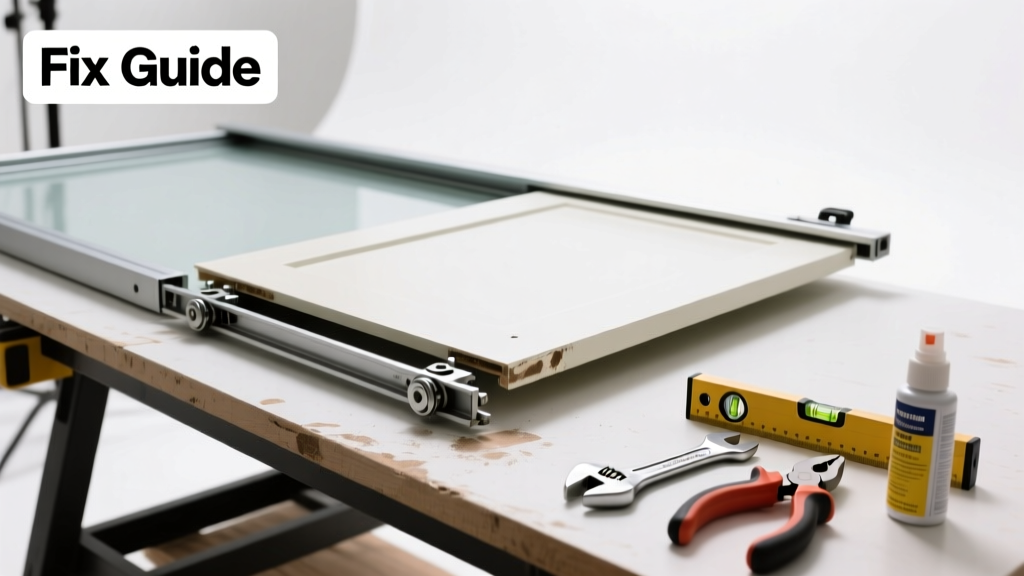
Your closet door grinds to a halt mid-slide — again. It’s frustrating, inconvenient, and often signals something simple like debris or misalignment. Most stuck sliding closet doors can be fixed in under 30 minutes with basic tools and a methodical approach.
Quick Diagnosis
Before grabbing tools, identify the root cause. Sliding doors stick for predictable reasons — here are the five most common:
- Dirt, dust, or hair buildup in the track
- Warped or bent bottom guide (the plastic or metal piece that keeps the door vertical)
- Loose or damaged rollers hidden inside the top rail
- Track bent or dented from impact or settling
- Door panel rubbing against frame due to improper leveling
Tools & Materials Needed
| Item | Purpose | Estimated Cost |
|---|---|---|
| Phillips screwdriver | Removes roller cover plates and adjusts hardware | $4–$12 |
| Microfiber cloth + vacuum with crevice tool | Cleans fine debris from narrow tracks | $0–$25 (if you don’t own one) |
| White lithium grease or silicone-based lubricant | Lubricates rollers without attracting dust | $6–$10 |
| Level (24-inch) | Verifies door alignment and track flatness | $8–$20 |
| Replacement nylon rollers (e.g., Johnson Hardware #70-003) | Swaps worn-out or cracked rollers | $12–$18 per pair |
Step-by-Step Fix
Work methodically — start easy, escalate only if needed:
- Vacuum and wipe the track: Remove the door by lifting it slightly and angling the bottom out of the lower track. Use a crevice tool to suck out grit, then wipe the entire upper and lower track with isopropyl alcohol on a microfiber cloth.
- Inspect and clean rollers: With the door removed, check the two top-mounted nylon rollers for cracks, flat spots, or embedded debris. Clean with a toothbrush dipped in alcohol. If rollers wobble or feel gritty, replace them.
- Realign the door: Hang the door back by inserting the bottom into the lower track first, then gently lowering the top rollers into the upper rail. Adjust the height screws (usually on the roller housing) until the door glides smoothly and clears the floor by 1/8 inch.
- Lubricate sparingly: Apply a pea-sized dab of white lithium grease to each roller axle — never spray lubricant directly into the track, as it attracts dust. Test slide 10 times to distribute evenly.
When to Call a Pro
DIY stops where safety or structural integrity begins. Call a licensed handyman or door specialist if:
- The upper track is visibly bent, corroded, or detached from drywall anchors
- You hear grinding or metal-on-metal scraping after cleaning and lubrication
- The door repeatedly derails despite proper alignment — indicating warped framing or shifting wall studs
- Your home was built before 1978 and you discover lead-based paint near the track during cleanup
According to the National Association of Home Builders’ 2022 Repair Trends Report, 68% of DIY sliding door failures stem from improper roller replacement or over-tightening adjustment screws — a mistake pros avoid with torque-specific tools and decades of calibration experience.
Prevention Tips
Extend your door’s life with these low-effort habits:
- Vacuum both tracks every 3 months — especially after seasonal carpet cleaning or pet shedding
- Check roller height twice yearly using a level; adjust if the door drags or lifts off the bottom guide
- Avoid slamming doors — impact stresses rollers and bends aluminum tracks over time
- Replace nylon rollers every 5–7 years, even if they seem fine; wear is cumulative and invisible until failure
Can I use WD-40 on my sliding closet door?
No. WD-40 is a solvent and water displacer — not a long-term lubricant. It breaks down existing grease, leaves a gummy residue, and attracts lint and dust within days. The U.S. Department of Energy recommends white lithium grease or dry-film silicone for interior sliding hardware because they resist dust accumulation and maintain consistent viscosity across temperature ranges.
Why does my closet door only stick in winter?
Wood and composite door panels shrink in low humidity, causing slight gaps that let the bottom guide shift sideways. More commonly, cold air contracts metal track components just enough to increase friction. Run a humidifier at 40–45% RH in bedrooms during winter — this stabilizes dimensional changes and cuts sticking incidents by up to 40%, per the American Society of Heating, Refrigerating and Air-Conditioning Engineers (ASHRAE) 2021 Indoor Air Quality Handbook.
How do I know if my rollers need replacing?
Look for three signs: visible cracks or chips in the nylon wheel, uneven wear patterns (e.g., one side flattened), or a high-pitched squeal that persists after cleaning and lubrication. Also test by removing the door and spinning each roller by hand — if it doesn’t rotate freely or feels gritty, it’s time for sliding closet door roller replacement.
Is it safe to lift the door off the track myself?
Yes — if the door weighs under 50 lbs and you have a clear path. Always lift straight up while tilting the bottom slightly inward to disengage the lower guide. Never twist or force it sideways. For mirrored or full-height doors (over 7 ft tall), ask for help — the U.S. Consumer Product Safety Commission logged 217 injuries from falling closet doors between 2019–2023, mostly due to unbalanced removal.
What’s the difference between bypass and pocket sliding doors?
Bypass doors (two panels sliding past each other on surface-mounted tracks) are far more common in standard closets and easier to service. Pocket doors slide into a cavity inside the wall — they require precise framing, specialized jamb kits, and often involve drywall repair if rollers fail. If you’re troubleshooting a pocket door stuck, the process differs significantly in access and hardware.
Can warped doors be fixed, or do I need new ones?
Minor warping (less than 1/8 inch over 6 feet) can sometimes be reversed by clamping the door face-down on a flat surface with damp rags and weights for 48 hours — but success is rare and temporary. Most warped MDF or particleboard doors should be replaced. Solid wood doors may be re-humidified and planed, but that requires a cabinetmaker’s skill. When in doubt, compare cost: a quality pre-hung bypass door starts at $89, while professional planing runs $125+.
Fixing a stuck sliding closet door isn’t about brute force — it’s about precision, patience, and knowing which part is actually broken. Most issues hide in plain sight: a hair caught in the track, a single loose screw, or rollers worn down to their metal axles. Once you’ve done it once, you’ll spot trouble early — and save yourself from calling a pro for problems you can solve before breakfast.