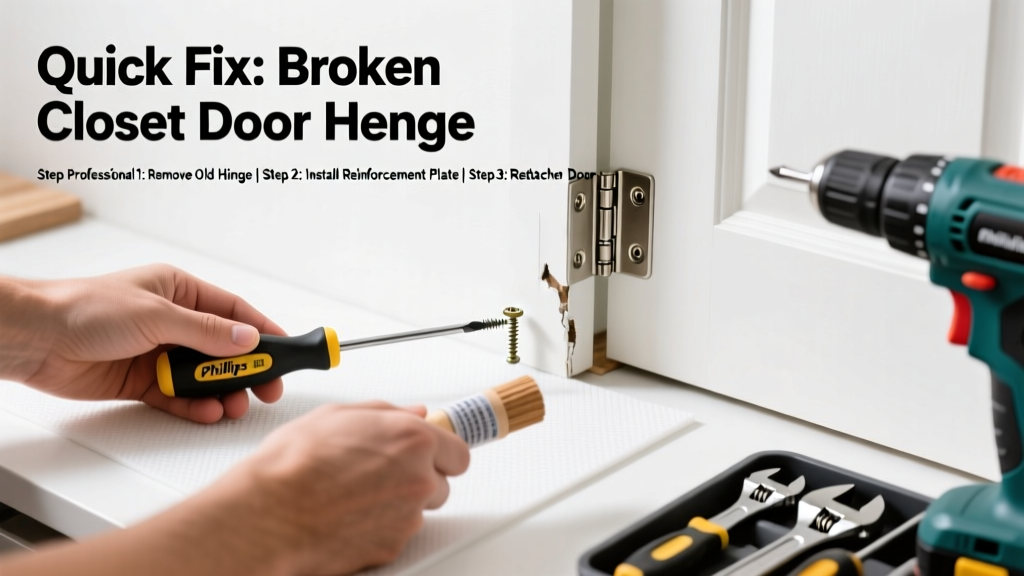
Your closet door suddenly sags, scrapes the floor, or won’t stay closed — and you notice the hinge is loose, bent, or stripped. This isn’t just annoying; it’s a sign of mounting stress on the frame and hardware that’ll only get worse if ignored.
Quick Diagnosis
Before grabbing tools, identify what’s really wrong. Most 'broken' hinges aren’t snapped — they’re compromised in one of these ways:
- Screw holes stripped in the door or jamb (most common — especially in hollow-core doors)
- Hinge leaf bent or warped from repeated slamming or misalignment
- Pivot pin worn or missing in pivot-style bypass doors
- Mounting screws missing, corroded, or driven too deep into softwood
- Door weight unevenly distributed due to improper hinge placement or sagging top rail
Tools & Materials Needed
| Item | Purpose | Estimated Cost |
|---|---|---|
| Phillips #2 screwdriver or drill/driver with clutch | Tightens or removes hinge screws without stripping heads | $8–$25 |
| Wood toothpicks + wood glue (or matchsticks) | Fills stripped screw holes for secure re-anchoring | $2–$5 |
| 1½" #8 coarse-thread drywall screws (optional upgrade) | Stronger hold than original screws, especially in particleboard | $4–$7 |
| 3/4" hinge shims (cardboard or plastic) | Corrects minor door sag or binding by adjusting hinge depth | $3–$6 |
| Small level (6") | Verifies door plumb and alignment during adjustment | $5–$12 |
Step-by-Step Fix
Try these methods in order — most issues resolve at Step 1 or 2:
- Tighten all hinge screws: Start with the top hinge. Use a drill/driver on low torque or hand-tighten. If a screw spins freely, the hole is stripped — skip to Step 2.
- Repair stripped screw holes: Remove the loose screw. Insert 2–3 wooden toothpicks dipped in wood glue into the hole. Snap off flush, let dry 30 minutes, then reinsert the screw. For MDF or particleboard doors, use coarse-thread drywall screws instead of originals.
- Reposition the hinge with shims: If the door drags at the bottom or gaps unevenly, insert a 1/16" shim behind the bottom hinge leaf (between leaf and jamb). Test swing, then add/remove shims in 1/32" increments until clearance is even top-to-bottom.
- Replace the hinge entirely: Match the hinge type (butt, pivot, or Euro-style) and size (typically 3½" x 3½"). Remove old hinge, pre-drill pilot holes slightly smaller than new screws, and mount securely. Learn hinge types here.
When to Call a Pro
DIY stops being safe or effective when:
- The door is solid-core and weighs over 75 lbs — lifting and supporting it alone risks injury or damage
- You find rot, water damage, or crumbling drywall around the hinge jamb — structural repair is needed
- The closet is part of a fire-rated wall (common in condos/apartments), and hinge replacement violates code requirements
- All three hinges are stripped and the door has shifted more than ¼" — this often means the header or stud framing has moved
According to the National Association of Home Builders’ 2022 Remodeling Impact Report, 68% of hinge-related door failures in rental properties stemmed from deferred maintenance on entry and closet doors — not faulty installation.
Prevention Tips
Extend hinge life with smart habits:
- Close closet doors gently — avoid slamming, especially on lightweight hollow-core doors
- Check hinge screws every 6 months; retighten if loose (don’t overtighten)
- Apply a dab of silicone-based lubricant to pivot pins annually — never oil, which attracts dust
- For bi-fold or bypass doors, ensure rollers are cleaned and adjusted seasonally to reduce hinge strain
- If replacing hinges, choose stainless steel or nickel-plated brass — they resist corrosion better than zinc-coated steel
Can I use regular wood screws instead of hinge screws?
Yes — but only if they’re the same length and gauge. Standard #8 x 1¼" wood screws work fine for light-duty closet doors. However, hinge-specific screws have a wider head and finer threads for better grip in thin hinge leaves. For heavy doors or soft substrates like MDF, opt for coarse-thread drywall screws — they bite deeper and resist pull-out.
Why does my closet door keep coming loose after tightening?
This almost always signals stripped screw holes or insufficient thread engagement. Hollow-core doors and MDF jambs compress under repeated torque, so standard screws lose purchase quickly. The fix isn’t tighter screws — it’s rebuilding the anchor point with glue-and-toothpick reinforcement or switching to longer, coarser screws anchored into the underlying stud.
Do I need to remove the door to fix a broken hinge?
Not always. For tightening, shimming, or replacing a single hinge on a standard hinged door, you can usually work with the door hanging. But if the hinge is severely bent, the screw holes are deeply stripped, or you’re replacing multiple hinges, removing the door (see our safe removal guide) gives better access and prevents accidental drops.
What’s the difference between a butt hinge and a pivot hinge for closets?
Butt hinges (two interlocking leaves, mounted on edge) are standard on swinging closet doors. Pivot hinges mount at top and bottom, allowing full 180° swing and smoother operation — common on high-end bifold or luxury hinged doors. Pivots require precise floor and header alignment; misalignment causes binding or premature wear. Butt hinges tolerate minor framing imperfections better.
How long should closet door hinges last?
With proper care, quality brass or stainless steel butt hinges last 15–20 years. Zinc-plated steel hinges average 5–8 years before corrosion or wear sets in — especially in humid climates or near bathrooms. According to the U.S. Department of Energy’s Residential Building Stock Assessment (2021), hinge failure is the #3 most-reported door issue in homes built before 2005, largely due to outdated plated-steel hardware.
Can I mix hinge brands or finishes on the same door?
You can — but don’t. Mixing brands risks inconsistent screw spacing, leaf thickness, or pivot geometry, leading to binding or uneven gaps. Even subtle finish mismatches (e.g., brushed nickel vs. satin nickel) become visually obvious over time. Always replace all hinges on one door with identical units — match finishes and specs carefully.
A working closet door hinge seems minor until it fails — then it disrupts your routine, damages flooring, and invites bigger problems like warped frames or latch misalignment. Fixing it correctly the first time takes under 30 minutes with basic tools and saves you from replacing the whole door later. Keep spare screws and shims in your garage kit — they cost pennies and solve 9 out of 10 hinge headaches before they start.