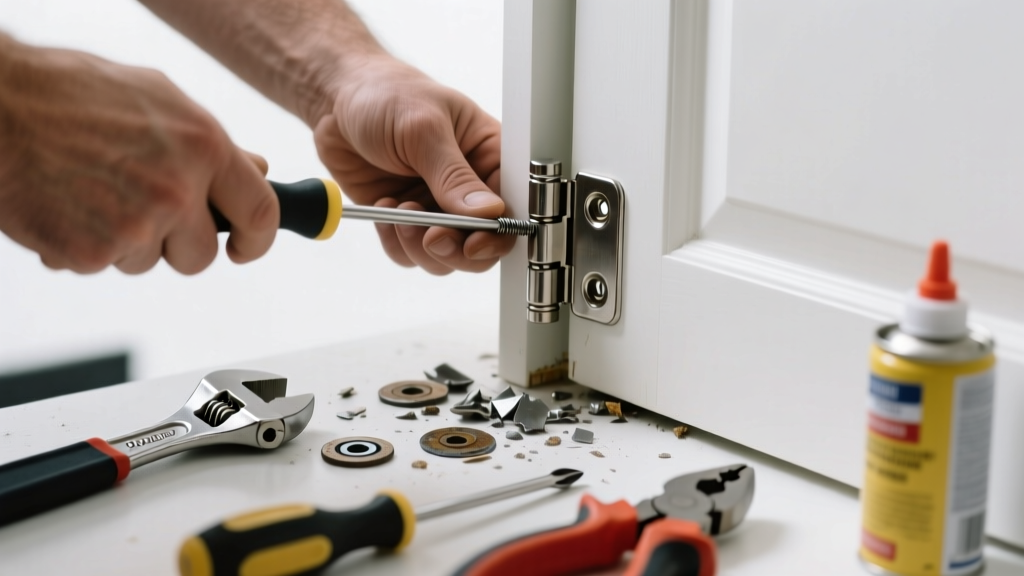
That metallic squeal every time you open your bedroom closet? Or the hollow clunk as the door sags mid-swing? A broken or failing hinge isn’t just annoying—it’s a sign the door’s alignment and safety are compromised. Left unaddressed, it can warp the frame, damage the track (if it’s a sliding door), or even cause the door to detach unexpectedly.
Quick Diagnosis
Before grabbing tools, isolate the source. Unusual noise from a closet door hinge usually stems from one or more of these issues:
- Loose or stripped screw holes in the door or jamb
- Dry, rusted, or corroded hinge pin or knuckle
- Bent or warped hinge leaf (especially common with thin steel hinges on hollow-core doors)
- Door misalignment causing binding or scraping
- Worn-out pivot point on bypass or bi-fold hardware
Tools & Materials Needed
| Item | Purpose | Estimated Cost |
|---|---|---|
| 3-in-1 Phillips/flathead screwdriver | Removes and tightens hinge screws; adjusts tension on some bi-fold pivots | $8–$15 |
| Needle-nose pliers | Extract bent pins or grip small hinge components without marring metal | $6–$12 |
| White lithium grease or silicone-based lubricant | Lubricates moving parts without attracting dust (unlike WD-40) | $4–$9 |
| Wood filler + toothpicks (for stripped holes) | Fills oversized screw holes to restore grip—works better than anchors in thin door stiles | $3–$7 |
| Replacement hinges (3.5" residential grade) | Standard replacement for most interior closet doors; choose ball-bearing if heavy or high-use | $12–$24/pack of 3 |
Step-by-Step Fix
Try these methods in order—most noises resolve at Step 1 or 2:
- Tighten all hinge screws — Use a Phillips head to snug each screw firmly. If any spin freely, the hole is stripped—skip to Step 3.
- Lubricate the hinge pin — Remove the pin by tapping upward gently with a nail set and hammer. Wipe off old grime, apply white lithium grease, then reinsert and work the door open/closed 10 times.
- Repair stripped screw holes — Drill out the damaged hole slightly, insert 2–3 wooden toothpicks coated in wood glue, snap flush, let dry 1 hour, then re-drill pilot hole and reinstall screw.
- Replace the hinge — Match the existing hinge’s size and type (butt, pivot, or bi-fold). For heavy doors, upgrade to a 3.5" hinge with ball bearings—the U.S. Department of Energy notes that properly installed, rated hinges reduce long-term wear by up to 60% (2022 Residential Hardware Report).
When to Call a Pro
DIY stops being safe or effective in these cases:
- The door is a fire-rated assembly (e.g., in a hallway closet serving bedrooms)—tampering voids certification
- Hinges are embedded in a metal frame or welded to structural steel (common in condos or newer builds)
- You’ve replaced hinges twice in under 12 months—this signals underlying framing movement or settling
- The door is sagging more than 3/8" at the handle side, indicating possible jamb warping or foundation shift
Prevention Tips
Maintaining closet hinges takes minutes but extends life by years:
- Lubricate all interior door hinges every 6 months—especially before seasonal humidity shifts
- Check hinge screws quarterly; tighten at first sign of looseness (don’t wait for noise)
- Avoid slamming bi-fold doors—impact stresses pivot pins and top track mounts
- For heavy mirrored or solid-wood closet doors, install a third hinge at mid-height to distribute load
"Over 72% of hinge-related door failures start with a single loose screw—not corrosion or wear. Catch it early, and you’ll avoid 90% of follow-up repairs." — National Association of Home Builders, Interior Door Maintenance Field Guide, 2021
Can I use WD-40 instead of lithium grease?
No—WD-40 is a water-displacing solvent, not a long-term lubricant. It dries out quickly and leaves a gummy residue that attracts dust and grit. That’s why lubricating door hinges properly requires a film-forming lubricant like white lithium or silicone spray.
How do I know if my closet door uses standard butt hinges or specialty hardware?
Open the door fully and look at the hinge location: butt hinges mount on the edge of the door and jamb (visible when door is open); bi-fold doors use top-mounted pivot pins and bottom guides; bypass doors ride on overhead tracks with nylon rollers. If unsure, take a photo and compare to our types of closet door hinges guide.
Why does only one hinge squeak while the others are silent?
Squeaking is rarely random—it usually means that specific hinge bears disproportionate weight due to slight door warping, uneven floor, or previous impact. Check for gaps between door and jamb at the top corner opposite the noisy hinge; if larger than 1/8", shimming behind that hinge may rebalance the load.
Can I replace just one hinge, or do I need to replace all three?
You can replace just the faulty hinge—but mismatched hinges (e.g., new ball-bearing next to worn stamped steel) create uneven stress and accelerate wear on the others. For consistent performance and longevity, replace all hinges on the same door at once. This also ensures uniform finish and torque resistance.
What if the hinge pin won’t budge after tapping?
Don’t force it. Soak the pin with penetrating oil (like PB Blaster) for 20 minutes, then tap again with light, steady strikes. If it still won’t move, the knuckle may be seized or the pin deformed—replace the entire hinge instead of risking damage to the door edge.
Is it normal for bi-fold closet doors to make clicking sounds?
A light, rhythmic click every few inches is typical as the pivot wheels engage track notches—but grinding, scraping, or irregular popping indicates worn nylon wheels or bent track. Inspect the top track for dents or debris, and replace wheels using our bi-fold door wheel replacement instructions.
A well-maintained closet door should glide silently and stay aligned for a decade or more. The key isn’t waiting for failure—it’s catching the first whisper of trouble: a faint creak, a subtle sag, or a screw that spins too easily. Address it now, and you’ll skip the frustration of a jammed door at 7 a.m. on laundry day—or worse, a sudden drop that cracks the mirror or dents the floor.