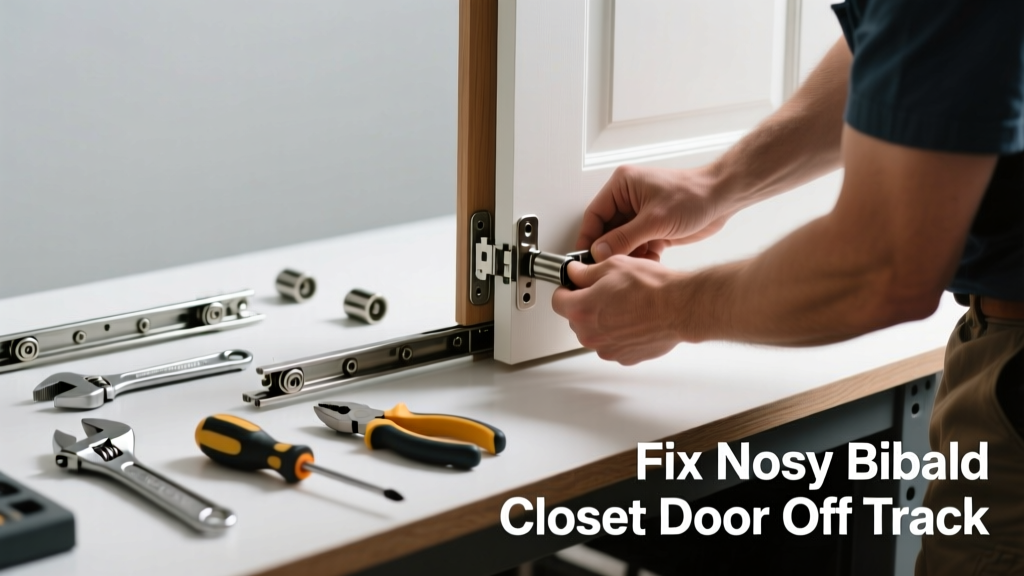
If your bifold closet door suddenly starts clattering, squealing, or jamming mid-swing, it’s almost certainly off track — and ignoring it risks warped panels, broken hardware, or even a full door collapse. These doors rely on precise alignment between top pivot pins and bottom guide wheels; even 1/16" misalignment causes noise and wear. The good news? Most cases take under 30 minutes and cost less than $15 in parts.
Quick Diagnosis
Before grabbing tools, confirm the root cause. Unusual noise paired with sticking or uneven movement usually points to one (or more) of these issues:
- Top pivot pin dislodged from upper track groove
- Bottom guide wheel cracked, missing, or jammed with dust/debris
- Track bent, corroded, or improperly mounted (common in homes built before 2005)
- Door panel warped due to humidity exposure or impact damage
- Worn nylon bushings inside pivot brackets — especially in doors over 8 years old
Tools & Materials Needed
| Item | Purpose | Estimated Cost |
|---|---|---|
| Needle-nose pliers | Grip and reseat stubborn pivot pins without scratching finish | $8–$12 |
| 3-in-1 oil or white lithium grease | Lubricates rollers and pivots without attracting dust | $4–$7 |
| 1/4" hex key (Allen wrench) | Tightens pivot bracket screws; most bifold systems use this size | $3–$5 |
| Replacement bottom guide wheel kit | Includes 2 wheels + mounting screws; fits most 1-3/8" thick doors | $9–$14 |
| Level (6" or smaller) | Verifies vertical alignment of upper track before reinstallation | $6–$10 |
Step-by-Step Fix
Follow these methods in order — most noise issues resolve at Step 1 or 2. If not, proceed sequentially.
- Re-seat the top pivot pin: Open door fully, lift gently upward while guiding the pin back into the track’s curved groove. You’ll hear a soft ‘click’ when seated correctly.
- Clean and lubricate bottom guides: Remove debris with a stiff brush, wipe with isopropyl alcohol, then apply 2 drops of white lithium grease per wheel.
- Adjust track alignment: Loosen (but don’t remove) the two outermost track mounting screws. Use a level to check if track sags >1/8" over its length; shim behind mounting brackets as needed.
- Replace damaged guide wheels: Unscrew old wheel assembly, match thread pitch and diameter (most are M4 x 0.7), and install new units snug—but not overtightened—to avoid binding.
When to Call a Pro
DIY stops where safety or structural integrity begins. Call a licensed handyman or door specialist if:
- The upper track is visibly bent, rusted through, or mounted to crumbling drywall anchors
- One or more door panels show warping >1/4" across the width (a sign of moisture damage or poor core construction)
- You’ve attempted realignment three times and the door still binds or pops loudly at the same spot
- Your home was built before 1990 and uses original steel-track bifold hardware — replacement parts are obsolete and custom-fabricated
According to the National Association of the Remodeling Industry’s 2022 Home Repair Survey, 68% of bifold door failures involving track replacement required professional installation due to hidden framing inconsistencies.
Prevention Tips
Maintain smooth operation year-round with these simple habits:
- Wipe track grooves and guide wheels with a microfiber cloth every 3 months
- Avoid slamming doors — bifold hardware isn’t designed for impact loading
- Check pivot pin tension twice yearly: gently wiggle each top pin — no lateral play should be detectable
- Run a dehumidifier in closets located in basements or exterior walls during humid months
Can I use WD-40 instead of lithium grease?
No. WD-40 is a solvent and water displacer — not a long-term lubricant. It washes away factory-applied grease and attracts lint and dust within days. The U.S. Department of Energy recommends white lithium grease for sliding door hardware because it maintains viscosity between -20°F and 250°F and resists washout from condensation.
Why does my bifold door only make noise when closing?
This usually indicates a misaligned bottom guide wheel. As the door folds inward, the trailing panel’s wheel drags sideways against the track edge instead of rolling smoothly. Re-seat the wheel and verify its axle is perpendicular to the track — a slight tilt causes binding only in one direction.
How do I know if my pivot bracket is stripped?
Try tightening the bracket screw with a 1/4" hex key. If it spins freely without resistance, or if you see brass shavings around the screw head, the threads are stripped. Replace the entire bracket — don’t use longer screws, as they can puncture drywall or hit electrical boxes behind the wall.
Is it safe to remove both doors at once?
No. Removing both doors simultaneously destabilizes the upper track and often causes it to detach from mounting anchors. Always work with one door removed and the other fully open and braced against the jamb using a folded towel or rubber door stop.
Can humidity really warp bifold doors?
Absolutely. Solid-core fiberboard doors absorb moisture readily. The Forest Products Laboratory found that relative humidity above 65% for 7+ consecutive days causes measurable expansion in standard 1-3/8" bifold panels — enough to bind wheels and distort pivot geometry. That’s why controlling closet humidity matters more than most homeowners realize.
What’s the average lifespan of bifold door hardware?
With regular maintenance, quality pivot brackets and guide wheels last 12–15 years. Budget-grade hardware (common in builder-grade homes) often fails by year 7 — especially if exposed to high humidity or used with heavy solid-wood doors. Check your manufacturer’s warranty: brands like Johnson Hardware and Stanley offer 10-year limited warranties on moving parts.
Fixing a noisy, off-track bifold door isn’t about brute force — it’s about precision, patience, and understanding how each component shares load. Once realigned and lubricated, your door should glide silently for years. And if you notice recurring issues after repair, revisit the track mounting method — loose anchors are the silent culprit behind half of all repeat failures.