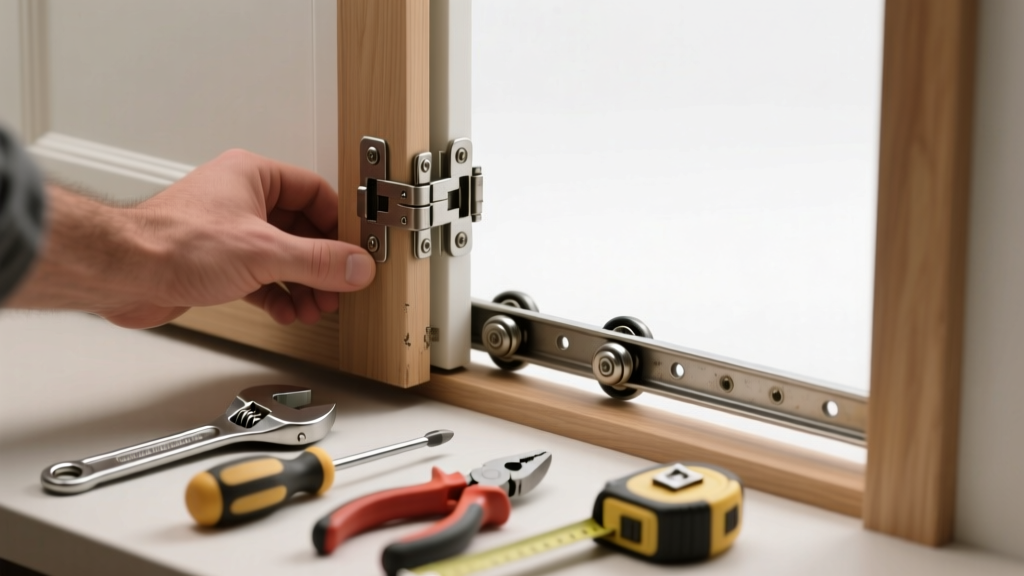
If your closet bifold door suddenly sags, scrapes the floor, or won’t close smoothly, it’s likely jumped off its track — a common but fixable issue. Most of the time, this happens due to loose hardware, worn rollers, or misaligned top tracks. You don’t need to replace the whole door system unless the frame or track is bent or corroded.
Quick Diagnosis
Before grabbing tools, identify what’s really wrong. Bifold doors go off track for predictable reasons — here are the top four:
- Loose or stripped mounting screws on the top pivot bracket or bottom guide
- Worn, cracked, or jammed nylon rollers (especially on older doors from the 1990s–2000s)
- Warped or dented upper track — often from heavy doors or repeated slamming
- Bottom pivot pin dislodged from the floor guide slot or missing entirely
Tools & Materials Needed
| Item | Purpose | Estimated Cost |
|---|---|---|
| Phillips screwdriver | Tightens pivot brackets and roller assemblies | $3–$8 |
| Needle-nose pliers | Reinserts stubborn bottom pivot pins or adjusts bent guides | $5–$12 |
| 3-in-1 oil or silicone lubricant | Reduces friction in rollers and tracks; prevents future binding | $4–$9 |
| Replacement nylon rollers (e.g., Johnson Hardware #675) | Direct swap for cracked or seized rollers; fits most standard 1-3/8" doors | $8–$15/pair |
| Level (12" or longer) | Verifies track alignment after reinstallation — critical for smooth operation | $10–$25 |
Step-by-Step Fix
Most off-track issues resolve in under 30 minutes. Try these methods in order — start simple, escalate only if needed:
- Reset the bottom pivot pin: Lift the door slightly while guiding the bottom pin back into the floor guide slot. If the pin wobbles, tighten its retaining screw with a Phillips driver.
- Re-seat the top roller into the track: Tilt the door inward at a 15° angle, lift gently, and slide the roller wheel back under the lip of the upper track. Listen for the soft 'click' as it engages.
- Tighten all pivot bracket screws: Check both top brackets — especially the hinge-side one. Overtightening strips drywall anchors; use medium torque and verify vertical alignment with a level.
- Replace damaged rollers: Remove the door by lifting it off the bottom pin, then unscrew the old roller assembly. Install new rollers using the same mounting holes — no drilling required.
When to Call a Pro
Some situations demand more than DIY finesse. Call a licensed handyman or door specialist if:
- The upper track is visibly bent, rusted through, or mounted to crumbling drywall
- Doors weigh over 50 lbs each — improper handling risks injury or ceiling damage
- You’ve attempted realignment three times and doors still bind or derail within 48 hours
- There’s evidence of water damage or mold behind the track — indicates deeper structural or moisture issues
According to the National Association of Home Builders’ 2022 Remodeling Impact Report, 68% of homeowners who delayed professional help for misaligned bifold systems ended up replacing both doors and track within 18 months — at 3× the cost of early intervention.
Prevention Tips
Maintain smooth operation year after year with these habits:
- Lubricate rollers and track every 6 months with silicone spray — never WD-40, which attracts dust
- Check pivot screws quarterly; retighten if doors feel loose or rattle when closing
- Avoid hanging heavy items on door edges — weight distribution shifts pivot stress
- Install soft-close kits like Blum Soft-Close Bifold Adapters to reduce impact on tracks and rollers
Can I force the door back onto the track without removing it?
No — forcing creates lateral pressure that bends rollers or warps the track. Always lift and tilt inward at a shallow angle. Forcing can shear off plastic roller housings, requiring full replacement.
Why does only one panel go off track while the other stays aligned?
This usually points to a failed roller on the problematic panel or a broken hinge pin between panels. Inspect the hinge joint: if it wobbles or doesn’t pivot smoothly, replace the hinge with a heavy-duty steel hinge.
Do all bifold doors use the same type of track?
No. Pre-1995 doors often use narrow, non-standard tracks; newer models (post-2005) typically use 1-3/8" wide aluminum tracks with standardized roller spacing. Measure your existing track width before ordering parts.
How do I know if my rollers are worn out?
Look for visible cracks, flattened treads, or excessive play when you wiggle the roller side-to-side. A working roller spins freely with no grinding noise — if it squeaks or drags, it’s time for replacement.
Can I install a new track without removing drywall?
Yes — modern retrofit tracks like the Hafele EasyTrack System mount directly over existing wood or metal framing using toggle bolts. No drywall patching required unless anchor holes are oversized.
Is it safe to adjust the track while the door is hanging?
No. Always remove the door first. Adjusting track position with weight applied causes uneven tension, misalignment, and potential failure of mounting anchors — especially in plaster or hollow-core walls.
Once reinstalled and tested, open and close each door 10 times slowly to confirm smooth travel and even gap spacing. If you notice consistent scraping near the center seam, double-check hinge alignment — a 1/16" offset there multiplies into 3/8" deviation at the edge. Small adjustments make big differences, and most bifold headaches vanish with methodical attention to the pivot points and track geometry.