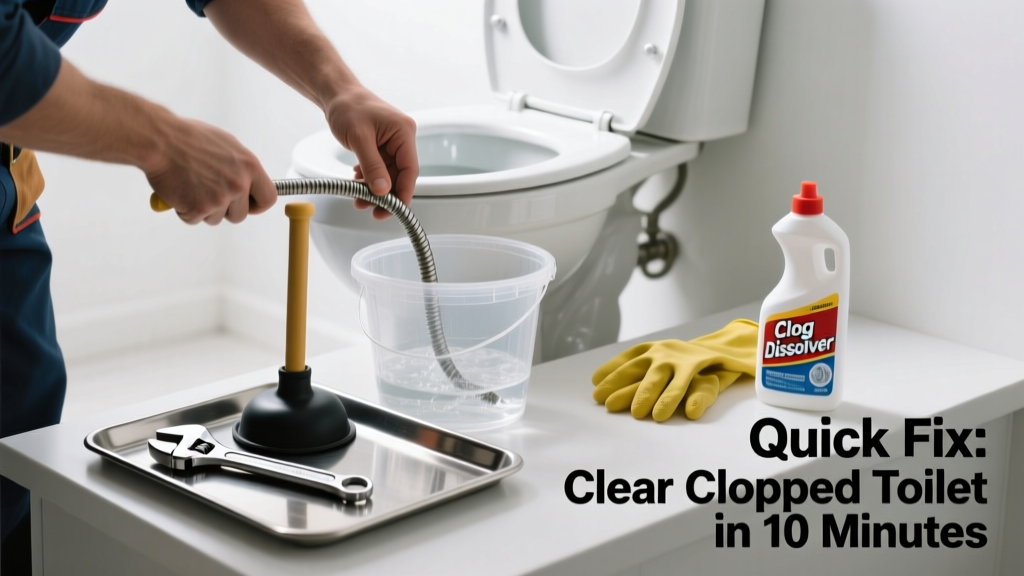
Yes—you read that right: a toilet in the kitchen. While rare in modern U.S. homes, some older apartments, studio units, or converted spaces have a toilet tucked beside the sink or under a cabinet. When it clogs, the stakes are higher: standing water near food prep areas, risk of overflow onto flooring, and potential cross-contamination.
Quick Diagnosis
Before grabbing tools, identify the likely culprit. Kitchen toilets often share drain lines with sinks or dishwashers—and suffer from unique blockages:
- Fat, grease, or cooking oil solidified in pipes (most common)
- Food scraps flushed accidentally (rice, pasta, coffee grounds)
- Wet wipes or paper towels mistaken for toilet paper
- Mineral buildup from hard water in narrow galvanized or older ABS piping
- Improper venting causing slow drainage and recurring clogs
Tools & Materials Needed
| Item | Purpose | Estimated Cost |
|---|---|---|
| Heavy-duty cup plunger (flange or accordion-style) | Creates stronger suction on low-profile or oddly angled toilet bowls | $8–$15 |
| Drain snake (25-ft manual auger) | Reaches past P-trap into shared kitchen drain line where grease accumulates | $12–$22 |
| Enzyme-based drain cleaner (e.g., Green Gobbler) | Breaks down organic matter without corroding pipes—safe near food prep zones | $10–$18 |
| Rubber gloves + N95 mask | Protects against aerosolized bacteria when working near kitchen plumbing | $5–$12 |
| Shop vacuum (wet/dry, with hose adapter) | Provides reverse suction if plunging fails—only safe if unit is rated for sewage | $40–$80 |
Step-by-Step Fix
Start with least invasive methods first. Always shut off the toilet’s water supply valve (usually behind or below the bowl) before proceeding.
- Plunge with precision: Cover the overflow hole in the tank with a wet rag, seal the cup fully over the outlet, and pump vertically—not side-to-side—for 15–20 seconds. Repeat up to three times.
- Snake the trap and branch line: Feed the auger past the P-trap until resistance is met (~2–3 ft), then rotate clockwise while gently pushing. Retract slowly—often you’ll pull out a greasy, fibrous mass.
- Hot water + baking soda + vinegar: Pour ½ cup baking soda followed by ½ cup white vinegar into the bowl. Wait 15 minutes, then add 3 quarts of near-boiling (not boiling) water—this melts grease without cracking porcelain.
- Enzyme treatment overnight: Add full dose of enzyme cleaner per label; let sit 8+ hours. Enzymes continue digesting organics for up to 48 hours—ideal for partial clogs that reappear.
When to Call a Pro
DIY stops where safety and code compliance begin. Call a licensed plumber immediately if:
- Water rises toward the floor or begins leaking from the base or supply line
- You smell raw sewage—even faintly—indicating a vent blockage or cracked pipe
- Multiple fixtures (kitchen sink, dishwasher, toilet) back up simultaneously
- You’ve attempted snaking twice and retrieved no debris, suggesting a deeper obstruction (e.g., collapsed cast iron or tree root intrusion)
- Your building is pre-1970 with galvanized steel pipes—the risk of pinhole leaks increases with pressure or chemical use
"In multi-unit buildings with shared waste stacks, a kitchen toilet clog is often a symptom—not the source. Over 68% of 'kitchen toilet' backups traced by the Plumbing-Heating-Cooling Contractors Association (PHCC, 2022) originated in upper-floor laundry drains or improperly vented dishwasher connections."
Prevention Tips
Prevent recurrence with habits and hardware upgrades tailored to this atypical setup:
- Post a laminated sign above the toilet: "Toilet Paper Only — NO grease, food, wipes, or cotton balls"
- Install a 1.28 GPF high-efficiency toilet with a wide 2.125" trapway (reduces snagging)
- Run hot water for 60 seconds after each use to flush residual oils
- Use an inline grease trap (like the Zurn Z1004) between the toilet and main stack—required by IPC Section 1002.3 for non-bathroom fixtures discharging into waste systems
- Schedule annual video inspection of the branch line using a drain camera inspection to spot early scale or offset joints
Can I use chemical drain cleaners like Drano?
No. Lye- or acid-based cleaners react violently with grease, creating heat-expanded sludge that hardens further downstream. They also degrade PVC seals near kitchen cabinets and violate FDA Food Code 3-301.12 for food-prep proximity. Stick to enzymatic or mechanical methods only.
Is it legal to have a toilet in the kitchen?
It depends on local code—but it’s rarely prohibited outright. The 2021 International Plumbing Code (IPC) allows fixture grouping if minimum clearances are met (15" from sink, 21" front clearance). However, many municipalities require separate ventilation and prohibit kitchen-toilet sharing of waste arms. Check with your local plumbing inspector before remodeling.
Why does my kitchen toilet gurgle when the dishwasher runs?
Gurgling signals venting failure. Dishwasher discharge pulses air into the shared drain, and without proper venting, that air escapes through the toilet’s trap—pulling water and releasing sewer gas. A blocked roof vent or missing air admittance valve (AAV) is the usual cause. Inspect the vent stack for bird nests or ice (in cold climates) or install a Studor Mini-Vent AAV within 5 ft of the fixture.
Can I replace just the toilet, or do I need new pipes?
You can usually replace just the toilet—if the existing rough-in (distance from wall to center of flange) is standard (12") and the flange is sound. But if you hear hollow sounds when tapping the floor near the base, or see efflorescence on nearby cabinetry, have a plumber check for subfloor rot using a moisture meter. Corroded galvanized lines should be replaced en masse—not piecemeal.
How do I disinfect the area after a minor overflow?
Mix 1 cup unscented household bleach (5.25% sodium hypochlorite) per gallon of cool water. Apply with a sponge—never spray—to all surfaces within 3 ft of the toilet base and floor. Let dwell 10 minutes, then wipe with clean water. Discard sponges and gloves. The CDC recommends this concentration for norovirus and E. coli deactivation on non-porous surfaces.
Will a toilet snake damage my pipes?
Manual snakes won’t harm PVC, ABS, or copper—but avoid power snakes unless you’re trained. A spinning cable can gouge galvanized or cast iron, especially at elbow joints. Always feed the cable slowly and stop at the first resistance; rotate first, then advance. If it won’t turn freely, retract and reposition—don’t force it.
A kitchen toilet isn’t just unusual—it’s a red flag for underlying plumbing compromises. Every successful fix buys time, but long-term reliability means verifying vent integrity, upgrading outdated materials, and separating waste streams where possible. If you’ve cleared the clog but notice sluggish draining elsewhere, don’t wait for the next backup—schedule a sewer line camera inspection before mold or structural damage takes hold.