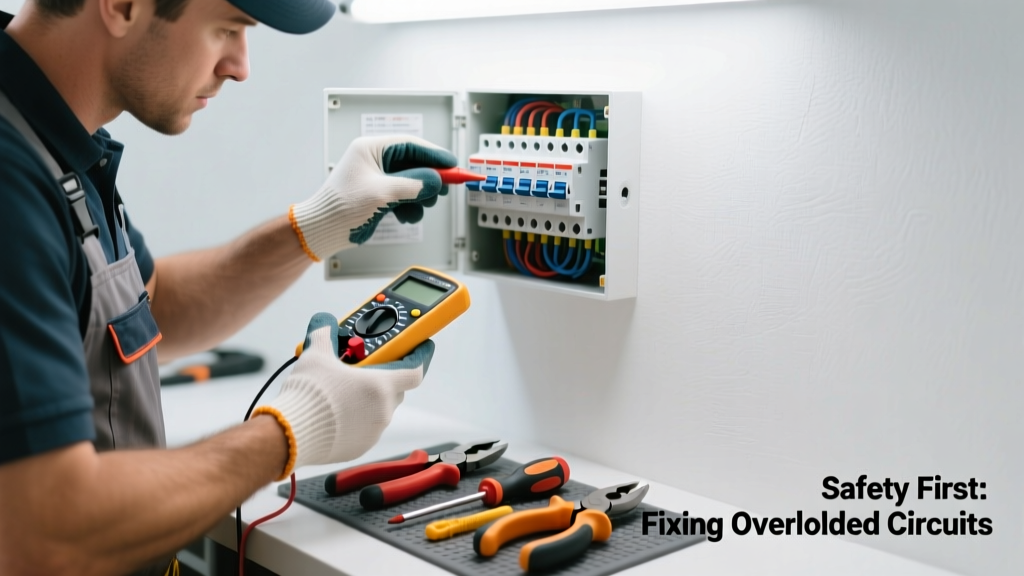
Your breaker trips repeatedly, lights dim when the microwave kicks on, or outlets feel warm — these are red flags that a circuit is overloaded. Ignoring them risks fire, damaged appliances, or electrical shock. This guide walks you through safe, actionable fixes — starting with what’s actually happening behind your walls.
Quick Diagnosis
Overloading isn’t random — it’s physics: too many devices drawing more amps than the circuit’s rating (usually 15A or 20A) can handle. Start here before touching a wire:
- Multiple high-wattage appliances on one circuit (e.g., space heater + hair dryer + vacuum)
- Older homes with outdated wiring and fewer circuits (many pre-1980s kitchens have just one 15A circuit for all outlets)
- Daisy-chained power strips or outlet extenders feeding multiple loads
- Faulty appliances drawing excess current (test by unplugging devices one-by-one)
- Loose connections at outlets or breakers causing resistance heat and false overloads
Tools & Materials Needed
| Item | Purpose | Estimated Cost |
|---|---|---|
| Non-contact voltage tester | Confirms power is off before inspection — critical for safety | $12–$25 |
| Outlet load tester (e.g., Kill A Watt) | Measures real-time wattage draw per outlet to identify hidden overloads | $25–$45 |
| Insulated screwdriver set | Tightens terminal screws safely without shorting hot/neutral wires | $18–$32 |
| Circuit breaker finder | Identifies which breaker controls each outlet — avoids guesswork | $20–$35 |
| LED nightlight (for testing) | Simple indicator of live circuits during troubleshooting | $3–$8 |
Step-by-Step Fix
Work methodically — never reset a tripped breaker until you’ve identified and resolved the cause. Here’s how:
- Unplug everything on the affected circuit. Reset the breaker. If it holds, plug devices back in one at a time, waiting 30 seconds between each. Note which device causes the trip — that’s your culprit or symptom of deeper trouble.
- Map your circuit using a breaker finder and label every outlet, light, and hardwired device. The National Electrical Code (NEC 2023) requires kitchen small-appliance circuits to be dedicated 20A — yet 68% of homes built before 2000 violate this (NFPA Electrical Safety Foundation, 2022).
- Redistribute loads: Move high-draw devices (toaster ovens, coffee makers, microwaves) to different circuits. Avoid plugging heaters or air conditioners into extension cords — they’re rated for 10–12A max, not the 15A+ those units demand.
- Inspect outlets and switches for discoloration, buzzing, or warmth. Tighten loose terminal screws (with power OFF), replace cracked or wobbly receptacles — especially if they’re older back-stabbed types known for failure.
When to Call a Pro
Some signs mean stop and call a licensed electrician immediately:
- Breaker trips instantly — even with nothing plugged in
- Burning smell, scorch marks, or buzzing from the panel or outlets
- Aluminum wiring (common in homes built 1965–1973) — requires COPALUM crimps or full replacement
- You need to add a new circuit, upgrade the panel, or install GFCI/AFCI breakers
- Tripping occurs across multiple circuits — points to main service or grounding issues
"Over 51,000 home fires annually are caused by electrical distribution or lighting equipment — and overloaded circuits account for nearly 1 in 5." — U.S. Fire Administration, Home Structure Fires Report 2023
Prevention Tips
Preventing overload isn’t about restriction — it’s smart load management and infrastructure awareness:
- Use your Kill A Watt meter quarterly on high-use outlets — catch creeping draws before they trip breakers
- Label your breaker panel clearly; include circuit purpose and max load (e.g., "Kitchen Outlets – 20A / 2,400W")
- Replace standard breakers with AFCIs in bedrooms and living areas — they detect dangerous arc faults before overheating occurs
- Avoid daisy-chaining power strips; instead, use a single UL-listed surge protector with built-in overload protection
- If adding an EV charger or heat pump, get a load calculation done — many panels max out at 100A and can’t support modern demands
Can I reset the breaker myself after it trips?
Yes — but only after unplugging all devices on that circuit and checking for obvious issues like melted plugs or frayed cords. Never tape or wedge a breaker in the ON position. If it trips again immediately, power is likely shorted or grounded — do not retry.
Why does my breaker trip only when I turn on the AC?
AC units draw 3–5x their running amps during startup (inrush current). A 15A circuit may handle the unit’s steady draw (10A), but not the 45A surge. Solutions include installing a dedicated 20A or 30A circuit, upgrading to a soft-start AC, or verifying the unit’s capacitor isn’t failing.
Is it safe to replace a 15A breaker with a 20A one?
No — and it’s illegal under NEC 210.19(A)(1). A 20A breaker on 14-gauge wire (rated for 15A) creates a fire hazard. Wire gauge must match breaker rating: 14 AWG = 15A, 12 AWG = 20A, 10 AWG = 30A. Always verify wire size before any upgrade.
Do LED bulbs reduce circuit load enough to prevent overloads?
Yes — significantly. A 60W incandescent draws ~0.5A; its 9W LED equivalent draws just 0.075A. Replacing ten such bulbs saves ~4.25A — enough to free up headroom for a laptop charger or fan. See our LED bulb replacement guide for wattage conversion charts.
What’s the difference between a tripped breaker and a blown fuse?
Functionally identical — both interrupt power due to overload or short. Breakers are resettable switches; fuses contain a metal strip that melts and must be replaced. Homes with fuse boxes (common pre-1960) often lack overcurrent protection for individual outlets — making overloads harder to isolate. Consider a fuse-to-breaker upgrade for safety and convenience.
Can a circuit overload damage my appliances?
Yes — especially sensitive electronics. Voltage drops during overload cause brownouts, stressing power supplies and shortening lifespans. Devices like refrigerators or gaming PCs may suffer capacitor failure or logic board damage over time. Use a whole-house surge protector and avoid sharing circuits with motors and electronics.
Fixing an overloaded circuit isn’t just about resetting a switch — it’s about understanding your home’s electrical personality. Most fixes take under an hour and cost less than $50, but knowing when to pause and call a pro keeps your family and structure safe. Treat your panel like your home’s nervous system: respect it, monitor it, and upgrade it before it sends warning signals you ignore.