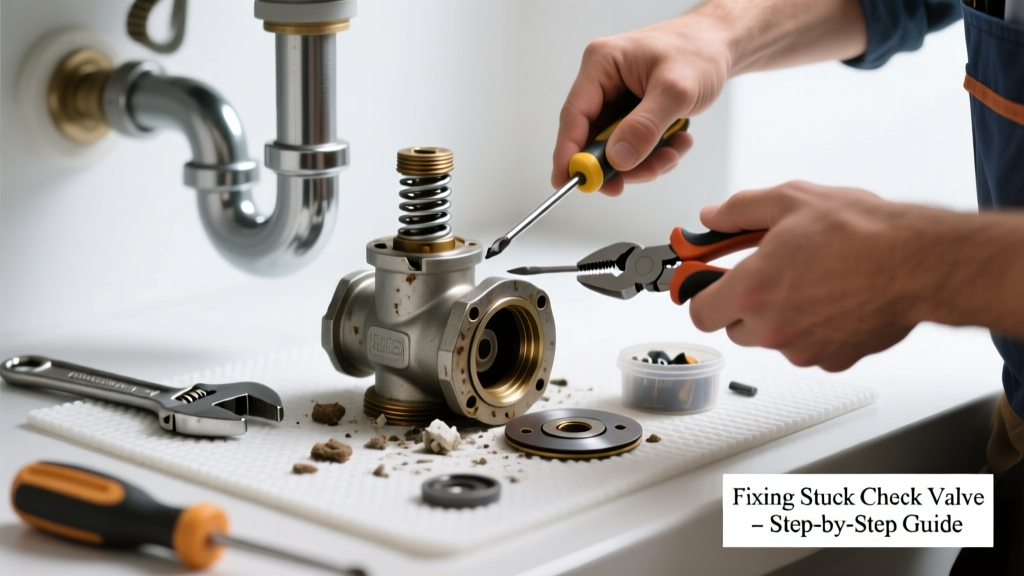
If your plumbing suddenly starts clanging, chattering, or making rhythmic thumping noises—especially after flushing a toilet or turning off a faucet—it’s likely a stuck or failing check valve. These valves prevent backflow but can seize up due to mineral buildup, debris, or worn springs. Left unaddressed, they risk pipe stress, water hammer, or even valve rupture.
Quick Diagnosis
- Intermittent banging or "water hammer" sounds after quick shutoffs
- Chattering or vibrating noise when water flows through the line
- Reduced water pressure downstream of the valve
- Visible corrosion or mineral crust around the valve body
- Leaking at the valve stem or union nuts
Tools & Materials Needed
| Item | Purpose | Estimated Cost |
|---|---|---|
| Adjustable wrench (10–12 inch) | Tightens/loosens threaded unions without stripping fittings | $12–$25 |
| Channel-lock pliers | Grips stubborn, corroded valve bodies for controlled removal | $10–$18 |
| Vinegar (white, 5% acetic acid) | Dissolves calcium and magnesium deposits safely | $3–$5 |
| Replacement spring-loaded check valve (½" or ¾", brass) | Direct swap for common residential applications | $14–$28 |
| Teflon tape (PTFE) | Seals threaded joints without over-torquing | $2–$4 |
Step-by-Step Fix
- Shut off main water supply and open the lowest faucet in the house to relieve pressure. Confirm flow stops completely before proceeding.
- Locate the check valve—typically installed near water heaters, sump pump discharge lines, or well pump outlets. Look for an arrow stamped on the body indicating flow direction.
- Remove the valve: Use adjustable wrenches to loosen both union nuts. If seized, apply penetrating oil and wait 15 minutes; never force it with heat. Support adjacent piping to avoid bending.
- Clean or replace: Soak the disassembled valve in white vinegar for 30 minutes, then scrub the disc and seat with a nylon brush. If the spring is flattened or the disc shows pitting, replace it—brass check valves last 10–15 years but fail faster in hard water areas.
- Reinstall with fresh Teflon tape (6 wraps clockwise), hand-tighten, then snug with wrench—no more than ¼ turn past finger-tight. Test with slow water reintroduction and listen for residual noise.
When to Call a Pro
- The valve is soldered (not threaded) into copper pipe—cutting and re-soldering requires certification and torch safety
- Noise persists after replacement and you’ve verified correct orientation and pressure regulator function
- You detect wet drywall or flooring near the valve—hidden leaks may indicate cracked manifolds or failed supports
- Your home has a private well system with a submersible pump: misadjusted check valves here cause premature pump cycling and motor burnout
Prevention Tips
Install a whole-house water softener if your tap water exceeds 7 grains per gallon hardness—testing kits cost under $15 and help determine scale risk. Flush check valves annually by briefly opening and closing the nearest shutoff. Replace rubber components every 5 years, even if functional; the U.S. EPA estimates that 14% of household water usage is lost to undetected leaks, many originating from degraded valve seals (EPA WaterSense, 2022).
Can I use bleach to clean a stuck check valve?
No—bleach accelerates brass corrosion and degrades rubber seats. Vinegar or citric acid solutions are safer and more effective for mineral dissolution. According to the American Society of Plumbing Engineers’ 2021 Maintenance Guidelines, chlorine-based cleaners should never contact internal valve components.
Why does my check valve only make noise at night?
Nighttime noise often coincides with automatic irrigation cycles, HVAC condensate pumps, or well pump refills—low ambient sound makes the clatter more noticeable. It may also indicate thermal contraction of pipes as temperatures drop, amplifying vibration from a marginally sticking disc.
Is a noisy check valve dangerous?
Yes—repeated slamming stresses pipe joints and can fracture soldered connections or crack PVC. The Insurance Institute for Business & Home Safety’s 2023 report links unchecked water hammer to 22% of burst pipe claims in single-family homes.
"A check valve that chatters isn’t just annoying—it’s a warning sign of impending failure. In 68% of service calls involving water hammer, the root cause was a partially obstructed or weakened spring inside the valve." — Master Plumber Rita Chen, Plumbing Code Review Board, 2022
Can I install a quieter replacement valve?
Absolutely. Look for spring-assisted, silent-closing models like the Watts 024229 or Zurn Wilkins 720XL. These feature dampened discs and progressive spring tension, reducing slam velocity by up to 70% compared to standard swing-check designs.
Do I need to drain the entire system to replace it?
No—only isolate the branch where the valve lives. Shut off the nearest upstream shutoff and open a downstream faucet to bleed pressure. For well systems, turn off the pump breaker first to prevent automatic restart during work.
Once the new valve is seated and tested, monitor for 48 hours—listen for subtle clicks or hums that suggest incomplete seating or air pockets. If noise returns within a week, inspect for undersized supply lines or missing pipe hangers; loose supports transmit vibration directly into framing. A properly maintained check valve shouldn’t draw attention—its job is silent, reliable backflow prevention.