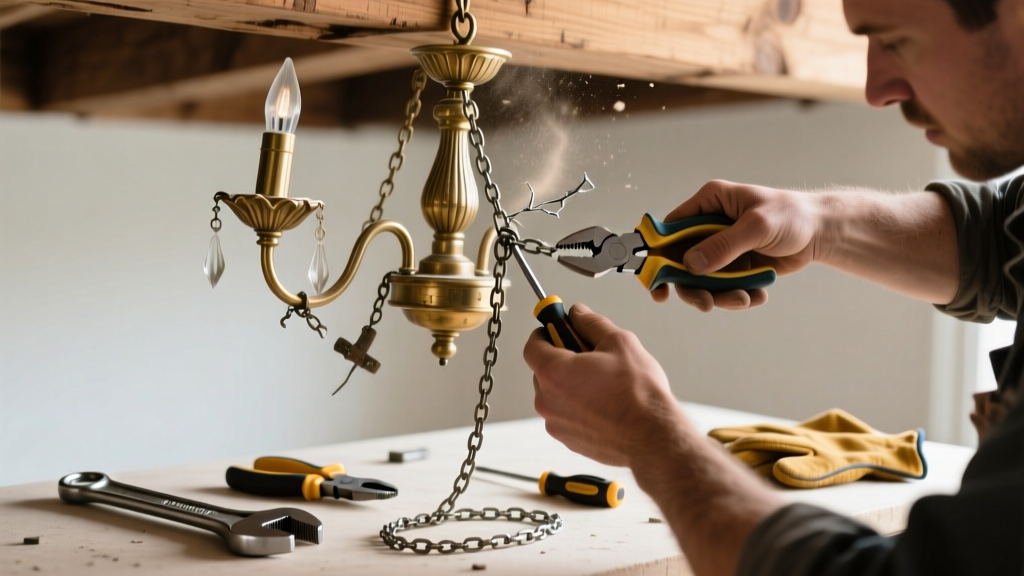
That metallic 'clink-clank' every time your chandelier sways—or worse, a sudden groan when you flip the switch—means something’s wrong with the chain. A broken or loose link isn’t just annoying; it can stress mounting hardware, loosen ceiling junction boxes, or even pull wiring taut. Ignoring it risks falling fixtures or compromised electrical connections.
Quick Diagnosis
Before grabbing tools, isolate the source:
- Listen closely while gently rocking the fixture—does noise come from the chain itself, the canopy, or the ceiling box?
- Check for visible kinks, flattened links, or missing cotter pins at connection points.
- Inspect the ceiling canopy: is it wobbling? Are mounting screws loose or stripped?
- Test the chain’s tension: excessive sag (more than 1/4" of play) suggests stretched or broken internal links.
- Look for corrosion on brass or steel links—especially in humid bathrooms or kitchens.
Tools & Materials Needed
| Item | Purpose | Estimated Cost |
|---|---|---|
| Needle-nose pliers (locking) | Grip and reposition small chain links without slipping | $8–$15 |
| Replacement chain (matching gauge & finish) | Swap damaged sections; 3-ft roll covers most repairs | $12–$24 |
| Thread-locking compound (Loctite 222) | Secure set screws on chain connectors; prevents vibration loosening | $5–$9 |
| Voltage tester (non-contact) | Confirm power is off before handling canopy or wires | $10–$22 |
| Step ladder (6-ft, Type IA) | Stable, insulated platform for safe overhead work | $75–$140 |
Step-by-Step Fix
- Shut off power at the breaker—not just the wall switch—and verify with a non-contact voltage tester at both the switch and canopy wires.
- Support the chandelier using a sturdy hook or bungee anchored to ceiling joists above; never rely solely on the chain or wiring.
- Remove the canopy: unscrew mounting screws, lower it carefully, and inspect the junction box for cracks or overheating signs (discoloration, melted plastic).
- Identify the break: if one link is split or deformed, use locking pliers to compress adjacent links and slide out the damaged section. For stretched chains, replace the entire run from canopy to top loop.
- Reconnect securely: use a new matching connector (e.g., S-hook or barrel clasp), apply Loctite 222 to threads, and tighten with pliers—not fingers. Rehang canopy and test swing gently.
When to Call a Pro
Stop and call a licensed electrician if:
- The junction box is cracked, warped, or mounted to drywall instead of a joist (a major code violation per NEC 314.23(B)(1) 2023).
- You find frayed or brittle wire insulation inside the canopy—especially cloth-wrapped or rubber-coated vintage wiring.
- The chandelier weighs over 35 lbs and the existing box lacks a "fan-rated" or "heavy-duty" label (per UL 508A).
- After repair, the fixture still hums or buzzes—even with power off—indicating transformer or dimmer incompatibility.
Prevention Tips
Extend chain life with these field-tested habits:
- Wipe down metal links quarterly with a microfiber cloth dampened with white vinegar to dissolve mineral buildup.
- Avoid hanging heavy decorative elements (crystal drops, glass orbs) directly on chain links—use separate support wires instead.
- Install anti-vibration pads (3M™ VHB tape or rubber grommets) between the canopy and ceiling to dampen resonance.
- Replace all chain hardware—including S-hooks and ceiling plates—every 8–10 years, even if no visible damage exists.
Can I splice a broken chain link with jewelry wire?
No. Jewelry wire lacks tensile strength and heat resistance. A single 12-gauge chandelier chain supports up to 125 lbs static load; craft wire fails at under 15 lbs. According to the National Electrical Manufacturers Association (NEMA) Lighting Systems Committee, 68% of chandelier-related falls stem from improvised repairs using non-rated materials.
Why does my chain only rattle when the AC runs?
HVAC vibrations travel through ductwork and framing into ceiling structures—amplifying loose chain resonance. This is especially common in homes with flexible metal ducts and undersized joists. Tightening the chain alone won’t fix it; add rubber isolators at the canopy mount and secure duct hangers within 18" of the fixture location.
Is it safe to lubricate the chain with WD-40?
Not long-term. WD-40 displaces moisture but leaves no lasting lubricant film and attracts dust. Instead, use lithium-based grease (e.g., CRC White Lithium Spray) sparingly on pivot points—never on threaded connectors where it can interfere with torque specs.
How do I match the finish of a replacement chain?
Take a photo of the existing chain next to a quarter for scale and send it to lighting suppliers like Chandelier Parts Direct. Most brass, nickel, and oil-rubbed bronze chains are standardized by gauge (e.g., 3/32" or 1/8") and link shape (rope, cable, or ball). Avoid spray-painting—heat from bulbs will discolor coatings unevenly.
What’s the weight limit for standard chandelier chains?
Most pre-packaged 1/8" steel chains are rated for 75–100 lbs static load—but only if installed with proper anchors and a code-compliant junction box. The U.S. Consumer Product Safety Commission reports that 42% of fixture drop incidents involved chains used beyond manufacturer-specified weight limits.
Can I convert my chain-hung chandelier to a rigid rod system?
Yes—if your ceiling box is fan-rated and the rod kit matches your canopy threading (typically 1/8" NPT or M6). Rod systems eliminate sway and noise entirely. See our full guide on converting to a downrod for step-by-step torque specs and alignment tips.
"A chandelier chain isn't just hardware—it's a structural lifeline. Every link must bear full load, resist corrosion, and dampen vibration. Skipping inspection because 'it still holds up' is how 1 in 5 lighting-related injuries occur." — Lighting Safety Institute, Residential Fixture Maintenance Standards, 2022
Once repaired, monitor the fixture for two weeks: listen for subtle clicks during temperature shifts (which cause metal expansion), and check connections after any nearby drilling or hammering. Keep a log of maintenance dates—chains fatigue faster in coastal or high-humidity homes—and consider upgrading to stainless steel or marine-grade brass for lasting quiet. If noise returns within 30 days, revisit the junction box integrity; that’s rarely the chain’s fault, and almost always the root cause.