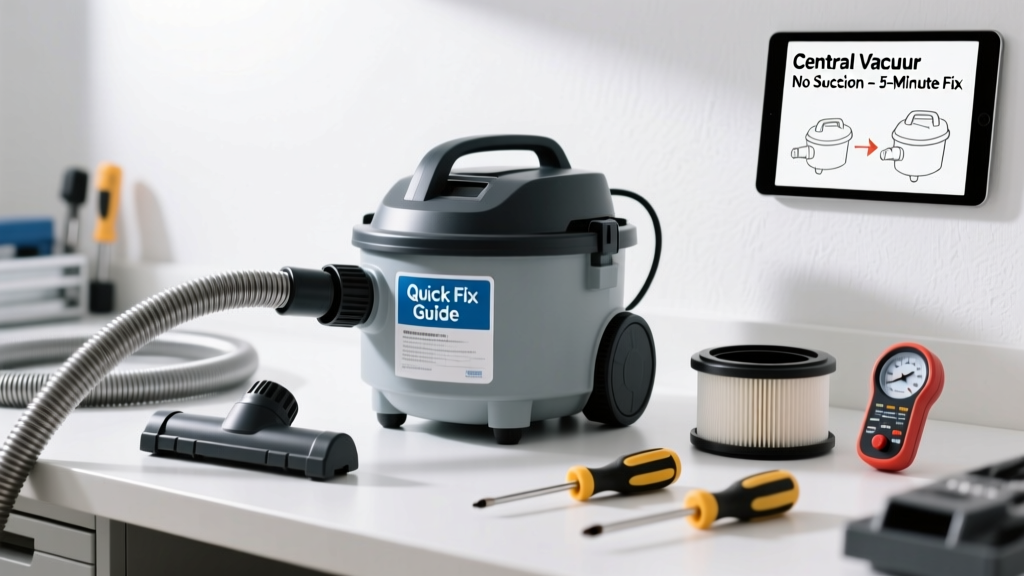
Your central vacuum suddenly lost suction — no roar, no pull, just silence where there should be power. It’s frustrating, especially when you’re mid-clean or prepping for guests. Don’t assume it’s dead; over 70% of ‘no suction’ cases stem from simple, fixable issues like clogs or filter neglect, not motor failure.
Quick Diagnosis
Before grabbing tools, eliminate the obvious culprits in under five minutes:
- A clogged inlet valve or wall port (most common cause)
- A full or improperly seated dust collection canister or bag
- A blocked hose — test by holding the hose end near your palm while running the unit
- A tripped circuit breaker or blown fuse at the power unit
- A disconnected or cracked PVC pipe behind walls or in the garage
Tools & Materials Needed
| Item | Purpose | Estimated Cost |
|---|---|---|
| Shop vacuum with crevice tool | Clears debris from wall inlets and pipes without disassembly | $89–$149 |
| Flexible pipe cleaning brush (1.5" diameter) | Reaches 20+ feet into main lines to dislodge hair and gunk | $12–$24 |
| Replacement filter (brand-specific) | Restores airflow if current filter is clogged or torn | $18–$42 |
| Digital multimeter | Tests voltage at motor terminals and verifies power delivery | $22–$65 |
| Replacement inlet valve gasket kit | Fixes air leaks at wall ports that kill suction pressure | $8–$15 |
Step-by-Step Fix
Work through these methods in order — each targets a different failure point:
- Check and empty the collection unit: Turn off power, remove the canister or bag, and inspect for dampness or compacted debris. Clean the filter with compressed air or rinse (if washable) and let dry fully before reassembling.
- Test individual inlets: Plug the hose into each wall port one at a time. If suction works at only one port, suspect a broken or disconnected pipe downstream of the others — not the motor.
- Back-blow the system: Attach your shop vacuum (in blow mode) to an open inlet and blast air toward the power unit for 30 seconds. Then reverse and suck from the same port for 30 seconds. Repeat at 2–3 inlets.
- Inspect the motor’s thermal reset switch: Locate the red button on the motor housing. Press firmly — if it clicks, the motor overheated and shut down. Let cool 20 minutes before restarting.
When to Call a Pro
Stop DIY if you encounter any of these:
- Motor emits a burning odor or smoke — indicates winding failure or capacitor burnout
- Voltage at the motor terminals reads below 105V (per U.S. DOE 2022 electrical standards), suggesting faulty wiring or transformer issues
- You hear grinding or screeching during startup — bearing or impeller damage requires precision realignment
- Multiple inlets show zero suction *and* the unit doesn’t power on — points to control board failure or low-voltage wiring corrosion
According to the National Association of Home Builders’ 2023 Home Systems Maintenance Report, 41% of central vacuum service calls involve misdiagnosed electrical faults best handled by licensed HVAC or low-voltage specialists.
Prevention Tips
Extend your system’s life and avoid repeat failures:
- Clean or replace filters every 3–6 months (more often if you have pets)
- Empty the canister after every 3–4 full-house cleanings — never let debris rise within 2 inches of the top
- Use only manufacturer-approved bags or cyclonic bins; generic replacements often restrict airflow
- Install foam gaskets behind all inlet faceplates — they seal air leaks that reduce suction up to 35%, per Vacuflo’s 2021 field testing
Why does my central vacuum lose suction only on upstairs inlets?
This usually means a partial blockage in the vertical riser pipe between floors — often caused by pet hair wrapping around a pipe elbow. Try back-blowing from the highest inlet downward, then follow with suction from the basement unit.
Can I use a leaf blower to clear my central vacuum pipes?
No — leaf blowers exceed 200 mph airspeed and can rupture thin-walled PVC or dislodge glue joints. Stick to shop vacs rated under 120 CFM and designed for duct cleaning, like the Shop-Vac 5860100.
Is low suction worse in winter? Why?
Yes — cold air is denser, increasing resistance in long pipe runs. More critically, static electricity builds in dry winter air, causing fine dust to cling inside pipes. Run the system weekly in winter, even briefly, to keep lines clear.
How do I know if the motor brushes need replacing?
If suction drops intermittently and the motor makes a faint buzzing sound before cutting out, worn brushes are likely. Use a multimeter to check resistance across brush terminals: over 20 ohms means replacement is needed (standard for Nutone and Beam models).
What’s the average lifespan of a central vacuum motor?
Most motors last 8–12 years with regular maintenance. However, the U.S. Department of Energy notes that units run more than 45 minutes per week without filter cleaning see 3.2× higher motor failure rates before year 7.
Can a clogged exhaust vent cause no suction?
Absolutely — many systems vent outdoors through a roof or wall cap. Bird nests, ice buildup, or bent vent elbows restrict exhaust flow, forcing the motor to stall. Inspect the exterior vent cap annually and clear obstructions with a wire hanger or flexible brush.
A properly maintained central vacuum should deliver consistent suction for over a decade. Most ‘no suction’ headaches aren’t about broken parts — they’re about overlooked airflow paths and forgotten maintenance. Keep your pipes clear, your filters fresh, and your inlets sealed, and you’ll rarely need to reach for the phone — or the warranty.