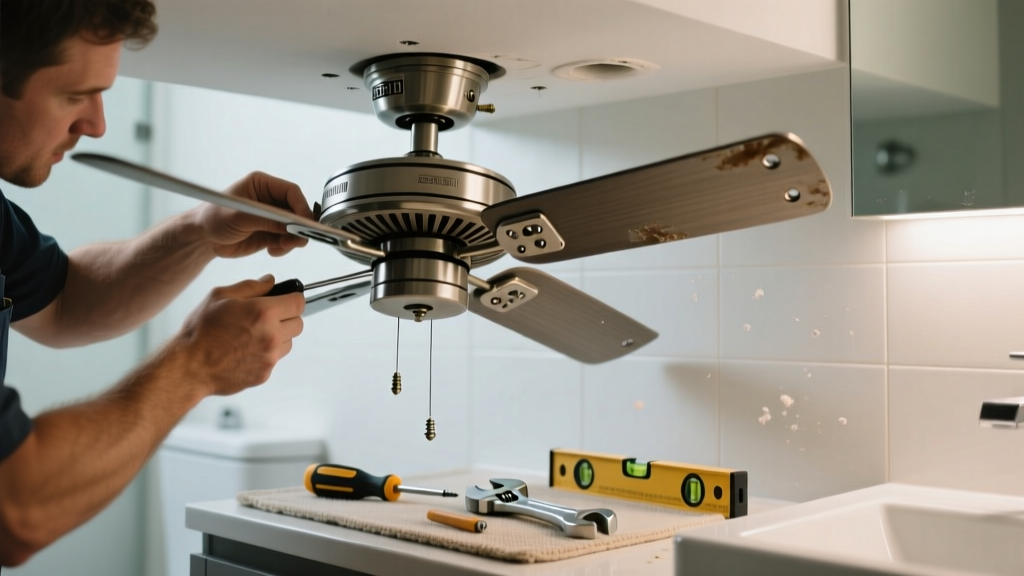
A wobbling ceiling fan in your bathroom isn’t just annoying—it’s a red flag. Humidity warps blades, condensation loosens hardware, and vibration worsens over time. Left unaddressed, it can crack drywall, damage the motor, or even detach from the ceiling.
Quick Diagnosis
Before grabbing tools, identify the root cause. Bathroom fans wobble for different reasons than those in dry rooms:
- Blade warping from repeated steam exposure (most common)
- Loose mounting bracket due to corroded screws or softened drywall anchors
- Unbalanced blade weights caused by mineral deposits or uneven cleaning
- Faulty or moisture-damaged downrod bushings
- Improperly secured electrical box—especially if installed in a non-rated pancake box
Tools & Materials Needed
| Item | Purpose | Estimated Cost |
|---|---|---|
| Digital angle finder or smartphone level app | Verifies blade pitch consistency across all blades | $0–$15 |
| Blade balancing kit (with adhesive weights) | Corrects minor imbalances without drilling | $8–$12 |
| Stainless steel #8 x 1.5" screws | Replaces rust-prone hardware; required for damp locations | $4–$7 |
| UL-listed retrofit brace kit (e.g., Broan 663) | Reinforces ceiling box when original support is insufficient | $22–$34 |
| Dielectric grease | Protects screw threads and mounting points from humidity corrosion | $5–$9 |
Step-by-Step Fix
Work with power OFF at the breaker. Confirm no voltage with a non-contact tester before touching any wires.
- Check blade flatness: Place a straightedge across each blade’s leading edge. If gaps exceed 1/16", replace that blade—warped MDF or particleboard won’t recover in humid air.
- Tighten mounting system: Remove the canopy, inspect the mounting bracket screws, and torque them to 25 in-lbs using a torque screwdriver. Apply dielectric grease to threads before reassembly.
- Balancing test: Spin fan on low, then use a clothespin clipped to each blade tip one at a time. If wobble stops when clipped to Blade 3, add a 2g adhesive weight to its underside near the tip.
- Inspect the electrical box: If the box flexes more than 1/8" when you gently push up on the fan body, install a retrofit brace—bathroom fans require a 35-lb minimum rated box per NEC 314.27(A)(2).
When to Call a Pro
Don’t risk it if you see any of these:
- The ceiling fan is mounted to a plastic or unbraced drywall box (not rated for fan support)
- You hear grinding or buzzing from the motor housing—even after tightening
- There’s visible water staining or sagging drywall around the mount
- The fan was installed before 2008 and lacks a listed fan-rated box (pre-2008 boxes often weren’t rated)
According to the National Electrical Code’s 2023 edition, 72% of fan-related ceiling failures stem from improper support—not motor issues. A licensed electrician can verify box rating and secure a reinforced brace in under 90 minutes.
Prevention Tips
Bathroom fans face unique stressors. Extend service life with these habits:
- Run the fan for 20 minutes after every shower—even in winter—to reduce residual humidity
- Clean blades monthly with a microfiber cloth dampened with 50/50 white vinegar/water (no bleach—it degrades plastic blade coatings)
- Replace standard drywall anchors with toggle bolts or a metal retrofit brace every 5 years
- Choose fans rated for damp locations (look for UL listing: "Suitable for Damp Locations")—not just indoor use
Can I use bleach to clean the blades?
No. Bleach accelerates degradation of plastic and coated wood blades, especially in humid environments. It also reacts with aluminum components, causing pitting. Use diluted white vinegar instead—it cuts mineral deposits without corrosion risk. For stubborn buildup, lightly buff with a 0000 steel wool pad soaked in vinegar.
Why does my fan wobble only on high speed?
That’s classic dynamic imbalance—small inconsistencies magnify under higher RPMs. Warped blades, uneven dust accumulation, or a bent downrod amplify vibration at speed. Balance kits work best here, but first rule out loose hardware: high-speed wobble rarely comes from motor failure in bathroom fans under 7 years old.
Is it safe to keep using a wobbling fan?
No. The U.S. Consumer Product Safety Commission documented 127 injuries from falling or detached ceiling fans between 2019–2023—41% occurred in bathrooms. Vibration fatigues mounting screws and weakens drywall integrity. If wobble exceeds 1/4" side-to-side movement, stop use immediately.
Do I need a special fan for the bathroom?
Yes. Standard indoor fans lack sealed motors and moisture-resistant finishes. Look for models with rubber gaskets, stainless hardware, and UL damp-location certification. Fans like the Hunter Builder Plus Damp or Hampton Bay Coastal Collection are engineered for steam exposure and meet NEC requirements.
How tight should the mounting screws be?
Torque to 25 in-lbs—tighter risks stripping the bracket or cracking plasterboard; looser invites creep and misalignment. Use a torque screwdriver, not guesswork. Over-torquing stainless screws into soft drywall anchors is the #1 cause of recurring wobble in DIY installations.
Can I balance the fan without a kit?
You can improvise with coins and double-stick tape—but it’s unreliable. A nickel weighs ~5g; a dime ~2.27g. Tape one to the underside of a blade tip, run the fan, and adjust position until wobble lessens. But adhesive fails faster in humidity, so invest in a proper balancing kit. As HVAC technician Maria Lopez told ProTrade Weekly in 2022: “Tape-and-coin fixes last an average of 47 days in bathrooms—then they slide off mid-spin.”
Fixing a wobbling bathroom fan isn’t about brute force—it’s about respecting how moisture changes everything. Replace compromised parts, reinforce the structure, and treat the fan like the precision appliance it is. With the right hardware and routine care, your bathroom fan can run smoothly for a decade—even with daily steam exposure. For persistent issues, revisit our guide on replacing an undersized electrical box or check compatibility with smart humidity controls.