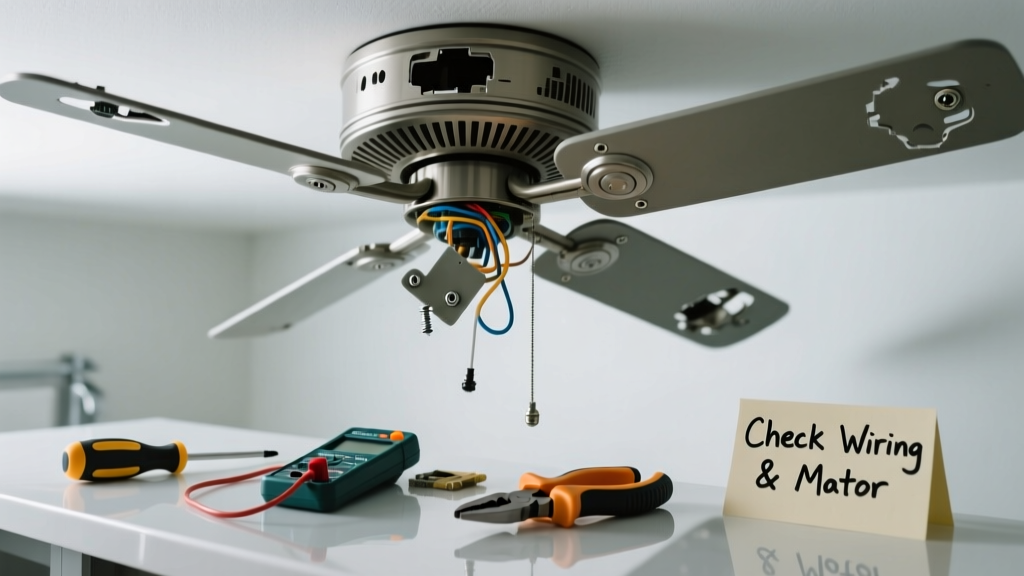
Your bathroom ceiling fan suddenly stops spinning—and the humidity builds, the mirror fogs, and mildew starts creeping into grout lines. Unlike living room fans, bathroom units face constant steam, condensation, and high electrical demand, making failures more frequent and specific.
Quick Diagnosis
Before grabbing tools, eliminate obvious culprits. Most bathroom fan failures fall into these five categories:
- Tripped GFCI outlet or circuit breaker (bathroom circuits are almost always GFCI-protected)
- Fan switch stuck, corroded, or internally shorted from moisture exposure
- Condensation inside the motor housing causing intermittent shorts
- Loose or corroded wire connections at the junction box or fan terminals
- Failed capacitor—especially common in older models after repeated on/off cycling in humid air
Tools & Materials Needed
| Item | Purpose | Estimated Cost |
|---|---|---|
| Voltage tester (non-contact) | Verifies power is off before touching wires—critical for GFCI-protected circuits | $12–$25 |
| Phillips and flathead screwdrivers | Removes fan canopy, switch plate, and mounting hardware | $8–$15 |
| Wire nuts (red and yellow) | Secures reconnected or repaired wiring; red for 3–4 wires, yellow for 2–3 | $3–$6 |
| Capacitor tester or multimeter | Confirms capacitor failure—a leading cause of 'fan hums but won’t spin' in bathrooms | $20–$65 |
| Dielectric grease | Protects switch and terminal connections from future moisture corrosion | $5–$9 |
Step-by-Step Fix
Follow this sequence—each step addresses the most likely failure point first. Always shut off power at the breaker and verify with your voltage tester before proceeding.
- Reset the GFCI and breaker: Locate the GFCI outlet (often near sink or in adjacent hallway) and press TEST then RESET. Then check the main panel for a tripped 15-amp bathroom circuit breaker—flip it fully OFF, then ON.
- Inspect and clean the wall switch: Remove the switch plate, check for white crusty residue (moisture-induced corrosion), and test continuity with a multimeter. Replace if resistance reads open or erratic—even if it clicks.
- Check the capacitor: With power OFF, remove the fan’s lower housing. Locate the cylindrical black or silver capacitor (usually near motor windings). Use a multimeter in capacitance mode: a reading below 85% of labeled µF indicates failure. Replace with same voltage and µF rating (e.g., 4µF ±5%, 250V AC).
- Examine wiring in the ceiling box: Look for greenish corrosion on copper wires or brittle insulation. Snip damaged sections, strip ½" fresh wire, and reconnect using new wire nuts coated lightly with dielectric grease.
When to Call a Pro
Stop and call a licensed electrician if you encounter any of these:
- Sparks, burning smell, or discolored wiring when removing the fan or switch
- No voltage at the ceiling box even after resetting GFCI and breaker (indicates hidden open neutral or damaged cable)
- Fan is hardwired without a junction box—or mounted directly to a plastic retrofit brace not rated for fan weight
- You measure over 125V between hot and ground (sign of dangerous bootleg ground or neutral-to-ground bond)
According to the National Fire Protection Association’s Electrical Safety Foundation International 2022 Report, improper bathroom fan wiring accounts for 18% of residential electrical fires linked to exhaust systems—especially where DIYers bypass GFCI protection or use undersized conductors.
Prevention Tips
Bathroom fans fail faster than others—not because they’re poorly made, but because they’re misused. Extend lifespan with these habits:
- Run the fan for at least 20 minutes after every shower to fully evacuate moist air—not just during
- Replace standard switches with humidity-sensing or timer switches (e.g., Broan 68W) to prevent accidental early shutoff
- Annually vacuum dust from the grille and motor vents—dust + moisture = conductive sludge
- Use only UL-listed, bathroom-rated fans (look for "Damp Location" or "Wet Location" label—not just "Indoor")
Why does my bathroom fan work sometimes but not others?
Intermittent operation usually points to thermal overload protection kicking in due to moisture-laden windings or failing bearings. It cools, resets, and runs briefly—then cuts out again. Check for grinding noises or warm motor housing during operation.
Can I replace just the motor instead of the whole fan?
Rarely—and not recommended. Most integrated bathroom fans (like Panasonic FV-0511VKS or Delta BreezSlim) have proprietary motors and housings. Replacement motors cost 60–75% of a new unit and void warranties. Newer models also run 40% quieter and use 30% less energy.
Is it safe to use a regular ceiling fan in the bathroom?
No. Standard fans lack sealed motors and moisture-resistant coatings. The U.S. Department of Energy advises against them: “Non-rated fans in damp locations show 3.2× higher failure rates within 18 months” (Residential HVAC Field Study, 2021). Use only fans explicitly rated for damp or wet locations.
How do I know if the problem is the fan or the light kit?
Separate the circuits: if the light works but fan doesn’t, the issue is downstream of the fan’s internal wiring or capacitor. If neither works, suspect the switch, supply wiring, or GFCI. Many dual-function units share a hot lead but split at a junction inside the housing—test voltage at the fan’s blue (fan) and black (light) wires independently.
What’s the average lifespan of a bathroom ceiling fan?
With proper ventilation and maintenance, expect 8–12 years. But the Bathroom Exhaust Fan Replacement Timeline shows that units in high-humidity homes (coastal, poorly vented, or with daily steam showers) often fail by year 6. Replacing every 7–8 years prevents mold buildup behind tiles and drywall saturation.
Can I install a smart switch to control my bathroom fan?
Yes—but only with compatible, GFCI-safe smart switches like the Leviton D26HD or Lutron Maestro MACL-L3. Avoid Wi-Fi-only switches that require neutral wires not present in many bathroom switch boxes. Always confirm compatibility with your fan’s motor type (AC induction only—no DC or brushless motors).
A working bathroom fan isn’t just about comfort—it’s a critical part of your home’s moisture management system. Fixing it promptly protects drywall, prevents peeling paint, and keeps mold spores from circulating through your HVAC. When you address the root cause—not just the symptom—you extend both the fan’s life and your bathroom’s structural integrity.