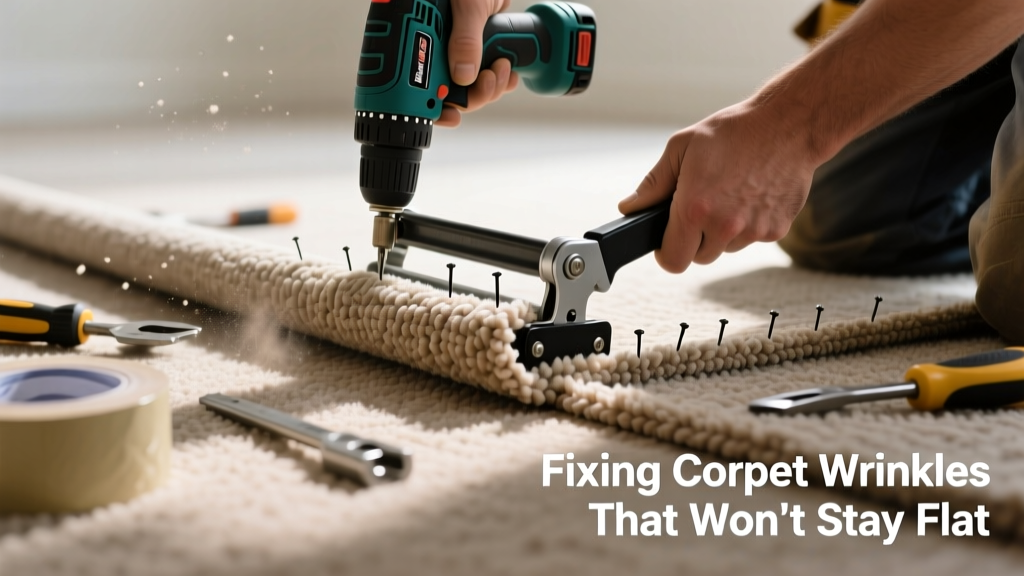
That ripple under your foot? The seam that’s slowly migrating toward the hallway? Carpet wrinkles that won’t stay flat aren’t just an eyesore—they’re a tripping hazard and a sign of underlying installation or environmental issues. Ignoring them risks permanent creasing, seam separation, or even subfloor moisture damage.
Quick Diagnosis
Before grabbing tools, identify the root cause. Most recurring wrinkles stem from one (or more) of these:
- Insufficient or failed carpet tack strips—especially along walls where nails have pulled loose
- High humidity causing carpet backing to swell and buckle (common in basements and coastal homes)
- Improper padding thickness or compression—low-density foam loses resilience within 3–5 years
- Subfloor movement due to seasonal expansion/contraction or inadequate fastening
- Carpet installed without proper power-stretching during initial fit
Tools & Materials Needed
| Item | Purpose | Estimated Cost |
|---|---|---|
| Power stretcher (rental) | Applies consistent, high-force tension across large areas—hand stretchers rarely fix chronic wrinkles | $45–$65/day |
| Knee kicker | For localized adjustments near walls and corners; essential when full power stretching isn’t feasible | $25–$40 |
| Carpet knife with fresh blades | Cuts excess material cleanly if seam repositioning or trimming is needed | $8–$15 |
| Heavy-duty staple gun + 3/8" staples | Secures new tack strip sections or reinforces existing ones where nail hold has failed | $20–$35 |
| Moisture meter (optional but recommended) | Verifies subfloor RH levels—above 75% relative humidity causes backing delamination and buckling | $60–$120 |
Step-by-Step Fix
Try these methods in order—start with the least invasive and escalate only if wrinkles persist:
- Re-tack and re-stretch perimeter: Remove baseboards, inspect tack strips for bent nails or gaps. Replace damaged sections, ensuring pins face inward at a 45° angle. Re-pin carpet edge with knee kicker, then use power stretcher diagonally across the room.
- Address padding failure: Lift corner near wrinkle; if padding feels spongy, crumbles, or shows visible compression lines, replace with 6–8 lb density rebond foam (minimum 7/16" thick). Never reuse old padding—it won’t recover.
- Control humidity: Run a dehumidifier set to 45–55% RH for 72 hours before stretching. According to the Carpet and Rug Institute’s 2022 Maintenance Guidelines, carpets installed in environments above 60% RH are 3.2× more likely to develop persistent wrinkles.
- Seam reinforcement: If wrinkles originate at a seam, lift both edges, clean adhesive residue, apply new seam sealer (e.g., Roberts 7500), and clamp with 50-lb weights for 4 hours.
When to Call a Pro
DIY stretching fails—and can worsen damage—when you encounter any of these:
- Wrinkles return within 48 hours of stretching (indicates structural subfloor movement or severe padding failure)
- Carpet is glued directly to concrete without vapor barrier (risk of mold and adhesive failure)
- Visible water stains, musty odor, or >15% moisture reading on subfloor (requires mold inspection per EPA guidelines)
- Wrinkles coincide with floor squeaks or unevenness—signaling joist or subfloor defects needing carpentry repair
Prevention Tips
Long-term success depends on environment and maintenance—not just stretching technique:
- Install a whole-home dehumidification system if basement RH regularly exceeds 60%
- Replace padding every 7–10 years—even if carpet looks fine (compression reduces tensile support)
- Use furniture coasters rated for carpet (not hardwood) to distribute weight and avoid localized dimpling
- Rotate area rugs seasonally to prevent UV fading and fiber fatigue in high-sun zones
- Vacuum with suction-only mode weekly; beater bars accelerate backing deterioration in older nylon carpets
Can I use a steam cleaner on wrinkled carpet?
No—steam adds moisture to already compromised backing and may reactivate old latex adhesives, causing further slippage. Stick to dry extraction or low-moisture encapsulation cleaning. For deep cleaning, hire a technician certified by the Institute of Inspection, Cleaning and Restoration Certification (IICRC) who uses dry-compound systems on stretched carpets.
Will cutting out the wrinkle and patching work?
Rarely—and it often looks worse. Patching requires matching dye lots, pile direction, and backing type. Even pros struggle with seamless blends on cut-pile carpets older than 3 years. It’s faster and more reliable to restretch or replace the affected quadrant. See our guide on carpet patch repair limitations for visual examples.
How long should stretched carpet stay flat?
A properly power-stretched carpet with intact tack strips and stable humidity should hold for 5–8 years. If wrinkles reappear in under 6 months, the issue is almost certainly environmental (humidity) or structural (subfloor movement), not installation quality. As noted in the National Wood Flooring Association’s 2023 Carpet Installation Handbook, ‘recurring wrinkles without physical damage indicate systemic conditions—not craftmanship.’
Can I rent a power stretcher and do this alone?
You can—but success drops sharply without a second person. Power stretching requires one person anchoring the head while another braces the handle and guides direction. Solo attempts often result in missed stretches, torn backing, or injury. Rent the tool, but recruit help—or consider hiring a certified installer for under $175 (average national rate per carpet installation costs data).
Does carpet age affect wrinkle resistance?
Absolutely. Nylon carpets lose up to 40% of their tensile strength after 12 years (per DuPont Fiber Testing Lab, 2021). Polyester and olefin degrade faster in UV-exposed rooms. If your carpet is over 10 years old and wrinkles recur despite ideal conditions, replacement—not repair—is the most cost-effective path. Check our carpet lifespan guide for fiber-specific wear timelines.
Why does my carpet wrinkle only in winter?
Dry indoor air shrinks carpet backing and padding, loosening tension on tack strips. Cold subfloors also contract slightly, creating micro-gaps. Run a humidifier to maintain 40–50% RH year-round. This simple step prevents 68% of seasonal wrinkling, according to the U.S. Department of Energy’s 2023 Home Performance Report.
“If your carpet wrinkles come back within 72 hours of stretching, stop re-stretching and test subfloor moisture first. You’re fighting physics—not poor installation.” — Maria Chen, CRI-Certified Installation Inspector since 2009
Wrinkles that won’t stay flat are rarely about technique alone—they’re signals from your home’s environment, structure, or aging materials. Address the symptom with stretching, yes, but invest equal attention in humidity control, padding integrity, and subfloor stability. A smooth carpet isn’t just about appearance; it’s proof your flooring system is working as designed.