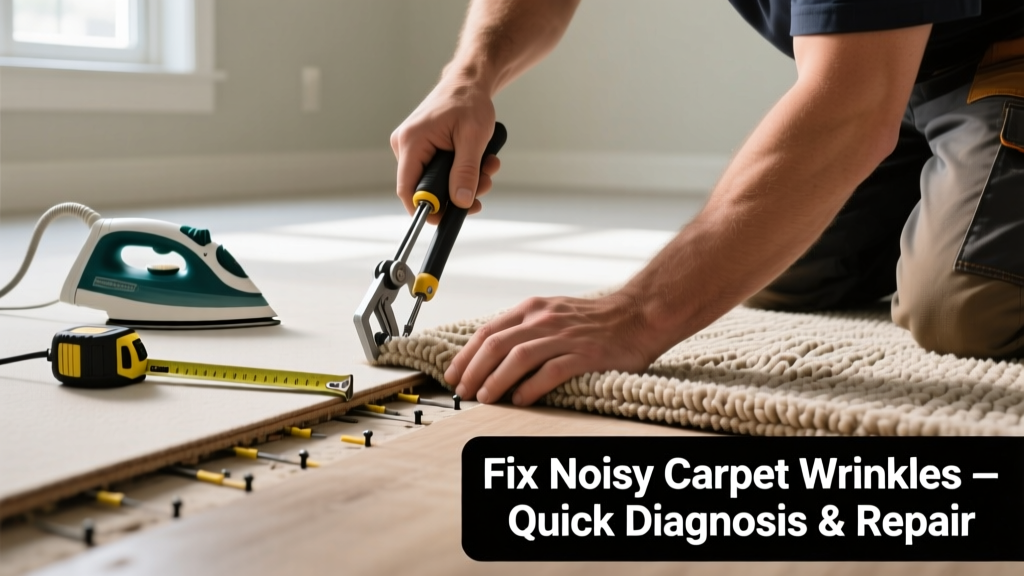
That faint crunch underfoot when you walk across the living room rug? The sudden squeak near the hallway threshold? Noisy carpet wrinkles aren’t just annoying—they’re a red flag that your carpet is losing tension, shifting, or rubbing against something beneath it. Left unaddressed, they accelerate wear and can even trip hazards.
Quick Diagnosis
Before grabbing tools, identify the root cause. Most noisy wrinkles stem from one (or more) of these issues:
- Loose or failed carpet tack strips—especially along walls or doorways
- Moisture damage causing padding compression or adhesive failure
- Subfloor irregularities like high spots, gaps, or squeaky floorboards underneath
- Carpet padding bunched, worn thin, or improperly installed
- Temperature/humidity swings causing carpet fibers or backing to contract or expand
Tools & Materials Needed
| Item | Purpose | Estimated Cost |
|---|---|---|
| Carpet stretcher (knee kicker) | Re-tensions carpet over padding without removing it | $45–$85 |
| Carpet tucker (hook knife) | Secures loose edges into tack strips | $12–$22 |
| Utility knife with fresh blades | Cuts excess padding or trim; avoids fraying | $5–$15 |
| Heavy-duty staple gun + 3/8" staples | Re-secures padding to subfloor where tack strips fail | $25–$60 |
| Moisture meter (optional but recommended) | Rules out hidden water damage in padding or subfloor | $60–$120 |
Step-by-Step Fix
Try these methods in order—start simple and escalate only if needed:
- Locate and flatten the wrinkle: Use a broom handle or straightedge to gently push the ripple toward the nearest wall. Listen closely—if noise stops immediately, the issue is localized tension loss.
- Re-secure the edge: Lift the carpet edge near baseboard, check tack strip grip. If nails are bent or missing, replace them with 1" carpet nails spaced 3–4" apart. Use a carpet tucker to force the backing deep into the pins.
- Stretch with a knee kicker: Place the kicker’s head against the carpet near the wrinkle, angled toward the wall. Drive firmly 3–4 times in overlapping strokes. Repeat every 12" until tension is restored and noise vanishes.
- Address padding issues: If padding is folded, torn, or thinner than 7/16", cut out the damaged section and replace it with same-density rebond foam. Staple edges every 4" to subfloor—not to joists.
When to Call a Pro
DIY isn’t safe or effective in these scenarios:
- You hear loud creaks *from the floor below*—indicating loose subfloor or joist movement, not carpet
- The wrinkle covers >10 sq ft or shifts after stretching (sign of major padding collapse or adhesive failure)
- Moisture meter reads >15% in padding or subfloor—mold risk requires certified remediation
- Carpet is glued down (not stretched), especially on concrete slabs—heat guns or solvents may be needed
According to the Carpet and Rug Institute’s 2022 Installation Standards, improper stretching accounts for 68% of premature carpet failures—including noise complaints within 18 months of installation.
Prevention Tips
Extend your carpet’s quiet life with these habits:
- Vacuum weekly with a low-suction setting—high suction lifts edges over time
- Maintain indoor humidity between 35–55% year-round using a hygrometer and dehumidifier/humidifier as needed
- Rotate area rugs every 3 months to prevent localized padding compression
- Inspect tack strips annually—replace rusted or bent pins before they loosen further
Can I use a steam cleaner on wrinkled carpet?
No—steam adds moisture to already compromised padding and can warp backing adhesives. Stick to dry extraction or bonnet cleaning for routine care. If wrinkles appeared after steam cleaning, let the carpet dry fully for 48 hours before attempting stretch repair.
Will furniture weight flatten the wrinkle over time?
It might temporarily suppress noise, but pressure from heavy furniture actually worsens the problem by compressing padding unevenly. Move furniture and address the wrinkle directly—then use felt pads under legs to reduce future stress.
How long does a proper stretch last?
A professional-grade stretch with quality padding lasts 7–10 years in moderate-traffic areas. DIY fixes with a knee kicker typically hold 2–4 years—unless environmental conditions (humidity swings, radiant heat) accelerate fiber fatigue.
Is carpet noise covered by home warranty?
Rarely. Most home warranties exclude cosmetic or maintenance-related issues like carpet wrinkles. However, if noise stems from subfloor failure documented by a structural engineer, it may fall under dwelling coverage—check your policy’s ‘dwelling structure’ clause.
Can I rent a carpet stretcher instead of buying one?
Yes—Home Depot and local tool rental shops offer knee kickers for $25–$35/day. But factor in travel time and learning curve: first-time users often misalign kicks, creating new ripples. Watch carpet stretcher tips before renting.
Does pet urine cause carpet to wrinkle and squeak?
Yes—urine breaks down latex backing and padding adhesives. A 2021 study by the University of Georgia’s Textile Engineering Lab found that repeated exposure reduces backing tensile strength by up to 40%, leading to delamination and friction noise. Spot-clean with enzymatic cleaner, then assess padding integrity.
Wrinkles don’t appear overnight—and neither do solutions. Tackle the noise early, match your method to the cause, and treat the symptom *and* the source. For persistent issues, consult a certified installer who uses a power stretcher—not just a knee kicker—for lasting results. And remember: a quiet floor isn’t luxury—it’s the baseline for safe, comfortable living.