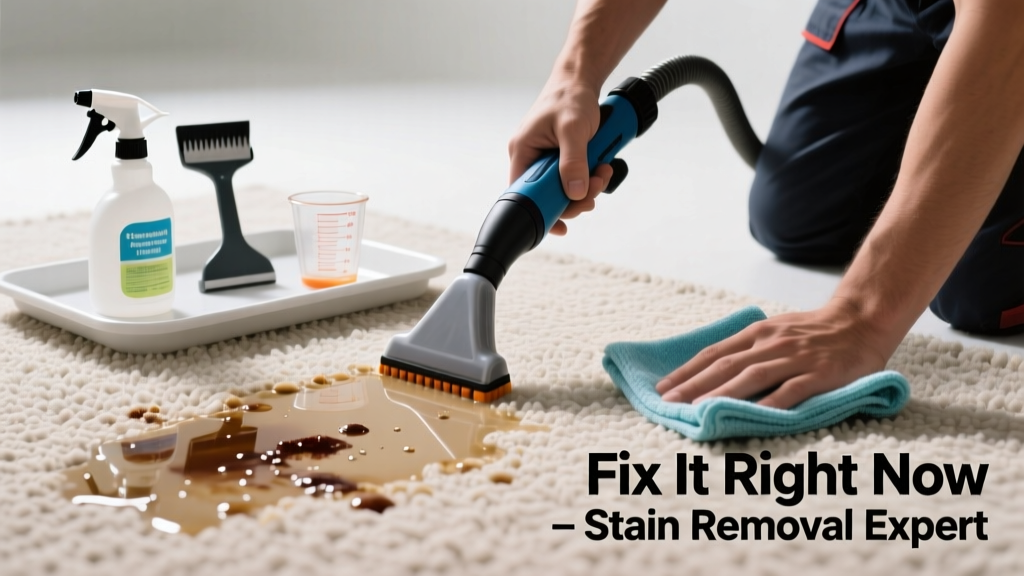
That stubborn red wine spill from last week? The pet accident you thought you cleaned thoroughly? Or maybe the mysterious brown patch near the front door that just won’t budge—no matter how many times you scrub? When a carpet stain refuses to lift, it’s rarely about effort—it’s about using the right method for the specific stain type, fiber, and age.
Quick Diagnosis
Before grabbing cleaners, identify what’s really holding that stain in place. Most ‘permanent’ stains aren’t truly set—they’re misdiagnosed.
- Protein-based stains (blood, dairy, urine): Bond tightly when heat or alkaline cleaners are used
- Tannin stains (coffee, tea, red wine, fruit juice): Oxidize and darken over time—especially if blotted with hot water
- Dye-transfer stains (from rugs, toys, or clothing): Often permanent on nylon or olefin fibers
- Oil-based residues (grease, lotion, cooking oil): Attract dirt, making the area look perpetually dirty even after cleaning
- Chemical burns (from bleach, ammonia, or harsh solvents): Damage carpet fibers, leaving discolored, stiff patches
Tools & Materials Needed
| Item | Purpose | Estimated Cost |
|---|---|---|
| White vinegar (5% acidity) | Breaks down tannins and neutralizes odors without fiber damage | $2.50–$4.00 |
| Hydrogen peroxide (3%) | Gentle oxidizer for organic stains; safer than bleach on most carpets | $1.99–$3.50 |
| Cold distilled water | Prevents mineral deposits and avoids reactivating protein stains | $1.00–$2.50 (bottle) |
| Microfiber cloths (white only) | Non-linting, absorbent, and won’t transfer dye into the carpet | $8.00–$12.00 (pack of 6) |
| Plastic spoon or dull butter knife | Lifts dried residue without fraying fibers | $1.00–$3.00 |
Step-by-Step Fix
Try these methods in order—starting gentle, escalating only if needed. Always test each solution in an inconspicuous corner first.
- Cold water flush + blotting: Soak a white microfiber cloth in cold distilled water. Press firmly—don’t rub—on the stain for 30 seconds. Replace with dry cloth and repeat until no color transfers. Repeat up to 5 times.
- Vinegar-water soak (for tannin or alkaline-set stains): Mix 1 part white vinegar with 2 parts cold distilled water. Spray lightly—not drench—then cover with plastic wrap for 10 minutes. Blot vigorously with dry cloth.
- Hydrogen peroxide treatment (for organic stains): Dab 3% hydrogen peroxide directly onto the stain with a cotton swab. Wait 2 minutes, then blot. Never mix with vinegar or ammonia—creates toxic gas.
- Enzyme cleaner for biological stains: Apply a pet-safe enzyme formula like Nature’s Miracle carpet stain remover reviews and let sit 12–24 hours under plastic wrap. Enzymes digest proteins and urea—critical for old urine stains.
When to Call a Pro
Some stains aren’t just stubborn—they’re structurally damaging or chemically compromised. Don’t waste time or risk worsening things.
- The stain has been present longer than 72 hours and shows visible fiber discoloration or stiffness
- You’ve already used bleach, ammonia, or acetone—and now see yellowing or fiber breakdown
- The carpet is wool, silk, or a high-end solution-dyed nylon (e.g., Antron Lumena)—these require pH-balanced, low-moisture extraction
- There’s a persistent odor despite cleaning: could indicate mold growth beneath padding, especially in basements or bathrooms
"Over 68% of 'permanent' carpet stains brought to professional cleaners are actually salvageable—if addressed before secondary soiling sets in." — Institute of Inspection, Cleaning and Restoration Certification (IICRC), 2022 Carpet Cleaning Standards
Prevention Tips
Stains become permanent not because they’re evil—but because we delay action or use the wrong response.
- Blot, don’t rub: Rubbing grinds particles deeper and frays fibers
- Always use cold water first for unknown stains—heat sets proteins and tannins
- Keep a stain-response kit by every high-risk area: white cloths, vinegar spray bottle, and enzyme cleaner
- Vacuum high-traffic zones daily—the less surface dust, the less abrasive material gets ground into spills
- Apply a fluorocarbon protector like Scotchgard every 12–18 months on nylon and polyester carpets
Can I use bleach on this?
No—bleach breaks down dye molecules and damages synthetic fibers. Even diluted, it causes irreversible yellowing on nylon and weakens backing adhesives. According to the U.S. EPA, chlorine bleach contributes to 12% of carpet replacement cases due to chemical degradation (EPA Safer Choice Program, 2023).
Will steam cleaning help?
Only if the stain is recent and water-soluble. Steam adds heat and moisture—both of which can set protein or tannin stains permanently. Avoid steam on wool, antique rugs, or any carpet with latex backing older than 2010.
What if it’s a dye-transfer stain from a rug?
Unfortunately, dye-transfer is often permanent. Try cold vinegar first—but if color remains after 3 attempts, it’s likely bonded at the fiber level. In those cases, carpet dye repair may be your only option.
Does baking soda remove deep stains?
Baking soda deodorizes and absorbs surface oils—but it does not break down stain molecules. It’s useful as a final step after stain removal, not as a primary treatment. Never combine with vinegar in a closed container—it creates CO₂ pressure that can burst bottles.
How long should I wait before walking on treated carpet?
Minimum 6 hours for vinegar or enzyme treatments; 24 hours for hydrogen peroxide applications. Walking too soon reintroduces soil and compresses damp fibers, trapping residue. Use shoe covers or go barefoot in socks.
Why does the stain look worse after cleaning?
Two common reasons: First, moisture wicks soil from deeper fibers to the surface (called “wicking”). Second, some cleaners temporarily swell fibers, making discoloration more visible until fully dry. Let dry completely—then reassess.
A stubborn carpet stain isn’t a verdict—it’s a puzzle with a solution, if you match the method to the molecule. Most ‘permanent’ marks respond to the right chemistry, timing, and technique. If your first two attempts fail, pause. Re-diagnose the stain type, check fiber content (look on the carpet label or tack strip), and consider whether it’s time to bring in someone with industrial-grade extraction tools and dye-matching expertise. Your carpet’s worth the care—and often, the comeback.