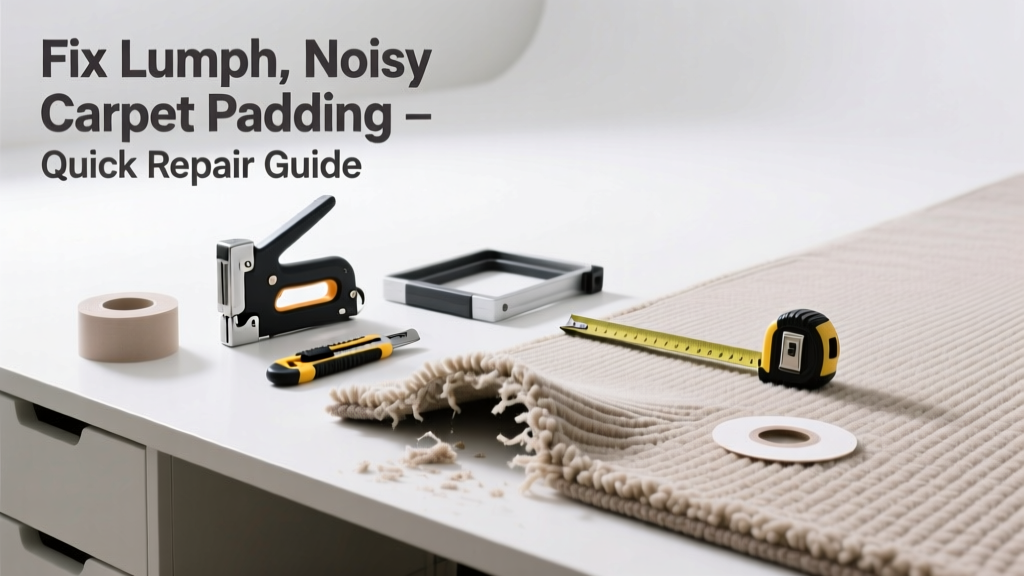
That hollow thump when you walk across the living room? The crunch underfoot near the hallway? Lumpy, noisy carpet padding isn’t just annoying—it’s a sign of underlying failure that can accelerate wear on your carpet and subfloor. Ignoring it risks permanent indentation, moisture trapping, and even tripping hazards.
Quick Diagnosis
Before grabbing tools, confirm the source. Most lumpy, noisy padding issues stem from one or more of these causes:
- Moisture exposure (spills, humidity, or slab condensation) causing foam compression or fiber breakdown
- Padding seams separating or overlapping due to poor initial installation
- Subfloor irregularities—nail pops, uneven plywood joints, or warped OSB—pushing up through thin or low-density padding
- Aging degradation: Rebond foam loses resilience after 7–10 years; rubber pads harden and crack
- Improper pad thickness for your carpet type (e.g., 8-lb density pad under plush cut pile)
Tools & Materials Needed
| Item | Purpose | Estimated Cost |
|---|---|---|
| Utility knife with fresh blades | Cutting away damaged padding without gouging subfloor | $8–$15 |
| Carpet knee kicker or power stretcher | Re-tensioning carpet over repaired or replaced padding | $45–$120 (rental) |
| 3/8" rebond foam padding (6–8 lb density) | Replacement pad with proper support and sound-dampening properties | $1.25–$2.10/sq ft |
| Carpet seam tape & seaming iron | Securing new padding seams to prevent future shifting | $22–$38 |
| Moisture meter (e.g., Protimeter Surveymaster) | Verifying subfloor moisture content <12% before reinstallation | $180–$295 |
Step-by-Step Fix
Choose the method based on severity and access. Start with the least invasive:
- Spot-replace compressed zones: Lift carpet in noisy area using a flat pry bar; cut out only the lumpy section (leave 1" margin around edges); glue new 6-lb rebond pad with spray adhesive (e.g., 3M Super 77); press firmly and re-stretch carpet.
- Re-seam shifted padding: If noise comes from a gap or ridge at a seam, lift adjacent carpet, align edges flush, apply double-sided seam tape, and roll with a seam roller. Avoid overlapping—this creates immediate lumpiness.
- Subfloor leveling prep: For nail pops or humps, countersink protruding nails and fill depressions with self-leveling compound (e.g., Henry 555 Level Pro). Let cure 24 hours before reinstalling padding.
- Full pad replacement: Recommended if >30% is degraded or moisture-damaged. Remove all old padding, vacuum subfloor thoroughly, check for mold (discard if present), then install new pad with seams staggered and taped.
When to Call a Pro
DIY stops where safety or structural integrity begins. Call a certified installer if:
- You find black mold growth on padding or subfloor—this requires containment and EPA-compliant remediation
- The subfloor has >3/16" deflection between joists (test with straightedge and feeler gauge)
- Noise persists after full pad replacement—indicating loose floor joists or failing subfloor fasteners
- Your home was built before 1980 and you suspect asbestos-backed padding (do not disturb; hire licensed abatement)
Prevention Tips
Extend padding life by controlling environmental stressors and selecting wisely:
- Maintain indoor relative humidity between 30–50% year-round using a dehumidifier in basements or humid climates
- Vacuum high-traffic zones twice weekly with a suction-only setting—rotary brushes accelerate pad breakdown
- Use furniture pads rated for carpet (not hardwood) to distribute weight and avoid localized compression
- Replace padding every 7 years—even if carpet looks fine—as foam resilience drops 40% by year 8 (Carpet and Rug Institute, 2022)
Can I reuse my old carpet over new padding?
Yes—if the carpet is less than 10 years old, shows no permanent crushing, and passes the “bounce test” (press down firmly with your thumb; it should rebound within 2 seconds). Older or flattened carpets may telegraph subfloor flaws through new padding.
Why does my carpet squeak only in winter?
Low humidity shrinks wood subfloors slightly, increasing gaps between boards and joists. When you step down, the carpet and pad flex into those voids, rubbing against dry framing members. According to the U.S. EPA, indoor RH below 25% accelerates this effect by 3x.
Is rubber padding better than foam for noise reduction?
No—while rubber resists compression, it transmits impact noise *more* than high-density rebond foam. Independent testing by the National Wood Flooring Association (2021) found 8-lb rebond reduced footfall noise by 22 dB vs. 14 dB for solid rubber pads.
How thick should carpet padding be for stairs?
Stairs need firmer support: use 1/4"–3/8" thick, 8–10 lb density rebond. Thicker or softer pads increase trip risk and cause excessive carpet movement on treads—contributing to both noise and wear.
Will steam cleaning fix padding noise?
No—steam adds moisture that worsens compression in degraded foam and promotes mold. The Carpet and Rug Institute explicitly warns against steam extraction on padding older than 5 years.
What’s the best glue for attaching carpet padding?
Use water-based contact cement (e.g., Roberts 1500) or low-VOC spray adhesive (3M 90). Solvent-based glues degrade foam over time and off-gas VOCs. Always ventilate during application and allow 2 hours drying before re-stretching.
"Padding accounts for 60% of perceived carpet comfort—and 70% of premature carpet failure when mismatched or degraded." — Dr. Lena Cho, Textile Engineering Lead, CRI Lab Report #CR-2023-08
Fixing lumpy, noisy padding isn’t about chasing silence—it’s about restoring the engineered interface between your feet, carpet, and home’s structure. A properly installed 8-lb rebond pad shouldn’t shift, compress, or whisper back at you. When you hear that crunch again, it’s not just an annoyance—it’s your floor telling you something’s slipping out of alignment. Address it early, choose materials with longevity in mind, and your carpet will stay quiet, resilient, and safe for years. For related guidance, see our how to stretch carpet without power stretcher and carpet subfloor moisture test guides.