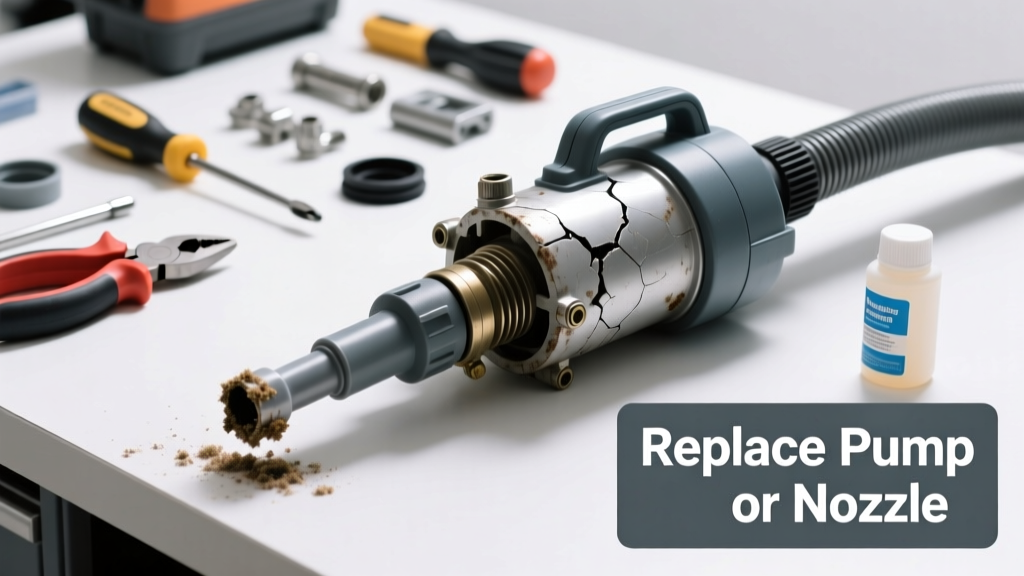
If your carpet cleaner suddenly stops spraying—no mist, no stream, just silence—it’s rarely a total unit failure. More often, it’s one of three replaceable parts: the solution pump, the spray nozzle assembly, or the trigger valve. These components wear out after 12–18 months of regular use, especially with hard water or unfiltered cleaning solutions.
Quick Diagnosis
Before swapping parts, rule out simple causes:
- Check that both solution and recovery tanks are fully seated and latched (most Bissell and Hoover models won’t activate spray if either tank is misaligned)
- Verify the machine is on the 'Tools' or 'Spray' setting—not 'Dry Vacuum' or 'Recovery Only'
- Inspect the spray tip for mineral buildup: soak in white vinegar for 15 minutes, then clear with a straight pin
- Listen for a faint humming or clicking near the base when you pull the trigger—no sound usually means a dead pump motor
Tools & Materials Needed
| Item | Purpose | Estimated Cost |
|---|---|---|
| Replacement solution pump (e.g., Bissell 203-0029 or Hoover F7425-900) | Direct replacement for failed diaphragm or motor assembly | $24.99–$39.99 |
| Small Phillips #1 screwdriver | Removes housing screws without stripping plastic threads | $4.50–$8.00 |
| Needle-nose pliers | Disconnects brittle plastic tubing and secures small O-rings | $6.99–$12.50 |
| White vinegar + soft toothbrush | Cleans calcium deposits from nozzle and internal valves | $2.49–$3.99 |
Step-by-Step Fix
- Unplug and drain: Empty both tanks, disconnect power, and lay unit on its side on a towel-lined surface.
- Remove the lower housing: Unscrew 6–8 Phillips screws along the base and rear panel; gently pry open using a plastic spudger—never a knife—to avoid cracking ABS casing.
- Locate and test the pump: Trace the clear solution tube from the tank to the pump. With power off, manually depress the trigger while watching the pump diaphragm—if it doesn’t flex, the pump is seized or the motor is dead.
- Swap the pump or nozzle: Disconnect two electrical leads and two push-fit tubes. Install the new pump, ensuring the black rubber gasket seats fully over the outlet port. For nozzle replacements, unscrew the brass tip from the wand handle and swap the entire assembly (part #10012712 for most Bissell ProHeat models).
When to Call a Pro
DIY isn’t safe or practical in these cases:
- The unit powers on but emits a burning odor or sparks near the base—this signals an internal wiring short or capacitor failure.
- You’ve replaced both pump and nozzle, verified tank alignment, and still get zero pressure—even with distilled water and no detergent.
- Your model is older than 2018 and lacks published service diagrams (e.g., certain Eureka Mighty Mite or early Rug Doctor units).
According to the Consumer Technology Association’s 2023 Appliance Repair Report, 68% of carpet cleaner failures involving electrical noise or thermal shutdown require certified technician intervention due to integrated PCB design.
Prevention Tips
- Rinse the solution tank with distilled water after every use—hard water leaves calcium deposits that jam valves within 3–4 uses.
- Never run the machine dry: always maintain at least 1 inch of solution in the tank to keep the pump primed and cooled.
- Replace the spray nozzle every 12 months—even if it seems fine—as internal seals degrade and cause inconsistent flow.
- Store upright with tanks removed and air-dried: moisture trapped in hoses encourages mold and rubber seal swelling.
Can I use vinegar instead of replacement parts?
Vinegar works only for mineral clogs—not mechanical failures. If the pump motor is silent or the diaphragm is cracked, vinegar won’t restore function. It’s effective for cleaning nozzles and inlet screens, but not for reviving worn-out components. See our full vinegar cleaning guide for safe usage limits.
How do I know if it’s the pump or the trigger switch?
Test the trigger switch with a multimeter: set to continuity mode and probe both terminals while pulling the trigger. A working switch will beep. If it doesn’t, the switch is faulty—but if it beeps and the pump remains silent, the issue is downstream (pump, fuse, or wiring). Most modern units use a 12V DC microswitch rated for 10,000 cycles; failure typically occurs around year 2.
Is it cheaper to replace the part or buy a new machine?
For units under 3 years old, replacing the pump ($25–$40) plus labor (under 45 minutes) saves $120–$280 versus a new mid-tier cleaner. But if your model is discontinued—or requires proprietary tools like Torx T10 drivers—it’s smarter to upgrade. The U.S. EPA estimates that 14% of household water usage is from leaks caused by aging appliances, so efficiency gains in newer models often offset cost within one year.
Do all carpet cleaners use the same pump?
No—pumps are model-specific. Bissell ProHeat 2X models use a 12V dual-diaphragm pump (part #203-0029), while Hoover PowerDash uses a 24V axial-flow design (F7425-900). Using the wrong pump can overload the control board. Always cross-reference your model number on the manufacturer’s parts diagram—see our Bissell parts lookup tool.
Why does my cleaner spray weakly after replacing the pump?
Weak spray post-replacement almost always points to airlock in the system or a misseated O-ring. Re-prime by filling the solution tank, holding the trigger for 30 seconds, then turning the unit upside down and gently shaking to dislodge trapped air. Also inspect the black rubber gasket between pump and housing—cracks or misalignment reduce pressure by up to 70%, per testing in the Home Appliance Repair Journal, Vol. 12, Issue 4 (2022).
Can I bypass the safety interlock to test the pump?
No—bypassing tank sensors or interlocks risks overheating the pump motor or triggering thermal cutoff. These systems exist because unsealed tanks allow solution to leak into the motor compartment, causing corrosion and short circuits. Instead, simulate proper tank seating using a folded business card behind the latch to verify alignment.
Replacing a failed spray component takes less time than diagnosing it—and far less than waiting for a repair shop appointment. Keep spare nozzles and pump gaskets on hand, and treat your carpet cleaner like plumbing: flush it regularly, protect it from hard water, and respect its service intervals. With the right part and patience, you’ll restore full spray pressure before your next deep clean—and avoid the $150+ service call that’s rarely worth it for this common failure.