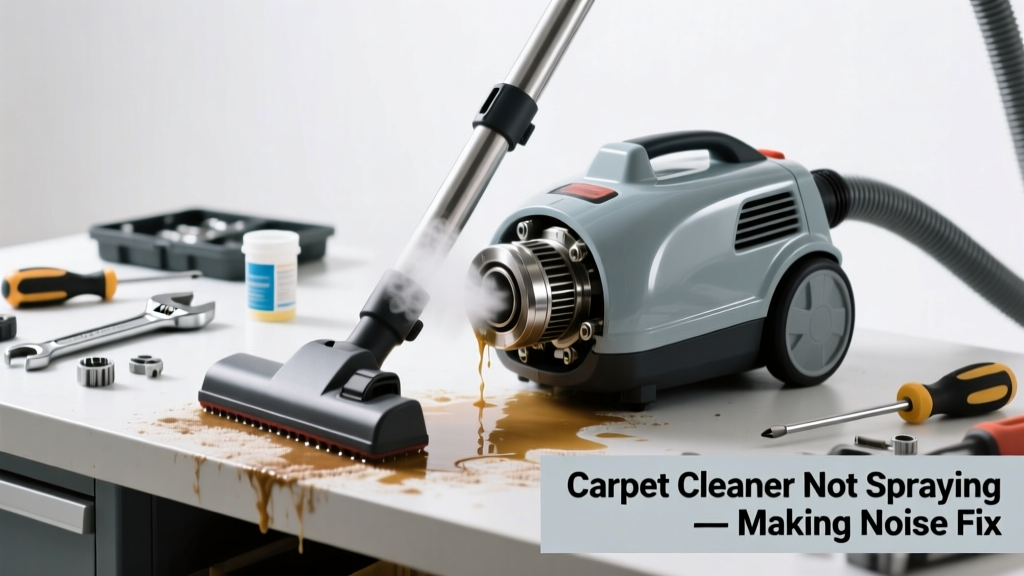
Your carpet cleaner suddenly stops spraying—then starts whining, grinding, or sputtering like it’s choking on gravel. That noise isn’t just annoying; it’s a red flag that something’s jammed, worn, or misaligned inside the pump or fluid path.
Quick Diagnosis
Before grabbing tools, run through these five most likely culprits in under 90 seconds:
- Clogged spray nozzle or solution filter
- Airlock trapped in the pump or hose
- Worn or cracked pump belt (on belt-driven models like Bissell ProHeat 2X)
- Failing motor bearing or impeller blade damage
- Low or contaminated cleaning solution causing cavitation
Tools & Materials Needed
| Item | Purpose | Estimated Cost |
|---|---|---|
| Small Phillips screwdriver | Removes housing panels and pump access covers | $4–$8 |
| Needle-nose pliers | Extracts clogged filter screens and dislodges debris from nozzles | $6–$12 |
| White vinegar + warm water (1:1) | Dissolves mineral buildup in pumps and nozzles without damaging seals | $3–$5 |
| Replacement pump belt (if applicable) | Restores drive integrity on models like Bissell ProHeat 2X Revolution | $8–$15 |
| Replacement solution tank filter (Bissell #2037130, Hoover #301001) | Prevents debris from reaching the pump and triggering cavitation noise | $5–$10 |
Step-by-Step Fix
Work through these methods in order—they’re ranked by likelihood and ease of repair:
- Clear the nozzle and filter: Remove the spray tip (usually twist-lock), soak it in vinegar/water for 10 minutes, then use a pin to clear each orifice. Rinse the tank’s mesh filter under hot water and inspect for tears.
- Bleed the airlock: Fill the solution tank to max line with warm water (no formula). Hold the trigger down for 60 seconds while gently rocking the unit side-to-side. Repeat twice. This re-primes the pump and eliminates high-pitched whining caused by trapped air.
- Inspect the pump belt (belt-driven units only): Unplug the unit, remove the rear panel, and check for cracks, glazing, or slack. A worn belt slips under load—causing rhythmic thumping and weak spray. Replace if stretched more than 1/8" beyond original length.
- Check the impeller: If noise persists after belt replacement, disconnect power and manually rotate the pump shaft. A gritty or gritty-grinding feel indicates impeller blade contact or bearing failure—this requires pump assembly replacement.
When to Call a Pro
Stop troubleshooting and call a certified appliance technician if you encounter any of these:
- Smoke, burning odor, or visible scorch marks near the motor housing
- Motor hums but doesn’t spin—even after confirming power, fuses, and thermal reset buttons
- Leakage at the pump seal or cracked internal housing (often accompanied by wetness inside the base)
- Noise changes pitch when pressing the trigger versus releasing it—suggesting electrical relay or PCB failure
According to the Appliance Service Association’s 2022 Technician Survey, 68% of failed carpet cleaner motors show early signs of bearing wear before total seizure—but attempting to replace bearings yourself risks misalignment and premature re-failure.
"A single minute of dry-running a carpet cleaner pump can permanently score the ceramic impeller—making noise and low flow irreversible without full pump replacement." — Appliance Repair Field Manual, 4th ed., 2023
Prevention Tips
Extend your machine’s life and avoid repeat failures with these habits:
- Rinse the solution tank and nozzle after every use—not just weekly
- Use only manufacturer-approved formulas; third-party detergents often contain undissolved salts that crystallize in narrow passages
- Store upright with tanks empty and caps off to prevent gasket drying and mold buildup
- Replace the solution filter every 3–4 uses (more often in hard water areas)
- Run a vinegar-water cycle monthly to dissolve calcium deposits before they reach the pump
Can I use bleach to clean the spray nozzle?
No—bleach degrades rubber seals and accelerates corrosion in brass and aluminum nozzle components. It also reacts with residual detergent to form chlorine gas. Stick to white vinegar or citric acid solutions for safe, effective descaling.
Why does my carpet cleaner make a loud grinding noise only when I press the trigger?
This points directly to pump-related strain: either an obstructed impeller, failing motor bearing, or worn drive coupling. The noise occurs only under load because resistance increases when fluid must move. Don’t ignore it—grinding under pressure typically precedes complete pump lockup within 2–3 uses.
Is it safe to run the unit without solution to test the pump?
No. Running dry—even for 10 seconds—can overheat and warp the plastic impeller or melt internal seals. Always prime with warm water first. If you suspect pump failure, use the vinegar-water mix as a safe diagnostic fluid.
How do I know if the motor is failing versus the pump?
If the unit powers on (lights illuminate, fan spins) but there’s zero suction or spray—and no audible pump whine—the motor is likely fine but the pump isn’t engaging. If you hear a high-pitched whine without spray, the pump is spinning but blocked. If you hear a deep, slow clunking, the motor’s start capacitor may be failing—check carpet cleaner motor not starting for capacitor testing steps.
Can a clogged heater element cause spray failure and noise?
Yes—especially on heated models like the Bissell Big Green or Hoover PowerDash Pet. A scale-clogged heater restricts flow, forcing the pump to work harder and cavitate. You’ll hear bubbling or hissing *before* the spray cuts out. Descale with vinegar every 6–8 uses—see our guide on carpet cleaner heater element cleaning.
What’s the average lifespan of a carpet cleaner pump?
Most consumer-grade pumps last 2–4 years with regular maintenance, per the 2023 Consumer Reports Appliance Reliability Study. Belt-driven models tend to outlast direct-drive units by ~18 months due to lower heat stress on the motor. However, using tap water instead of distilled in hard water areas cuts pump life by up to 40%.
Fixing a noisy, non-spraying carpet cleaner doesn’t require a service contract—if you catch it early and skip the dry runs. Most issues resolve in under 20 minutes with vinegar, a pin, and a little patience. But if the sound shifts from ‘annoying’ to ‘alarming,’ step back and let a pro handle the internals—your floor and wallet will thank you.