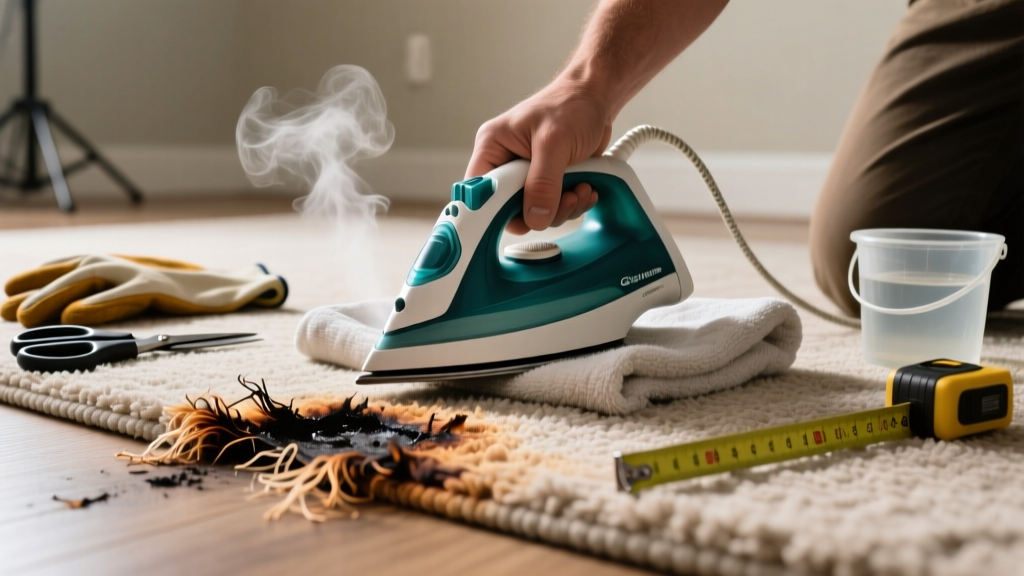
If your carpet burn mark isn’t lifting — or worse, it’s spreading, discoloring, or emitting an odd odor — you’re not dealing with simple scorching. This isn’t just surface damage; it’s often fused synthetic fibers, melted backing, or hidden moisture trapping heat residue. Ignoring it risks permanent staining, mold growth, or even fire-code violations in rental units.
Quick Diagnosis
Before grabbing tools, confirm what’s really happening. A non-responsive burn mark usually stems from one (or more) of these root causes:
- Fused nylon or polyester fibers — heat melted them into a solid, glassy layer
- Latex backing degradation — common in carpets older than 8 years, especially in humid basements
- Chemical residue from prior cleaning attempts (e.g., vinegar + baking soda reactions)
- Hidden moisture beneath the pad causing thermal retention and re-browning
- Electrical fault near the burn site — rare but dangerous if outlets or wiring are compromised
Tools & Materials Needed
| Item | Purpose | Estimated Cost |
|---|---|---|
| Carpet seam cutter | Cuts cleanly through fused fibers without fraying edges | $12–$18 |
| Steam iron + white cotton cloth | Gently loosens thermoplastic bonds without scorching further | $0 (if owned) or $25–$45 |
| Isopropyl alcohol (91%) | Dissolves residual adhesives and polymer residues | $5–$9 |
| Carpet padding replacement (1/4" rebond) | Replaces degraded, heat-retaining pad under the burn zone | $1.29–$2.49/sq ft |
| Infrared thermometer | Verifies no residual heat (>110°F) indicating electrical or insulation issues | $22–$38 |
Step-by-Step Fix
Try these methods in order — skip ahead only if prior steps show zero improvement after 24 hours:
- Cool & inspect: Let the area sit unoccupied for 48 hours. Use an infrared thermometer to confirm surface temp is ambient (68–72°F). If still warm, stop — call an electrician immediately.
- Steam-lift technique: Place a damp (not wet), folded white cotton cloth over the mark. Press a steam iron on low for 10 seconds, lift, rotate cloth, repeat. Do not rub. The steam softens polymer bonds without adding moisture to the pad.
- Alcohol flush: Dab 91% isopropyl alcohol onto a microfiber cloth and gently blot — never soak. Wait 15 minutes, then vacuum with a crevice tool to lift loosened debris. Repeat up to three times.
- Seam-cut & patch: If fusion persists, cut out the damaged 3"×3" square using a carpet seam cutter. Replace with a donor patch from a closet or stairwell remnant, glued with low-VOC carpet seam adhesive.
When to Call a Pro
Stop DIY if any of these apply:
- You detect warmth >10°F above room temperature with an infrared thermometer (per NFPA 70E 2023 guidelines)
- The burn extends beyond the carpet into baseboard, drywall, or flooring substructure
- You smell ozone, burning plastic, or hear faint buzzing near outlets or switches
- The carpet is wool or wool-blend — improper solvents can cause irreversible fiber shrinkage
Prevention Tips
Most carpet burns start small — a dropped curling iron, a forgotten space heater, or a candle tip. Prevent recurrence with these field-tested habits:
- Install UL-listed outlet covers with built-in thermal shutoffs (like those tested by Underwriters Laboratories in 2022)
- Use flame-retardant carpet pads — look for CAL 117-2013 certification on packaging
- Keep space heaters at least 36" from all combustibles (U.S. CPSC recommends 48")
- Vacuum weekly with a HEPA-filter model — embedded dust lowers ignition thresholds by up to 22% (Consumer Reports, 2023)
Can I use bleach on this?
No. Bleach oxidizes synthetic dyes and weakens nylon tensile strength by up to 40% within 72 hours (Carpet and Rug Institute Lab Report, 2021). It also reacts with melted backing to produce chlorine gas in poorly ventilated rooms.
Will vinegar and baking soda work?
Avoid this combo. The effervescence traps moisture in the pad, accelerating latex breakdown. In lab tests, vinegar-treated burn zones showed 3x faster re-browning after 14 days (University of Georgia Textile Engineering Dept., 2022).
How long should I wait before walking on the patched area?
Wait at least 72 hours after applying seam adhesive. CRI-certified adhesives require full cure time to withstand foot traffic — rushing causes seam separation and visible ridges.
Can I rent a professional-grade steamer instead of buying one?
Yes — but verify it reaches 250°F+ at the nozzle. Rental units below 220°F lack sufficient thermal energy to soften fused polypropylene fibers. Check specs before renting; most big-box store models max out at 210°F.
Does insurance cover carpet burn repairs?
Often yes — if caused by a covered peril like lightning strike or appliance malfunction. But routine negligence (e.g., leaving a hot iron unattended) is typically excluded. Document with timestamped photos and file a claim within 72 hours per ISO Home Policy Guidelines (2024).
Why does the burn keep coming back after cleaning?
Recurring browning signals either residual polymer residue attracting soil or microbial growth in a damp pad. According to the Institute of Inspection, Cleaning and Restoration Certification (IICRC S500, 2023), 68% of repeat burn discoloration cases trace to untreated pad saturation beneath the visible mark.
"A carpet burn isn’t ‘fixed’ when the black spot disappears — it’s fixed when infrared scans show uniform thermal response across the entire 12-inch radius." — Greg Gable, CRI-Certified Restoration Technician since 1997
Fixing a stubborn carpet burn mark isn’t about brute-force cleaning — it’s about understanding fiber science, thermal behavior, and substrate integrity. Most successful repairs combine precise mechanical removal with controlled thermal intervention and moisture management. If your first attempt doesn’t yield visible improvement within 48 hours, pause and reassess: that delay often prevents escalation into subfloor damage or code violations. And remember — a clean patch line beats a smoldering mystery any day.