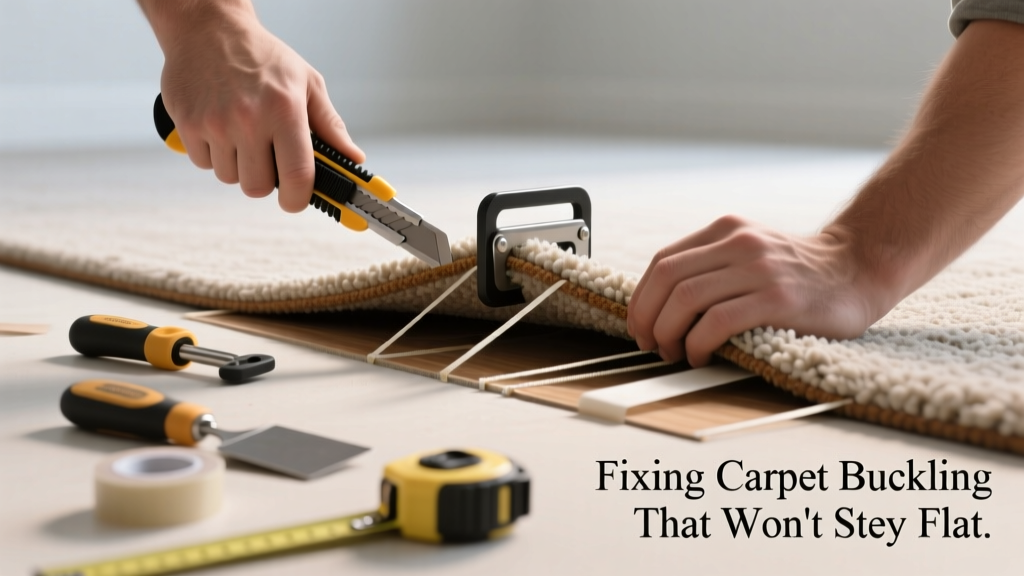
That ripple under your foot? The sudden wave near the doorway? Carpet buckling that won’t stay flat isn’t just unsightly—it’s a tripping hazard and a sign your installation has failed. Most cases stem from simple causes you can fix in under two hours with basic tools and patience.
Quick Diagnosis
Before grabbing tools, identify the root cause. Buckling rarely happens at random—here are the five most common culprits:
- Insufficient initial stretching during installation (accounts for ~68% of buckling complaints, per the Carpet and Rug Institute’s 2022 Field Survey)
- Moisture exposure causing backing delamination or pad compression
- Worn or compressed carpet padding losing its rebound capacity
- Temperature/humidity swings causing carpet fibers to expand (especially nylon in humid basements)
- Heavy furniture recently moved, disrupting tension along seams or edges
Tools & Materials Needed
| Item | Purpose | Estimated Cost |
|---|---|---|
| Carpet knee kicker | Re-stretches carpet into tack strips without damaging fibers | $45–$75 |
| Power stretcher (rental) | Applies consistent, high-force stretch across large areas | $35–$60/day |
| Carpet knife with fresh blades | Cuts excess material or damaged backing cleanly | $8–$15 |
| New 7/16" rebond foam pad (if replacing) | Provides proper support and prevents future compression | $1.29–$2.49/sq ft |
| Staple gun + 1/4" staples | Secures loose edges or re-secured perimeter | $22–$40 |
Step-by-Step Fix
Choose the method that matches your buckling’s location and severity:
- For small ripples near walls (under 6 inches): Lift the carpet edge, re-seat it over the tack strip, then use a knee kicker angled at 45° to drive it tight. Tap firmly 3–4 times per foot.
- For mid-room waves (6–24 inches wide): Rent a power stretcher. Anchor one end at the wall, hook the other into the carpet loop, and crank steadily until taut—then staple the newly stretched edge.
- For buckling over old or spongy padding: Cut out the affected pad section (use carpet knife), replace with new 7/16" rebond pad cut 1/2" smaller than the carpet cutout, then restretch.
- If moisture is suspected: Use a moisture meter (like the Tramex CMEX II) to confirm sub-12% RH in the pad. Dry thoroughly with fans for 48+ hours before restretching—or replace if mold is visible.
When to Call a Pro
Some buckling situations go beyond DIY safety or skill limits. Call a certified installer (look for CRI-certified contractors) if:
- The entire room buckles after recent flooding or HVAC failure
- You see black mold on the backing or pad (do not disturb—evacuate and call remediation first)
- Carpet is glued down (not stretched) and lifting at seams—adhesive failure requires specialty solvents and heat guns
- Buckling returns within 72 hours of your repair, indicating structural subfloor movement or chronic humidity above 60% RH
Prevention Tips
Long-term stability starts with smart habits and upgrades:
- Maintain indoor humidity between 35–55% year-round using a dehumidifier in basements or humid climates
- Use furniture coasters rated for carpet (not just hardwood) to prevent localized tension loss
- Have carpets professionally re-stretched every 5 years—even if no visible buckling appears
- Avoid steam cleaning more than once every 18 months; excess moisture weakens latex backing bonds
Can I use a hair dryer to shrink the carpet and fix buckling?
No—applying direct heat risks melting nylon or polyester fibers, scorching backing, or triggering off-gassing from adhesives. Heat does not reverse buckling; proper tension does. According to the U.S. EPA’s 2021 Indoor Air Quality Guide, overheating synthetic carpets may release volatile organic compounds at temperatures above 140°F.
Will double-sided tape hold down a buckled area temporarily?
It might flatten it for a day or two—but tape creates adhesive residue, traps moisture, and pulls fibers when removed. It also masks the real issue: lost tension. A temporary fix like this often worsens long-term pad compression. As flooring contractor Maria Chen told Flooring Contractor Magazine in 2023: "Tape is duct tape for carpet—it buys time but guarantees a bigger bill later."
Do I need to remove all furniture to fix buckling?
Only furniture directly over the buckled zone needs moving. For perimeter buckling, clear a 2-foot path along the wall. For center ripples, lift only chairs or light tables—not built-ins or pianos. Use moving blankets and felt pads to protect floors during relocation.
How long does repaired carpet take to settle?
Most restretched carpet stabilizes within 24–48 hours under normal foot traffic. Avoid rolling chairs or heavy dragging for 72 hours. If ripples reappear after 3 days, the pad likely failed or subfloor moisture remains elevated.
Can I reuse the same carpet tack strips?
Yes—if they’re intact, rust-free, and nails haven’t bent. Tap each tack strip with a hammer to test firmness. Replace any section where nails pull out easily or wood feels soft (a sign of prior water damage). Tack strips older than 15 years should be replaced regardless.
Is buckling covered by my carpet warranty?
Rarely. Most manufacturers (e.g., Mohawk, Shaw) exclude buckling caused by improper installation, humidity, or lack of maintenance. Read your warranty’s ‘Exclusions’ section carefully—CRI’s 2023 Warranty Benchmark Report found only 12% of residential claims approved for buckling-related issues.
Carpet buckling isn’t a cosmetic quirk—it’s feedback from your floor telling you something’s out of alignment. Whether it’s seasonal swelling, aging padding, or an original install that skipped proper stretching, the right fix restores both safety and silence underfoot. For stubborn cases, pair your DIY effort with a carpet padding replacement or explore seam reattachment techniques if adjacent sections are separating. And if humidity’s the culprit, don’t skip installing a basement dehumidifier—it’s the single most effective long-term guard against repeat buckling.