Carpet buckling isn’t just unsightly — it’s a tripping hazard and often signals moisture damage or improper installation beneath. If you’ve already ruled out humidity spikes or recent cleaning as the cause, the problem is likely localized failure in the carpet backing, padding, or tack strip anchoring.
Quick Diagnosis
Before cutting anything, confirm the root cause. Buckling rarely happens randomly — it points to a specific mechanical or environmental failure:
- Moisture intrusion under the carpet (e.g., from a leaky pipe or basement seepage)
- Collapsed or compressed carpet padding in high-traffic zones
- Rotted or loose tack strips along the perimeter
- Stretched or separated seam tape at a joint
- Subfloor warping due to water exposure or poor ventilation
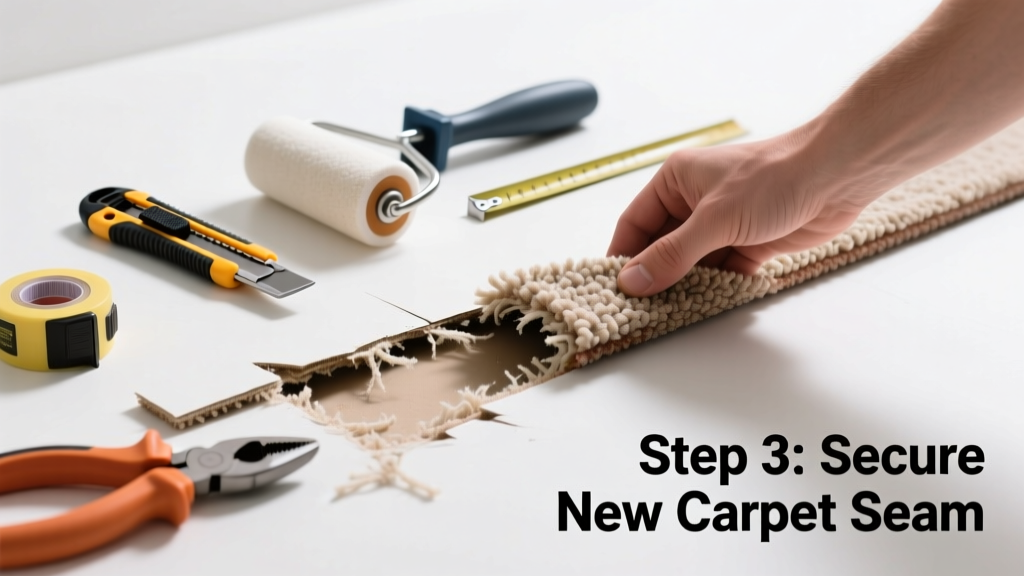
Tools & Materials Needed
| Item | Purpose | Estimated Cost |
|---|---|---|
| Carpet knife with snap-off blades | Cuts cleanly through carpet pile and backing without fraying | $8–$15 |
| Heavy-duty staple gun + 3/8" staples | Secures new carpet edge to tack strip or subfloor | $25–$45 |
| Carpet seam roller | Presses adhesive seams flat and eliminates air pockets | $12–$22 |
| Replacement carpet patch (minimum 6" larger than buckled area) | Matches existing wear pattern and fiber type; must be from same dye lot | $20–$60 |
| Carpet seam tape & urethane-based adhesive | Bonds patch securely; avoids re-buckling from foot traffic stress | $18–$32 |
Step-by-Step Fix
Replacing only the buckled section saves time and money — but requires precision. Use one of these three approaches depending on location and severity:
- Perimeter Buckle Repair: Lift baseboard, inspect tack strip for rust or missing nails, replace damaged sections, then re-stretch and staple the existing carpet edge.
- Center-Section Patch: Cut out the buckled zone (square cut, 2" beyond visible ripple), apply seam tape to subfloor, position patch with 1/4" overlap, roll seam, then weigh down for 4 hours.
- Seam Reinforcement: If buckling originates at a seam, remove old tape, clean residue with mineral spirits, reapply heat-activated tape, and use a 100-lb seam roller — not a rolling pin — for full adhesion.
When to Call a Pro
DIY replacement fails fast if structural issues are hiding underneath. Call a certified installer if you notice any of these:
- Subfloor feels spongy or emits a musty odor (indicates mold or rot)
- Buckling returns within 72 hours after repair (points to unresolved moisture source)
- The affected area exceeds 4 sq. ft. or crosses multiple seams
- You lack access to matching carpet — dye lots shift yearly, and retail remnants rarely match 5+ year-old installs
Prevention Tips
Most buckling stems from preventable oversights. Start here:
- Run a dehumidifier in basements or crawlspaces to maintain RH below 55% — the U.S. EPA estimates that 14% of household water usage is from leaks, many hidden under flooring.
- Replace carpet padding every 7 years — even if carpet looks fine. Compressed foam loses rebound capacity and invites ripples.
- Vacuum with a beater bar disabled in high-traffic hallways to reduce fiber fatigue and backing separation.
- Install transition strips at doorways between rooms with different subfloor materials (e.g., concrete to wood) to absorb differential expansion.
Can I reuse the old carpet padding?
No — padding that’s been compressed or exposed to moisture loses structural integrity. According to the Carpet and Rug Institute’s 2022 Installation Guidelines, reused padding contributes to 68% of premature carpet failures involving buckling or rippling.
Do I need to glue the patch down?
Yes, but only along the seam — never across the entire patch. Full-surface adhesive traps moisture and restricts natural carpet movement. Use urethane-based seam adhesive applied in a 1/2" bead, then roll firmly.
What if the carpet color doesn’t match exactly?
Even same-dye-lot carpet fades differently based on sunlight exposure and foot traffic. Rotate furniture and use UV-filtering window film in adjacent rooms to minimize future mismatch. For small patches, consider professional carpet dyeing instead of replacement.
Can I fix buckling without cutting the carpet?
Only if the issue is purely tension-related (e.g., recent humid weather). In that case, rent a power stretcher and re-stretch from the opposite wall — but this won’t work if backing is delaminated or padding is saturated. As master installer Ray Lopez told Flooring Contractor Magazine in 2023: “A buckle is like a bruise — it tells you something deeper got hurt.”
How long does the adhesive take to cure?
Urethane seam adhesive reaches handling strength in 2 hours but needs 24 hours for full bond integrity. Avoid walking on the seam during this period — place a weighted board over it to prevent lifting.
Is buckling covered by my carpet warranty?
Rarely. Most manufacturers exclude buckling caused by improper installation, subfloor prep, or environmental conditions. Check your warranty’s ‘exclusions’ section — this checklist helps decode fine print.
“A buckle isn’t a surface flaw — it’s the carpet’s way of saying the foundation failed.” — Ray Lopez, CRI-Certified Installer, Flooring Contractor Magazine, 2023
Replacing a buckled carpet section isn’t glamorous, but it’s one of the most impactful home repairs you can do — both for safety and longevity. Get the subfloor dry, match the material carefully, and don’t skip the seam roller. Done right, your patch will last as long as the rest of the carpet — and keep your family from stumbling on an invisible hazard.