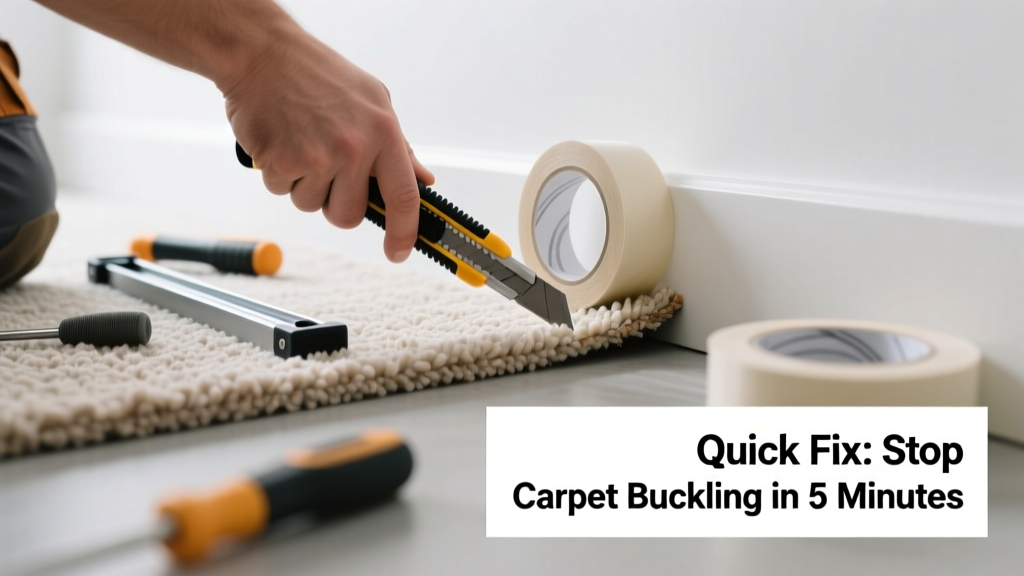
Kitchen carpet buckling isn’t just unsightly—it’s a tripping hazard and often signals hidden moisture or installation failure. Unlike living room carpet, kitchen carpet faces constant temperature swings, spills, and foot traffic that accelerate wear and distortion. If you’ve noticed ripples near the fridge or bulges by the sink, don’t ignore them.
Quick Diagnosis
Carpet buckling in kitchens rarely happens without cause. Here are the most frequent culprits:
- Moisture trapped under the carpet or pad from leaks, high humidity, or improper ventilation
- Improperly stretched installation—especially if tack strips were undersized or improperly nailed
- Subfloor movement due to seasonal expansion/contraction of plywood or particleboard
- Heavy appliance weight (e.g., refrigerator) compressing the pad unevenly over time
- Old or degraded carpet padding losing resilience—common after 5+ years
Tools & Materials Needed
| Item | Purpose | Estimated Cost |
|---|---|---|
| Carpet knee kicker | Re-stretches carpet tightly against tack strips without damaging fibers | $45–$75 |
| Carpet stretcher (power or manual) | Applies even tension across larger buckled areas | $60–$180 |
| Utility knife with fresh blades | Cuts excess carpet or damaged padding; precise trimming near cabinets | $8–$15 |
| Moisture meter (pin-type) | Confirms subfloor dryness before re-stretching—critical in kitchens | $35–$90 |
| Replacement foam padding (8-lb density) | High-density padding resists compression under appliances and resists moisture wicking | $1.25–$2.50/sq ft |
Step-by-Step Fix
Most kitchen buckling can be resolved in under two hours—if moisture and subfloor integrity check out. Follow these methods in order:
- Test for moisture: Use a pin-type moisture meter on the subfloor beneath the buckled area. Readings above 15% indicate active moisture—stop here and address the source first.
- Remove baseboards and appliances: Pull back toe-kick panels and slide the refrigerator out at least 18 inches. Remove baseboards along affected walls to access tack strips.
- Lift and inspect padding: Cut away buckled sections with a utility knife. Check for mold, compression, or dampness. Replace any padding showing discoloration or loss of thickness.
- Re-stretch using knee kicker and stretcher: Start at the farthest corner from the door. Use the knee kicker along walls, then run the power stretcher diagonally across the buckled zone. Secure edges with new nails every 4 inches into the tack strip.
- Trim and reinstall: Trim excess carpet flush with baseboard edges. Reattach baseboards and appliance panels—leave a ¼-inch gap behind cabinets for expansion.
When to Call a Pro
DIY stretching fails—and risks further damage—when:
- The subfloor feels spongy or flexes underfoot (sign of rot or delamination)
- Buckling returns within 72 hours of repair (indicates unresolved moisture or structural shift)
- You discover black mold on padding or subfloor (requires EPA-certified remediation per U.S. EPA Mold Remediation Guidelines, 2022)
- The carpet is glued down rather than stretched—removal requires solvent application and floor prep
"Over 60% of carpet failures in kitchens stem from undetected moisture—not poor installation." — Flooring Contractors Association, 2023 Field Survey
Prevention Tips
Stop buckling before it starts with these targeted strategies:
- Install a dehumidifier or exhaust fan rated for ≥100 CFM—kitchens generate up to 1.5 pints of moisture per hour during cooking (ASHRAE Standard 62.2-2022)
- Use only 8-lb density rebond padding—it compresses 30% less than standard 6-lb under appliance weight
- Place rubber-backed mats—not vinyl or plastic—under small appliances to allow airflow
- Inspect under-sink supply lines and dishwasher hoses every 6 months for micro-leaks
- Leave a ½-inch expansion gap between carpet edge and all cabinetry—never caulk or seal this gap
Can I use a steam cleaner on buckled kitchen carpet?
No. Steam adds moisture directly to the backing and padding, worsening buckling and encouraging mildew. Instead, spot-clean with a pH-neutral cleaner like Bissell SpotClean Pro and blot thoroughly with microfiber.
Will cutting out the buckle and gluing it down work?
Temporarily—but it creates a weak seam prone to fraying and lifting. Glued-down patches also trap moisture underneath. Always re-stretch or replace the full section.
How long does carpet padding last in a kitchen?
Typically 5–7 years in kitchens due to humidity, temperature swings, and appliance weight. Replace padding during any carpet replacement—even if the carpet looks fine. Degraded padding loses >40% of its rebound capacity after 5 years (Carpet and Rug Institute Lab Report, 2021).
Do I need to remove the entire carpet if only one corner is buckling?
Not necessarily. Isolated buckles near appliances or doors can often be fixed by re-stretching just that quadrant—provided the rest of the carpet lies flat and shows no signs of moisture or wear.
Can I reuse old tack strips?
Only if they’re straight, rust-free, and have intact pins. Bent or corroded strips won’t grip carpet properly and cause repeat buckling. Replace any strip showing more than 2 bent pins or surface pitting.
What’s the best carpet fiber for kitchens?
Nylon 6,6 with soil-resistant treatment (e.g., Stainmaster PetProtect). It withstands abrasion from chair casters, resists hydrolysis from humidity, and recovers 92% of pile height after compression—unlike polyester or olefin.
Carpet buckling in the kitchen is rarely random—it’s your flooring’s way of flagging a deeper issue. Address moisture first, stretch smartly, and invest in quality padding. A well-maintained kitchen carpet should stay taut for years, not months. If you’ve recently replaced your kitchen subfloor, double-check for proper acclimation before reinstalling carpet—unfinished plywood can swell up to 3% in high-humidity conditions.