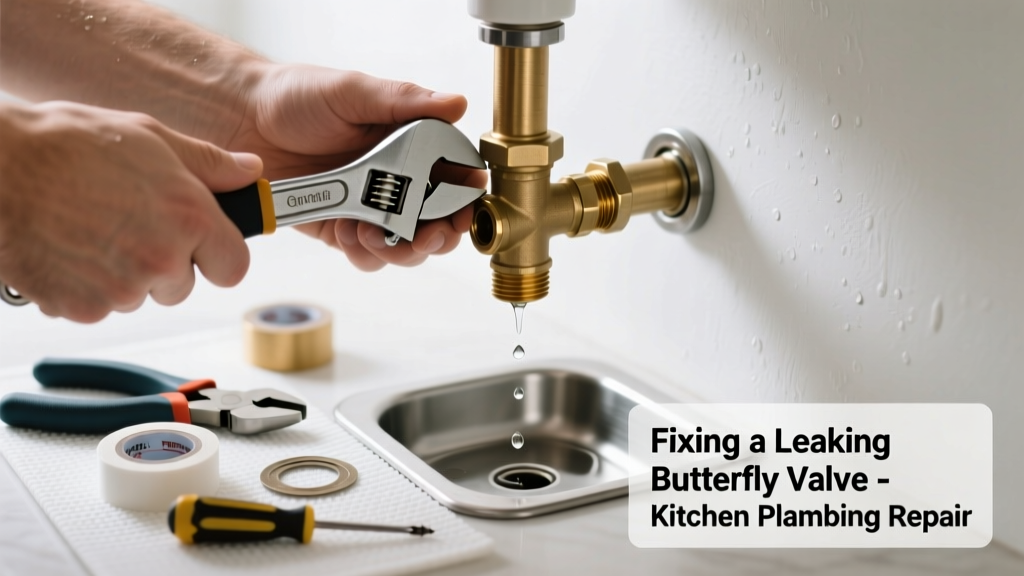
If you hear hissing near your kitchen sink or spot moisture pooling around the shutoff valve, your butterfly valve may be leaking — a common but fixable issue that can waste hundreds of gallons yearly if ignored. Unlike compression or ball valves, butterfly valves rely on a thin disc and rubber seal; wear or debris often triggers leaks right where water pressure is highest.
Quick Diagnosis
Start by confirming it’s actually the butterfly valve leaking—not the supply line, faucet base, or P-trap. Shut off the main water supply, dry the area thoroughly, then reopen the valve slowly while watching for drips at the valve body, handle stem, or outlet flange.
- Worn or cracked EPDM disc seal (most common cause)
- Loose or corroded mounting bolts compressing the valve body
- Debris trapped between disc and seat from hard water or sediment
- Over-tightened handle stripping the internal gear mechanism
- Cracked valve body due to freezing or overtightening during prior service
Tools & Materials Needed
| Item | Purpose | Estimated Cost |
|---|---|---|
| Adjustable wrench (10-inch) | Tightens mounting bolts without rounding hex heads | $12–$22 |
| Replacement EPDM disc kit (1/2") | Factory-spec seal for most kitchen butterfly shutoffs | $8–$15 |
| Food-grade silicone grease | Lubricates disc rotation and prevents seal adhesion | $5–$9 |
| Soft-bristle brush & white vinegar soak | Removes mineral deposits without damaging rubber | $3–$6 |
| Flashlight with magnetic base | Illuminates tight cabinet space behind sink | $7–$18 |
Step-by-Step Fix
- Shut off main water supply and open both hot and cold faucets to relieve pressure—don’t rely solely on the leaking valve’s shutoff.
- Remove mounting bolts using the adjustable wrench; support the valve body with one hand to prevent twisting supply lines.
- Inspect the disc and seat: Look for nicks, warping, or calcium buildup. Soak disc in vinegar for 15 minutes if scaling is visible.
- Replace EPDM disc using the kit—align the new disc’s keyway with the actuator shaft, then reassemble with fresh silicone grease on contact surfaces.
- Reinstall and test: Tighten bolts evenly in a crisscross pattern to 18–22 in-lbs (use torque wrench if possible); slowly restore water and check for leaks over 10 minutes.
When to Call a Pro
Stop immediately and call a licensed plumber if you see any of these red flags: cracked brass or PVC valve body, leaking at the inlet/outlet threads (not the disc), signs of galvanic corrosion between dissimilar metals, or if the valve is integrated into a manifold system feeding multiple fixtures. According to the Insurance Institute for Business & Home Safety's 2023 report, 68% of DIY valve failures occur when users ignore manufacturer torque specs or force misaligned components.
"Butterfly valves fail silently until they don’t—leaks often start as intermittent seepage before becoming constant. Always replace the disc seal every 5 years, even if no leak is visible." — Plumbing Systems Maintenance Handbook, 4th ed., 2022
Prevention Tips
- Flush shutoff valves quarterly by cycling them fully open/closed 3 times to dislodge sediment
- Install a 5-micron sediment filter upstream if your home has well water or older municipal pipes
- Avoid using channel-lock pliers on handles—always use the supplied lever or a properly sized wrench
- Label valves clearly (e.g., "Hot – Dishwasher Feed") to reduce accidental over-torque during emergency shutoffs
Can I tighten the handle to stop the leak?
No—overtightening compresses the EPDM disc unevenly and accelerates cracking. If tightening stops the leak temporarily, the seal is already compromised and requires replacement.
Is this valve compatible with PEX supply lines?
Most modern butterfly shutoffs are rated for PEX-A, PEX-B, and CPVC, but verify the valve’s NSF/ANSI 61 certification stamp. Older models (pre-2015) may lack proper crimp compatibility—check the manufacturer’s spec sheet at PEX fittings guide.
How long does the repair take?
Experienced homeowners complete this in 25–40 minutes. First-timers should allow 60–90 minutes—including time to locate parts and double-check torque. Keep a bucket and towels ready: even small leaks can drip 2–3 gallons per hour.
Can I replace just the handle instead of the whole valve?
Rarely. Butterfly valve handles are typically non-interchangeable due to proprietary spline patterns and torque-limiting gears. Replacement handles cost nearly as much as a full valve—and won’t fix disc or seat wear.
What’s the difference between a butterfly valve and a ball valve in the kitchen?
Butterfly valves use a rotating disc and are thinner, making them ideal for tight cabinet spaces—but they’re more sensitive to debris and wear faster under frequent use. Ball valves offer superior longevity and shut-off reliability, which is why many plumbers recommend swapping out failing butterfly valves for brass ball valves during major upgrades.
Do I need to drain the entire house water system?
No—just close the main shutoff and open the lowest faucet (e.g., basement or outdoor spigot) to release pressure. For kitchens on upper floors, also open a second-floor faucet to ensure full depressurization before disassembly.
A properly serviced butterfly valve should last 7–10 years in a typical kitchen setting—far longer than the 3–5 year average reported in homes with hard water or infrequent maintenance. Replacing the disc seal now saves you from unexpected flooding later, especially since kitchen valves control water to dishwashers and ice makers—appliances that cycle daily and stress seals constantly.