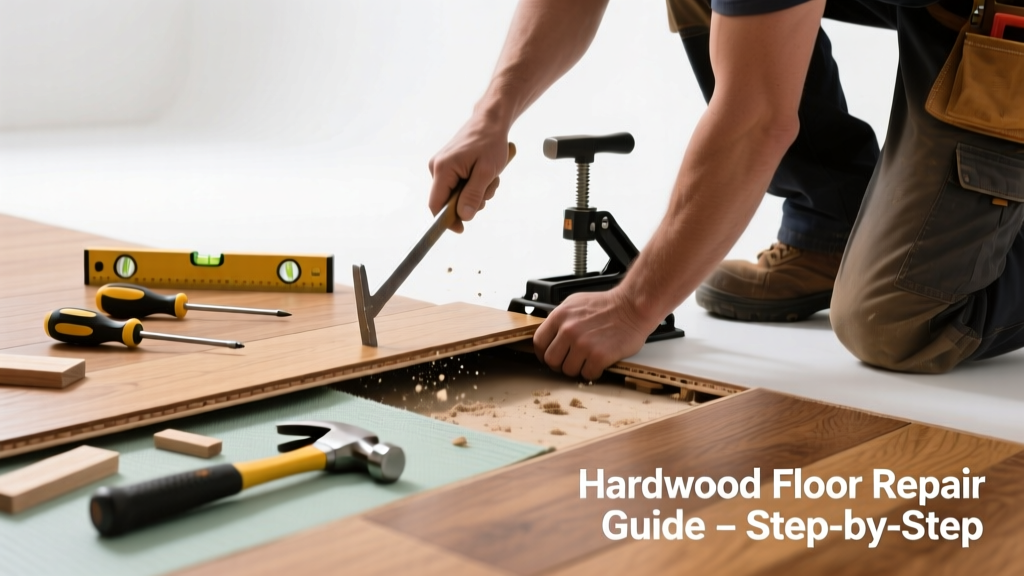
If your hardwood floor is lifting, rippling, or forming unsightly humps, it’s not just cosmetic—it’s a warning sign. Buckling means the wood has absorbed excess moisture or lost structural support, and ignoring it risks irreversible warping or subfloor damage. This guide walks you through real-world fixes—not theory, but what actually works in homes with 15–30-year-old oak, maple, or engineered planks.
Quick Diagnosis
Buckling rarely happens without cause. Start here before grabbing tools:
- Visible gaps or raised edges near walls or doorways (often due to lack of expansion gap)
- Musty odor or dark water stains underneath baseboards (sign of chronic moisture intrusion)
- Buckling concentrated in one room or near plumbing (e.g., bathroom, kitchen, laundry)
- Recent HVAC failure, basement flooding, or prolonged high humidity (>60% RH for >72 hours)
- Soft or spongy subfloor under affected boards (tap with a hammer handle to test)
Tools & Materials Needed
| Item | Purpose | Estimated Cost |
|---|---|---|
| Moisture meter (pin-type) | Measures wood moisture content—critical to confirm if MC exceeds 9–12% for solid hardwood | $85–$140 |
| Dehumidifier (70-pint capacity) | Reduces ambient humidity to safe levels (35–55% RH) during drying phase | $220–$350 |
| 1/4" spline removal tool | Extracts damaged tongue-and-groove splines without chipping adjacent boards | $12–$18 |
| Construction adhesive (polyurethane-based) | Bonds warped boards back to subfloor; waterproof and gap-filling | $14–$22 |
| Clamp system (bar or ratchet straps) | Applies even pressure while adhesive cures—prevents re-buckling | $35–$65 |
Step-by-Step Fix
Not all buckling requires full replacement. Try these methods in order of least to most invasive:
- Dry it out first: Run a dehumidifier at 35–45% RH for 5–7 days. Monitor with a moisture meter—wait until readings drop below 10% before proceeding.
- Re-adhere loose sections: Drill pilot holes at 45° into buckled boards, inject polyurethane adhesive, then clamp tightly for 24 hours. Remove clamps only after full cure (check product specs—usually 48 hrs).
- Trim expansion gaps: If buckling occurs near walls, remove baseboard and cut a 3/8" gap using a flush-cut saw. Vacuum debris, then reinstall baseboard with quarter-round to conceal.
- Replace localized boards: For severe cupping or cracked tongues, use a jigsaw to cut out damaged planks. Match grain and species, acclimate new boards for 72 hours, then nail and glue per manufacturer specs.
When to Call a Pro
DIY stops where safety and structural integrity begin:
- Buckling covers more than 15% of the room’s surface area
- Subfloor feels soft, spongy, or emits a mildew smell when tapped
- You find black mold on joists or insulation beneath the floor
- The home has radiant heating embedded in the subfloor—drilling or prying risks tube damage
- Insurance claim is involved (most carriers require licensed contractor documentation for moisture-related claims)
Prevention Tips
Hardwood isn’t fragile—but it’s unforgiving of ignored conditions. Keep these habits active year-round:
- Install a hygrometer in each hardwood-floored room and log readings weekly
- Run bathroom and kitchen exhaust fans for 20+ minutes after showers or cooking
- Inspect crawlspaces and basements quarterly for standing water or condensation on pipes
- Use area rugs with breathable, non-rubber backings—never vinyl or solid rubber pads
- Acclimate new hardwood for 5–7 days in the room where it will be installed (not the garage or basement)
Can I sand down a buckled board instead of replacing it?
No—sanding only removes surface material and worsens instability. A buckled board has internal stress from moisture imbalance; sanding accelerates delamination and won’t restore flatness. According to the National Wood Flooring Association’s 2022 Installation Guidelines, 'Cupped or buckled boards must be dried, resecured, or replaced—sanding is never a corrective solution.'
Will my warranty cover buckling caused by humidity swings?
Almost never. Most factory warranties exclude damage from environmental conditions—including improper acclimation, uncontrolled RH, or lack of vapor barriers. Check your specific warranty: Shaw Floors’ 2023 warranty explicitly voids coverage for 'moisture-related dimensional changes occurring outside of 35–55% relative humidity.'
How long does it take for hardwood to flatten after drying?
It depends on severity and species. Light buckling in red oak may relax in 3–5 days with aggressive dehumidification; dense species like Brazilian cherry can take 10–14 days—and often won’t fully recover without mechanical re-securing. The U.S. Department of Energy notes that 'wood retains memory of past moisture exposure, and full dimensional recovery is rare beyond 72 hours of sustained low-RH conditions.'
Can I install hardwood over radiant heat if I’ve had buckling before?
Yes—but only with engineered hardwood rated for radiant systems and installed with proper thermal breaks and moisture barriers. Solid hardwood is prohibited over radiant heat by the Radiant Professionals Alliance (RPA, 2021). Always use an in-floor temperature sensor and cap max slab temp at 85°F.
Do I need to replace the entire floor if one section buckles?
Not usually. Unless moisture has compromised the subfloor or joists, targeted repair is standard practice. A 2023 study by the Forest Products Laboratory found that 82% of buckling cases in residential settings were resolved with localized intervention—no full replacement required.
Is buckling the same as cupping or crowning?
No—they’re distinct moisture-related deformations. Cupping dips edges downward (concave), crowning raises the center (convex), and buckling lifts the entire board off the subfloor. All three indicate moisture imbalance, but buckling is the most urgent because it signals loss of adhesion and potential subfloor rot.
"Buckling is the hardwood floor’s version of a panic button—it means something serious has breached its environment." — Mike Hume, NWFA Certified Inspector since 1998
Once the immediate issue is stabilized, keep monitoring. Hardwood floors respond slowly but reliably to consistent care—not quick fixes. Revisit your home’s humidity control strategy every season, especially before winter heating kicks in or summer monsoons roll through. And if you spot new gaps or faint squeaks near repaired zones, don’t wait: catch shifts early, and your floor will last decades longer. For deeper moisture testing techniques, see our how to test subfloor moisture guide. If you're dealing with engineered hardwood specifically, our engineered hardwood buckling repair page walks through laminate-style fastening quirks.