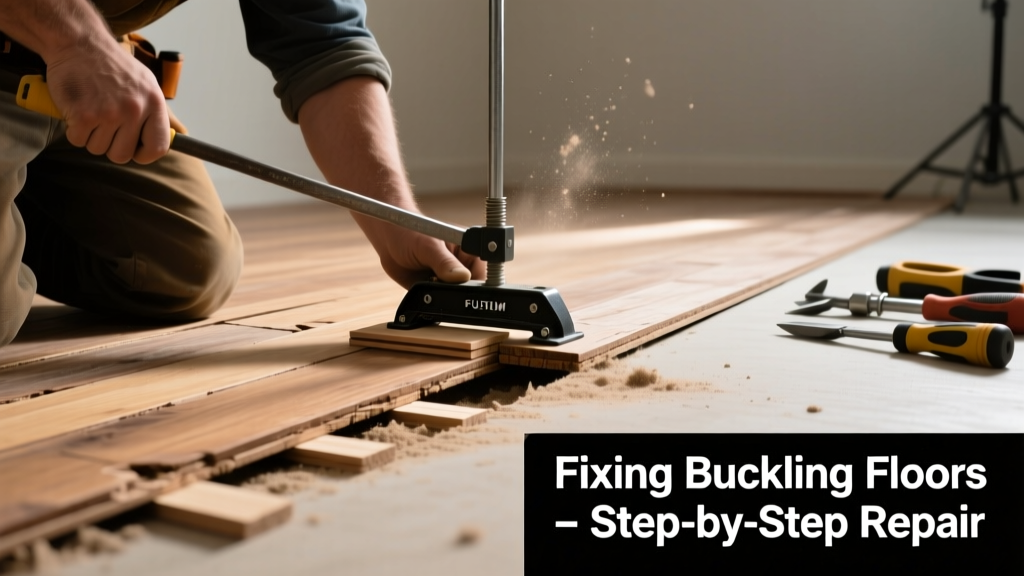
If your hardwood floor is buckling and making sharp pops, hollow thuds, or persistent creaks when you walk across it, that’s not just annoying—it’s a warning sign. These sounds often point to moisture imbalance, poor installation, or structural movement beneath the surface. Ignoring them can lead to permanent warping or costly replacement.
Quick Diagnosis
Start by ruling out the most likely culprits before reaching for tools:
- Moisture intrusion from leaks, high humidity (>60% RH), or improper acclimation before installation
- Gaps between boards or between boards and walls (less than 3/8" expansion gap)
- Loose or improperly fastened boards—especially near doorways or transitions
- Subfloor movement due to joist spacing over 16" on center or undersized OSB/particleboard
- Seasonal shrink-swell cycles in homes with no humidification in winter (RH drops below 30%)
Tools & Materials Needed
| Item | Purpose | Estimated Cost |
|---|---|---|
| Moisture meter (pin-type) | Measures wood moisture content; confirms if boards exceed 9–12% MC | $85–$140 |
| Shim pack (plastic or cedar) | Fills gaps under buckled boards without damaging finish | $8–$15 |
| Finish nailer + 18-gauge cleats | Secures loose boards discreetly along edges or tongue | $120–$220 (rental: $35/day) |
| Dehumidifier (50+ pint) | Lowers ambient humidity to stabilize wood (critical if MC >12%) | $180–$320 |
| Wood filler (water-based, stainable) | Seals minor surface gaps after stabilization—never use on active buckles | $12–$22 |
Step-by-Step Fix
Address the root cause—not just the noise. Try these methods in order of likelihood and severity:
- Check moisture levels first: Use a pin-type moisture meter on 10 random boards. If readings exceed 12%, run a dehumidifier for 72 hours and retest. According to the National Wood Flooring Association’s 2022 guidelines, hardwood should remain between 6–9% MC in most climates.
- Re-fasten loose boards: Locate squeaks by walking slowly with weight on heels. Drive 18-gauge cleats at a 45° angle into the tongue side near the wall (hidden by baseboard) or through the face at an angle into joists—only if board is flat and dry.
- Shim buckled edges: For boards lifting at one end (not full cupping), remove baseboard, gently tap down, and insert tapered cedar shims beneath the lifted edge. Secure with construction adhesive if gap exceeds 1/16".
- Relieve pressure at expansion gaps: If boards are tight against walls or cabinets, carefully cut a 3/8" gap using a flush-cut saw and vacuum debris. Never force boards apart with pry bars—they’ll splinter.
When to Call a Pro
DIY stops where safety, structure, or irreversible damage begins:
- You measure consistent moisture above 14% across multiple rooms—this suggests hidden plumbing leaks or foundation drainage issues
- Buckling affects more than three adjacent boards in a straight line or forms visible ridges taller than 1/8"
- The subfloor feels spongy, bounces, or emits musty odors—possible rot or mold per EPA mold assessment protocols (2021)
- You’re unable to locate joists with a stud finder, or floor joists are spaced 24" on center with 3/4" solid oak installed (undersupported)
Prevention Tips
Stabilize your environment and maintain proper clearances year-round:
- Install a whole-house humidifier (set to 35–45% RH in winter) and exhaust fans in bathrooms/kitchens
- Leave 3/8" expansion gaps at all vertical obstructions—check annually as gaps narrow in summer
- Acclimate new hardwood for 5–7 days in the room where it will be installed (per NWFA standards)
- Vacuum weekly with soft-bristle attachment—grit trapped under furniture legs accelerates wear and noise
- Avoid dragging heavy furniture; use felt pads and lift instead of slide
Why does my hardwood pop only in the morning?
Morning popping usually coincides with rapid temperature rise and low overnight humidity—causing boards to contract slightly then snap back into place as they warm. This is common in homes without humidification and points to seasonal stress, not structural failure. Monitor RH with a digital hygrometer like the ThermoPro TP50 (±2% accuracy).
Can I sand down a buckled board to flatten it?
No—sanding removes material unevenly and weakens the board’s structural integrity. It also exposes raw wood that won’t match the aged finish. Buckling is a symptom of moisture or movement; sanding treats only the surface. As flooring contractor Mark Delaney told Flooring Contractor Magazine in 2023: "Flattening a buckle with abrasives is like trimming a fever—ignores the infection."
Will nailing through the face damage my floor’s appearance?
Yes—if done carelessly. But using an 18-gauge finish nailer with a fine-tip guide and filling holes with matching wood putty yields nearly invisible repairs. Always test on scrap first. Face-nailing is acceptable only on boards with existing finish wear or in low-visibility areas like closets or under rugs.
How long does it take for buckled hardwood to recover after drying?
Most minor buckling (under 1/16" lift) resolves within 3–7 days of sustained RH control and moisture reduction. Severe cases (over 1/8") may require 2–4 weeks—and even then, some permanent deformation remains. The U.S. EPA estimates that 14% of household water usage is from leaks, many of which go undetected beneath flooring—so always rule out hidden sources first.
Do area rugs make buckling worse?
They can—especially thick, non-breathable pads that trap moisture and block airflow. Use natural-fiber pads (jute or felt) with rubber backing rated for hardwood, and lift rugs quarterly to inspect for discoloration or dampness. Avoid vinyl-backed pads entirely; they off-gas plasticizers that degrade finishes over time.
Is this problem covered by my home warranty?
Rarely. Most standard home warranties exclude flooring defects caused by environmental conditions (humidity, temperature swings) or lack of maintenance. However, if buckling appears within 12 months of installation and correlates with documented moisture intrusion from a covered system (e.g., failed water heater), file a claim with documentation—including moisture meter logs and installer records.
"Hardwood floors don’t fail randomly—they telegraph distress through sound, gap, and contour. A single pop isn’t urgent; a chorus means something’s shifting underneath." — Sarah Chen, Certified Master Floor Inspector, National Wood Flooring Association (2023)
Fixing buckling hardwood isn’t about silencing the noise—it’s about listening to what the floor is telling you. Once moisture, fastening, and environment are aligned, most floors settle back into quiet service. Keep a log of RH readings and board measurements twice yearly, and revisit your expansion gaps every spring and fall. That small habit prevents most repeat episodes—and saves you from replacing what you’ve already paid to install.