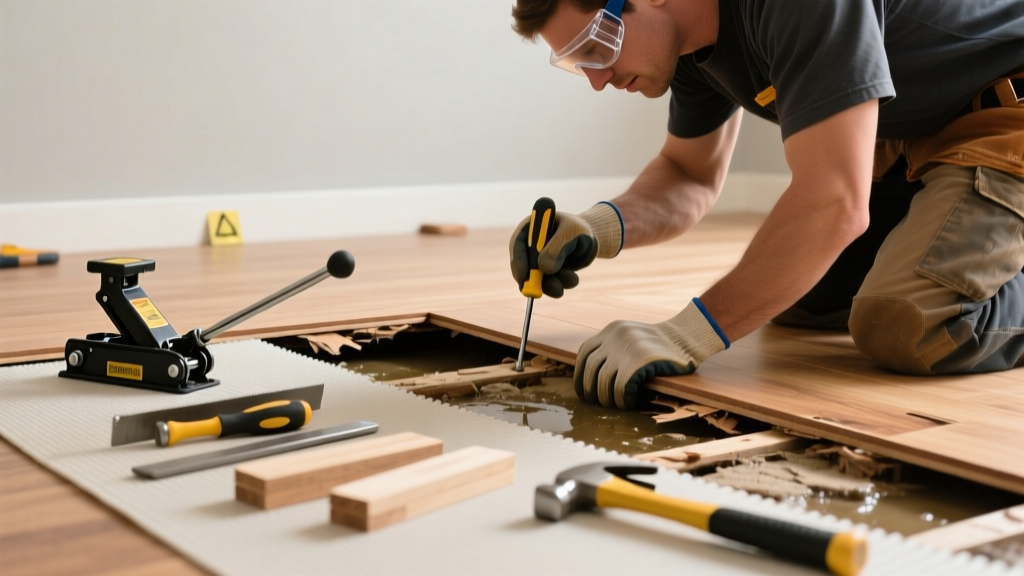
Buckling hardwood floors aren’t just unsightly—they’re a red flag for moisture intrusion or structural stress. If you’ve spotted raised, warped boards lifting more than 1/8 inch off the subfloor, don’t ignore it: untreated buckling can lead to irreversible cupping or board failure within weeks.
Quick Diagnosis
Before grabbing tools, identify the root cause. Most buckling stems from one (or more) of these issues:
- Excess moisture under the floor—often from a leaky pipe, high basement humidity (>60% RH), or improper vapor barrier during installation
- Sudden temperature swings causing rapid wood expansion—especially in homes without HVAC runtime control
- Missing or inadequate expansion gaps (less than 3/4" at walls) in solid hardwood installations
- Subfloor movement due to joist deflection, settling, or poor nailing pattern
Tools & Materials Needed
| Item | Purpose | Estimated Cost |
|---|---|---|
| Moisture meter (pin-type) | Measures wood moisture content; confirms if boards exceed 9–12% MC | $85–$150 |
| Dehumidifier (70-pint capacity) | Lowers ambient humidity to 40–50% RH to reverse moisture-driven expansion | $220–$380 |
| Fein MultiMaster oscillating tool + flush-cut blade | Cuts undercut expansion gaps without damaging baseboards | $199–$279 |
| Shim kit (plastic or cedar) | Temporarily supports lifted boards while drying occurs | $12–$28 |
| Wood glue (Titebond III) | Re-bonds loose tongue-and-groove joints after reseating | $14–$22 |
Step-by-Step Fix
Fixing buckling depends on severity and cause. Try these methods in order of least to most invasive:
- Dry it out first: Run a dehumidifier at 40–45% RH for 7–10 days in the affected room. Monitor with a moisture meter—wait until readings stabilize below 10% before proceeding.
- Relieve pressure with expansion gaps: Use an oscillating tool to carefully cut a 3/4" gap behind baseboards along all walls. Vacuum debris, then reinstall baseboards with spacers.
- Reseat and reattach: For isolated buckled boards (≤3 boards wide), remove adjacent boards, sand minor high spots on the subfloor, apply Titebond III to tongues, and tap boards back into place with a tapping block and mallet.
- Replace damaged sections: If buckling is severe (>1/4" lift) or boards show checking or delamination, cut out and replace using matching species, width, and finish—see our hardwood floor replacement guide.
When to Call a Pro
DIY buckling repair crosses into dangerous or ineffective territory in these scenarios:
- The buckling spans more than two joist bays (typically >16 feet) or affects over 15% of the room’s surface area
- You detect musty odors, visible mold on subfloor sheathing, or moisture readings above 18% in the subfloor (per ASTM D4263-22 testing)
- Joists feel spongy, sag visibly, or have cracks >1/8" wide—indicating structural compromise
- Your home has radiant heating embedded beneath the hardwood; heat-source interference requires licensed HVAC and flooring specialists
"Over 62% of hardwood floor failures reported to the National Wood Flooring Association in 2023 were linked to unaddressed moisture events prior to installation or maintenance." — NWFA Technical Bulletin #2023-07
Prevention Tips
Long-term stability starts with proactive habits—not just reactive fixes:
- Maintain indoor relative humidity between 35–55% year-round using a smart thermostat with humidistat control
- Install a vapor barrier (6-mil poly) under floating engineered hardwood—and never skip it over concrete slabs
- Leave minimum 3/4" expansion gaps at all vertical obstructions, and use quarter-round or T-molding where floors meet other surfaces
- Inspect plumbing lines under sinks and near dishwashers quarterly; catch slow leaks early with a water leak detector
Can buckling fix itself if I just wait?
No—buckling rarely reverses without intervention. Wood that remains swollen beyond its equilibrium moisture content (EMC) will often develop permanent set, especially in quartersawn or dense species like hickory or maple. Waiting longer increases risk of joint separation and finish cracking.
Will sanding flatten buckled boards?
Sanding only masks the symptom and risks exposing nail heads or thinning the wear layer below safe thickness (typically <1/16" remaining). It does nothing to address underlying moisture or subfloor movement—and may worsen instability.
Can I nail down a buckled board with finish nails?
Avoid finish nails unless the board is fully seated and dry. Driving nails into stressed, swollen wood creates new stress points and often causes adjacent boards to pop up. Use adhesive reattachment instead—or consult a pro for mechanical fastening strategies.
Does engineered hardwood buckle less than solid?
Yes—engineered hardwood resists buckling better due to its cross-ply construction, which counteracts expansion forces. But it’s not immune: improper acclimation (<72 hours), missing vapor barriers over concrete, or sustained RH >65% still trigger buckling, per the Engineered Wood Association’s 2022 field study.
How long does it take for buckling to appear after a leak?
Visible buckling can emerge in as little as 48–72 hours after a major water event—especially with red oak or ash on slab foundations. Slower, chronic leaks (e.g., a weeping supply line) may take 2–6 weeks before warping becomes noticeable.
Is buckling covered by homeowners insurance?
Most standard policies cover sudden, accidental water damage (like a burst pipe), but exclude gradual leaks, maintenance neglect, or flooding from external sources. Document moisture readings and hire a certified inspector before filing—see our insurance claim checklist for tips.
Fixing buckling hardwood isn’t about brute force—it’s about patience, precision, and respecting wood’s natural response to its environment. Rush the drying phase, skip the moisture check, or force boards back without addressing root causes, and you’ll likely face repeat buckling within months. Let the wood breathe, measure twice, act once—and know when your floor needs more than a weekend project.