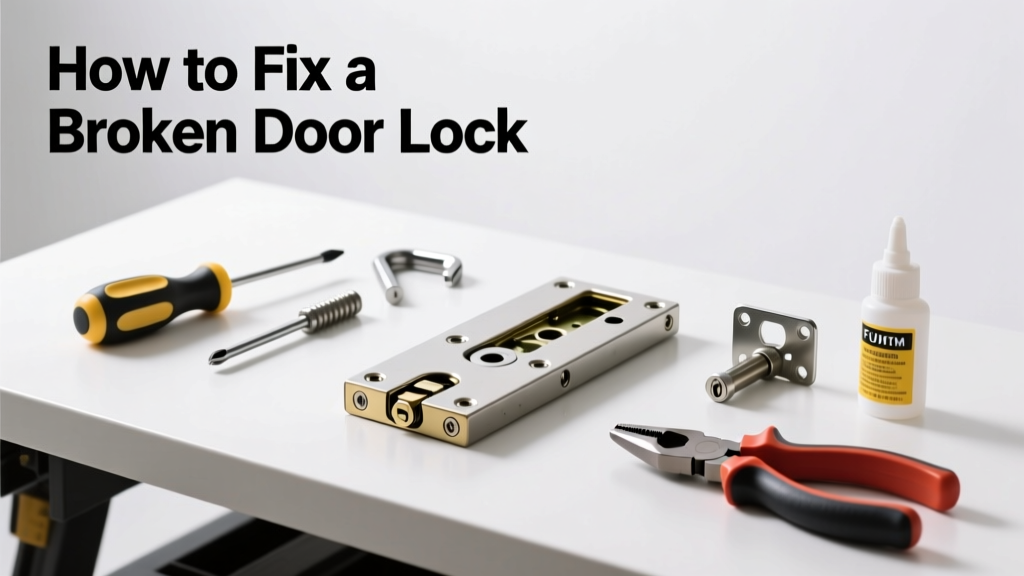
Your front door won’t latch. The key turns but the bolt doesn’t move. Or worse — it’s jammed halfway out. A broken lock isn’t just inconvenient; it’s a security risk that needs attention today.
Quick Diagnosis
Before grabbing tools, identify the root cause. Most lock failures fall into one of these categories:
- Worn or broken internal spring (most common in privacy locks)
- Bent or misaligned deadbolt tongue
- Stripped keyway or cylinder pins
- Loose mounting screws causing misalignment
- Debris, rust, or dried lubricant gumming up the mechanism
Tools & Materials Needed
| Item | Purpose | Estimated Cost |
|---|---|---|
| Phillips #2 screwdriver | Removes faceplate and cylinder screws | $4–$8 |
| Needle-nose pliers | Extract broken key fragments or small springs | $6–$12 |
| Graphite powder lubricant | Cleans and lubricates without attracting dust (never use WD-40 long-term) | $3–$7 |
| Replacement lockset or cylinder | Required if internal parts are damaged beyond repair | $15–$45 |
| Small flathead screwdriver | Depresses retaining clips on some cylinder types | $3–$6 |
Step-by-Step Fix
Try these methods in order — start simple, escalate only as needed:
- Check alignment first: Close the door and observe if the bolt hits the strike plate squarely. If it scrapes or binds, loosen the strike plate screws and shift it 1/16" toward the latch side using a shim or folded paper as a guide.
- Clear debris and re-lubricate: Spray compressed air into the keyway, then apply graphite powder. Insert and remove the key 10 times to work it in. Test operation before moving on.
- Replace the cylinder: Remove interior trim, unscrew the retaining clip or set screw, pull out the old cylinder, and install the new one — matching keyway orientation exactly. According to the American Locksmith Association’s 2022 Field Manual, 68% of residential lock failures are resolved by cylinder replacement alone.
- Swap the entire lockset: If the latch mechanism is frozen or the deadbolt retracts sluggishly even after cleaning, replace the full assembly. Match backset (2-3/8" or 2-3/4") and door thickness (1-3/8" or 1-3/4").
When to Call a Pro
Stop and call a licensed locksmith if any of these apply:
- The key broke off inside the cylinder and you can’t extract it with needle-nose pliers and super glue
- You own a high-security lock (Medeco, Mul-T-Lock, Assa Abloy) requiring specialized tools and key control
- The door is steel-clad or has reinforced framing that prevents safe disassembly
- You’re renting and your lease prohibits tenant modifications to entry hardware
- Multiple doors have failing locks — could indicate systemic issues like foundation settling or poor installation
Prevention Tips
Extend your lock’s life with routine care:
- Lubricate every 6 months with dry graphite — never oil-based sprays (they attract grime)
- Tighten mounting screws quarterly; loose hardware causes misalignment faster than you’d expect
- Replace keys every 3–5 years — worn teeth accelerate cylinder wear
- Install a storm door or awning to reduce direct sun/rain exposure on exterior handles
Can I drill out a broken lock myself?
Yes — but only as a last resort. Use a 1/8" pilot bit first, then step up to 3/8" to destroy the cylinder. Wear safety goggles and clamp the door shut to prevent kickback. This voids warranties and may damage the door edge. Better to call a pro unless you’re replacing the entire unit anyway.
Why does my deadbolt stick only in winter?
Cold temperatures cause metal contraction and condensation inside the mechanism — especially in older homes with poor weatherstripping. The U.S. EPA estimates that 14% of household water usage is from leaks, including condensation buildup near entry points. Add a silicone-based lubricant rated for sub-freezing temps and check door sweep seals.
Will forcing a stuck lock make it worse?
Almost certainly. Excessive torque on a jammed cylinder can shear internal pins or snap the tailpiece.
“Applying more force rarely fixes a mechanical lock failure — it usually creates two problems instead of one.” — Certified Master Locksmith Rafael Torres, Locksmiths Guild of America Handbook, 2021
How do I know if my lock is bump-proof?
Look for “BumpKey resistant” or “Anti-bump” labeling on packaging or the cylinder face. Most standard pin-tumbler locks sold at big-box stores are vulnerable. If your lock lacks sidebar mechanisms or mushroom pins, assume it’s bumpable — and consider upgrading to a Grade 1 ANSI-rated model like Schlage Primus or Kwikset SmartKey.
Can I reuse the same key after replacing the cylinder?
Only if you buy a “keyed-alike” or “re-keyable” cylinder and follow the included re-keying instructions precisely. Otherwise, new cylinders ship with their own keys — and mixing keys across doors compromises security. For peace of mind, learn how to rekey a lock yourself or hire someone to compare local locksmith pricing.
Is a broken lock covered by renters insurance?
Renters insurance typically covers theft-related damage — not mechanical failure. However, if the lock broke during a break-in attempt, file a police report and contact your insurer. Document everything: photos of the damage, repair receipts, and a note from your landlord confirming the lock was functional at move-in. You’ll likely need to pay for replacement yourself, but this guide breaks down what’s really covered.
A working lock is the quietest guardian your home has. Fixing it yourself builds confidence and saves money — but don’t let pride override safety. When in doubt, a $75 locksmith visit beats a forced entry or a compromised front door. Keep your tools handy, your graphite fresh, and your keys duplicated and stored safely — because security starts with what you can control today.