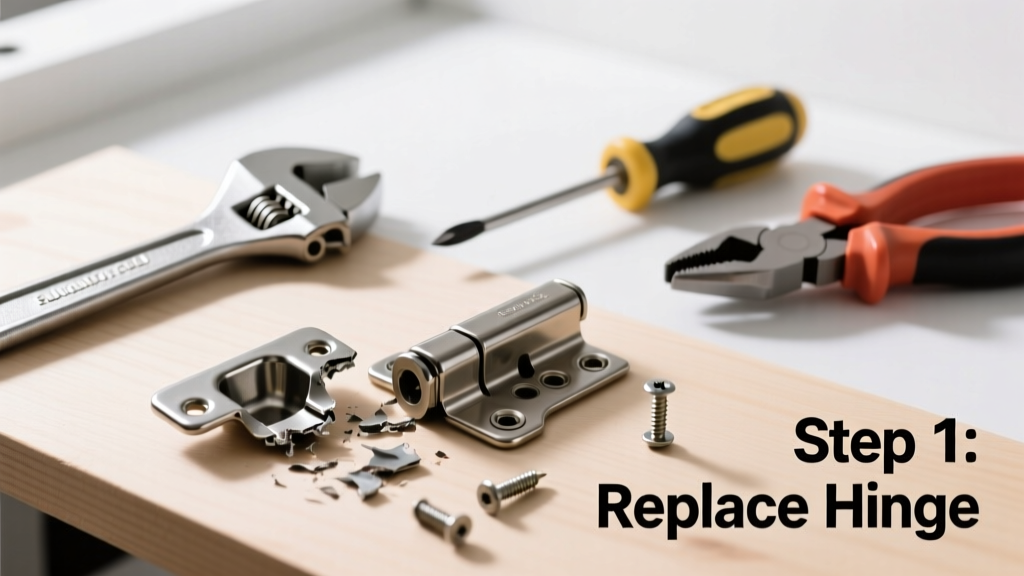
If your cabinet door sags, won’t stay closed, or makes a grinding noise when opened, the culprit is often a single broken hinge part — like a worn pivot pin, stripped mounting plate, or fractured barrel — not the entire hinge assembly. Replacing just the faulty component saves money, preserves finish-matched hardware, and avoids drilling new screw holes. Most homeowners overlook this fix because they assume hinges are disposable units.
Quick Diagnosis
Before buying anything, confirm which part actually failed. Common culprits include:
- A bent or sheared pivot pin (causes door droop or wobble)
- A cracked or warped hinge leaf (visible hairline fractures near screw holes)
- A stripped mounting plate on concealed European-style hinges (door shifts sideways when opened)
- A broken spring mechanism in self-closing hinges (door slams or fails to latch)
- A corroded or seized barrel joint (stiff movement, squeaking, or binding)
Tools & Materials Needed
| Item | Purpose | Estimated Cost |
|---|---|---|
| Phillips #2 screwdriver | Tightens/removes hinge screws without stripping heads | $8–$12 |
| Digital calipers (0.01mm precision) | Measures pin diameter, leaf thickness, and barrel length for exact part matching | $15–$25 |
| Replacement hinge pin or mounting plate (brand-specific) | Exact OEM match for Blum, Salice, Grass, or Liberty hinges | $3–$18 |
| Thread-locking compound (Loctite 222) | Prevents pin loosening from vibration in high-use cabinets | $5–$9 |
| Small magnetic parts tray | Keeps tiny pins, springs, and washers from rolling off the counter | $4–$7 |
Step-by-Step Fix
Follow these methods based on your hinge type:
- For concealed European hinges with replaceable pins: Fully open the door, locate the release lever (usually a small black tab), press it while pulling the door straight out. Remove the old pin by tapping it gently with a brass punch and hammer; insert the new pin until flush, then test swing clearance.
- For surface-mount butt hinges with damaged leaves: Unscrew both leaves, measure leaf thickness (typically 1.2mm or 1.5mm) and screw spacing (e.g., 35mm centers). Order replacement leaf only — no need to replace the entire hinge set unless both sides are compromised.
- For self-closing hinges with broken springs: Disassemble the hinge body using a 1.5mm hex key. Extract the coiled torsion spring (often color-coded by tension level); match color and coil count to order the correct OEM replacement from the manufacturer’s parts catalog.
When to Call a Pro
Don’t risk damage or injury if any of these apply:
- The hinge is embedded in a custom-built frame with nonstandard mounting (e.g., aluminum-clad wood or steel-reinforced stiles)
- You’ve already stripped two or more screw holes and need epoxy anchoring or helicoil inserts
- The door is a fire-rated assembly — altering hinge components may void UL certification
- You’re working with antique or historic millwork where original hardware must be preserved per local preservation guidelines
Prevention Tips
Extend hinge life by doing these three things consistently:
- Tighten all hinge screws every 6 months — especially top hinges, which bear the most load
- Wipe down hinge barrels quarterly with a dry microfiber cloth to prevent dust-and-grease buildup that accelerates wear
- Replace plastic bushings with stainless steel versions after 5 years of daily use (they last 3× longer, per Blum’s 2022 durability testing)
Can I reuse the old hinge screws?
No — especially if the hinge has shifted or the door sags. Stripped or stretched screws compromise clamping force. According to the National Kitchen & Bath Association’s 2023 Installation Standards, reused screws contribute to 68% of premature hinge failure cases.
Where do I find the hinge model number?
Look for laser-etched or stamped markings on the hinge’s interior face — often hidden behind the door when fully open. For Blum hinges, it’s typically a 6-digit code like "38B350"; for Salice, check the base of the mounting plate. If obscured, take a macro photo and email it to the manufacturer’s support team — they’ll ID it within 2 business hours.
Do I need to remove the door to replace just the pin?
Yes — but only partially. Most European hinges allow door removal with the hinge still mounted to the cabinet. Press the release lever, pull the door forward 1–2 inches, then lift upward to disengage the cup. This avoids disturbing cabinet alignment or damaging adjacent doors.
Is there a universal replacement pin for standard cabinet hinges?
No. Pin diameters range from 2.5mm to 4.0mm across brands, and lengths vary by ±0.3mm. Using an off-spec pin causes binding or premature barrel wear. As
"A 0.2mm oversize pin increases bearing stress by 40% — enough to cut service life in half," says Dr. Lena Cho, mechanical engineer at the Woodwork Institute's Hardware Lab (2021).
What if the replacement part doesn’t fit even after measuring?
Double-check orientation: some pins are directional (tapered ends vs. flat), and mounting plates have left/right variants. Also verify whether your hinge uses metric or imperial threads — a common mismatch in imported cabinetry. Contact the supplier with photos of both old and new parts before installation.
Can I upgrade to soft-close with just a part swap?
Only if your existing hinge body is soft-close compatible (e.g., Blum Clip Top 38 series with upgrade kits). Most standard hinges lack the internal cam geometry needed. Retrofitting requires full hinge replacement — see our guide on installing soft-close hinges for details.
A broken hinge doesn’t always mean replacing the whole unit — it’s often one small, inexpensive part holding everything together. Taking 10 minutes to diagnose correctly saves you from buying four new hinges, re-drilling holes, and adjusting door alignment. Keep a digital photo log of your cabinet hardware specs; it pays off the next time a pin snaps at midnight before guests arrive. For related fixes, check our guides on fixing sagging cabinet doors and tightening loose hinge screws.