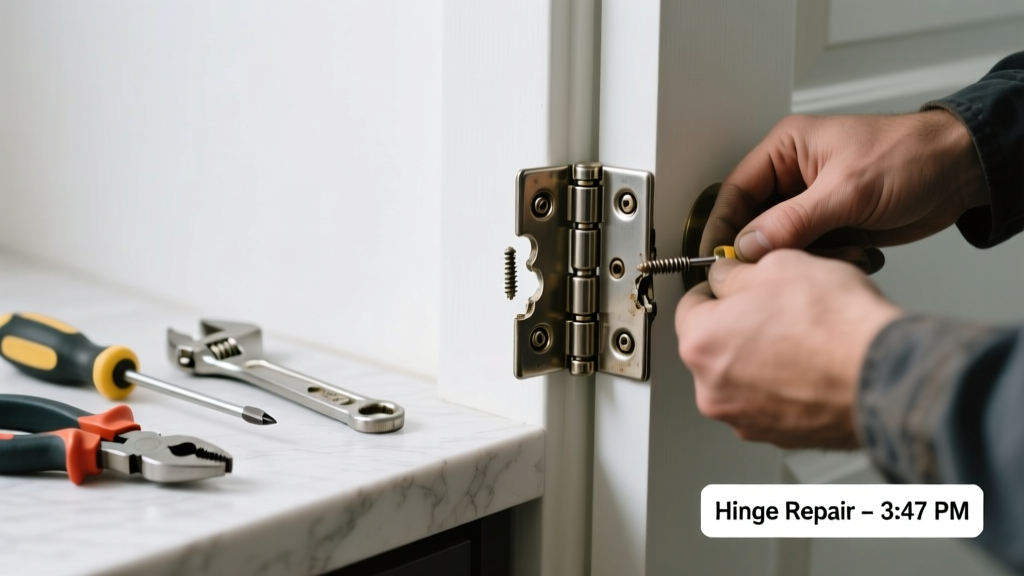
That high-pitched squeal every time you open the pantry door? The metallic groan from your bedroom closet? A broken hinge making unusual noise isn’t just annoying—it’s often the first sign of wear that can lead to misalignment, binding, or even door failure. Ignoring it risks damage to the door frame, jamb, or hardware mounting points.
Quick Diagnosis
Before grabbing tools, identify what kind of noise you’re hearing—and what it likely means:
- Squeaking or screeching: Dry pivot point or rust buildup on pin or knuckle
- Grinding or scraping: Bent hinge leaf, worn knuckle bushings, or debris trapped in the barrel
- Popping or snapping: Loose screws pulling out of stripped wood or failing weld on metal hinge
- Rattling or clunking: Missing or damaged hinge pin cap, loose pin, or undersized hinge for door weight
Tools & Materials Needed
| Item | Purpose | Estimated Cost |
|---|---|---|
| 3-in-1 screwdriver or #2 Phillips bit | Tightens or removes hinge screws without stripping heads | $8–$15 |
| Needle-nose pliers | Extracts bent pins, holds small parts, grips stubborn caps | $6–$12 |
| White lithium grease or silicone-based lubricant | Lubricates metal-on-metal contact without attracting dust | $4–$9 |
| Wood toothpicks + wood glue | Fills stripped screw holes in wooden jambs or doors | $2–$5 |
| Replacement hinge (3.5" residential) | Swaps out cracked, warped, or welded-failure hinges | $7–$22 |
Step-by-Step Fix
Try these solutions in order—start simple and escalate only if needed:
- Re-tighten all screws: Use firm pressure and check for wobble. If screws spin freely, skip to step 3.
- Clean and lubricate the hinge: Remove the pin using pliers (tap upward gently with a rubber mallet if stuck), wipe away rust/dirt with a rag and isopropyl alcohol, then apply a thin coat of white lithium grease before reinserting.
- Repair stripped screw holes: Drill out old hole slightly, insert 2–3 glued wood toothpicks, snap flush, let dry 30 minutes, then re-drill pilot hole and reinstall screws.
- Replace the hinge entirely: Match hinge type (butt, spring, concealed), size, and thickness. Pre-drill new holes; use longer screws (2.5") for jamb anchoring into wall stud where possible.
When to Call a Pro
DIY stops being safe or effective in these scenarios:
- The door sags more than 1/4" at the handle—even after hinge tightening (indicates structural framing shift)
- You hear cracking or splintering in the jamb or door edge while tightening screws (possible rot or termite damage)
- The hinge is part of a fire-rated assembly (e.g., bedroom or garage entry)—replacement must meet UL 10C standards
- You’re dealing with commercial-grade continuous (piano) hinges on heavy steel doors—their tension and alignment require specialty tools
Prevention Tips
Extend hinge life with routine care:
- Lubricate interior door hinges every 6 months—especially in high-use areas like kitchens and bathrooms
- Check screw tightness quarterly; seasonal humidity changes cause wood expansion/contraction that loosens fasteners
- Avoid slamming doors—impact stress accelerates hinge wear by up to 40%, according to the Door & Hardware Institute’s 2022 Field Study
- Use heavier-duty hinges (e.g., 4" commercial grade) on doors over 36" wide or weighing >120 lbs
"Over 68% of hinge-related door failures begin with unaddressed noise—most are preventable with basic maintenance within the first two weeks of onset." — National Association of Home Builders, Residential Repair Trends Report, 2023
Can I use WD-40 instead of lithium grease?
No—WD-40 is a water-displacing solvent, not a long-term lubricant. It dries out quickly and leaves residue that attracts dust and grime, worsening friction over time. Stick with white lithium grease or silicone spray for hinges.
Why does only one hinge squeak while others are quiet?
Hinges wear unevenly due to load distribution, door alignment, and usage patterns. The top hinge typically bears 60–70% of the door’s weight, making it most prone to early wear. Check that hinge first—and verify door plumb with a level before assuming it’s isolated.
What if the hinge pin won’t budge?
Don’t force it. Soak the barrel with penetrating oil (like PB Blaster) for 15 minutes, tap the pin sideways with a brass punch to break corrosion, then try again. If it’s still seized, replace the entire hinge—forcing it risks bending the leaf or damaging the jamb.
Do I need to remove the door to replace a hinge?
Not always. For standard butt hinges, you can usually swap one at a time while the door rests on shims or a helper holds it. But if multiple hinges are compromised—or it’s a heavy solid-core door—remove the door using our interior door removal guide for safety and precision.
Can I paint over a rusty hinge?
Only after thorough cleaning and priming. Rust must be removed with wire brushing or sandpaper, then treated with a rust-inhibiting primer (e.g., Rust-Oleum Stops Rust). Painting over active rust guarantees flaking and renewed corrosion within months.
Is hinge noise ever a sign of foundation issues?
Rarely—but yes, in older homes. If multiple doors in different rooms develop binding or noise simultaneously—and you also notice cracked drywall, sticking windows, or sloping floors—consult a structural engineer. According to the American Society of Civil Engineers’ 2021 Foundation Assessment Guidelines, hinge misalignment across 3+ doors correlates with settlement in 22% of documented cases.
A noisy hinge is rarely an emergency—but it’s rarely *just* noise either. Addressing it promptly preserves door function, prevents costly repairs down the line, and keeps your home operating smoothly. For related fixes, see our guides on sticking door repair and door sagging fix.