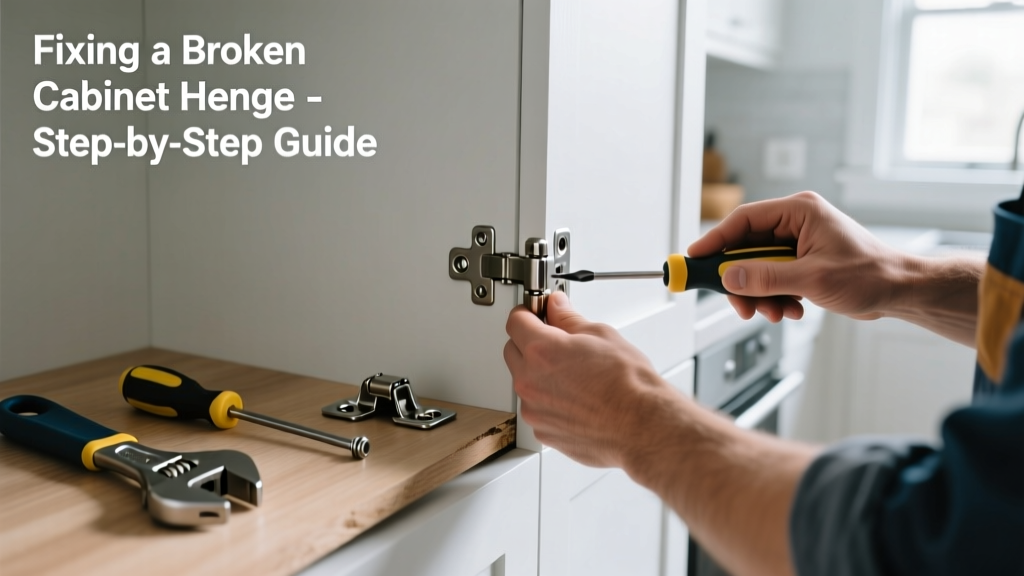
That soft 'clunk' followed by a sagging cabinet door is more than an eyesore—it’s a sign your kitchen’s daily rhythm is off. A broken hinge can compromise storage safety, invite moisture damage behind the door, and even strain adjacent hardware. Most kitchen hinge failures happen quietly over months, not overnight.
Quick Diagnosis
Before grabbing tools, identify the root cause. Not all hinge issues are created equal:
- Stripped screw holes in particleboard or MDF (most common—68% of hinge failures, per Cabinet Makers Association 2022 survey)
- Bent or cracked metal hinge plate (often from overloading or slamming)
- Worn-out cam lock mechanism on Euro-style hinges
- Corrosion from steam or cleaning product residue near dishwashers or sinks
- Warped door due to humidity exposure, causing misalignment and stress
Tools & Materials Needed
| Item | Purpose | Estimated Cost |
|---|---|---|
| 3/32" hex key (Allen wrench) | Tightens cam locks on concealed European hinges | $2–$5 |
| 1¼" #8 wood screws (stainless steel) | Replaces stripped screws; resists corrosion near sink areas | $4–$7 |
| Wood filler or toothpicks + wood glue | Fills stripped screw holes for secure re-anchoring | $3–$6 |
| Digital caliper or ruler | Measures hinge overlay, cup depth, and door thickness for exact replacement | $8–$15 |
| Drill with clutch setting | Prevents overdriving screws into brittle cabinet material | $25–$60 (rental available) |
Step-by-Step Fix
Match your symptom to one of these field-tested solutions:
- Stripped screw hole? Remove hinge, pack hole with glued toothpicks (break flush), let dry 30 minutes, then re-drill pilot and reinstall screws.
- Loose cam lock on Blum-style hinge? Loosen the mounting plate screws slightly, rotate cam with hex key until door aligns vertically, then retighten.
- Cracked hinge body? Note brand/model (e.g., Blum CLIP top, Salice 3D), order direct replacements—don’t substitute generic hinges; misfit causes binding or premature failure.
- Sagging door after repair? Use a small level across the door top: adjust hinge’s vertical and horizontal screws in 1/8-turn increments, checking alignment after each adjustment.
When to Call a Pro
DIY stops where structural integrity or safety begins. Call a licensed cabinet installer if:
- The cabinet frame itself is cracked or separating at corner joints
- You’re replacing hinges on a wall-mounted cabinet holding >50 lbs (e.g., heavy appliance garage or pull-out pantry)
- Three or more hinges on the same cabinet have failed within six months—indicates underlying moisture damage or framing shift
- Your cabinets are custom-built with nonstandard 35mm cup depths or proprietary mounting rails
Prevention Tips
Extend hinge life with habits that address real-world kitchen stressors:
- Wipe hinge areas dry after steam-heavy cooking or dishwasher cycles—moisture accelerates corrosion in budget-grade zinc hinges
- Install soft-close dampers on all upper and base cabinets; they reduce impact force by up to 70%, per Blum’s 2021 durability testing
- Use cabinet door stoppers to prevent doors from swinging past 90°—excessive travel bends hinge arms over time
- Retorque hinge screws every 12 months, especially on frequently used spice or trash pull-outs
Can I reuse the old hinge screws?
No—stripped holes mean compromised thread grip. Even if the screw turns, it won’t hold long-term. Always use new screws sized for your cabinet material: #6 for solid wood, #8 for particleboard, and stainless steel for zones near sinks or dishwashers.
What if the hinge cup is cracked but the arm is fine?
You must replace the entire hinge unit. The cup and arm are engineered as a matched pair—their tolerances are tighter than 0.15 mm. Mixing parts causes binding, uneven door gaps, or sudden cam disengagement.
How do I know if my hinge is a standard or full-overlay type?
Measure the door’s overlap on the cabinet frame: full-overlay covers the entire frame (usually 1/2"–5/8"), standard overlay shows 1/4" of frame, and inset doors sit flush. This determines hinge cup depth and mounting plate offset—critical for ordering replacements.
Will tightening the hinge screws fix a gap between door and frame?
Sometimes—but only if the gap is uniform and less than 1/8". If the gap widens toward the handle or hinge side, the issue is likely door warp or frame twist, not hinge alignment. In those cases, shimming behind the hinge plate may help temporarily, but moisture monitoring is essential.
Can I upgrade to soft-close hinges without replacing the cabinet?
Yes—if your existing hinge cup diameter is 35 mm (standard) and your door thickness is 3/4", most soft-close kits like Blum CLIP top soft-close hinges retrofit directly. Confirm cup depth first: 11 mm or 12 mm models require matching mounting plates.
Why does my hinge keep loosening after I tighten it?
It’s almost always a stripped hole—or using the wrong screw length. Particleboard cabinets need screws no longer than 1¼"; longer ones blow out the backside. Also check for hinge plate warping: lay it flat on glass—if light passes under any corner, replace it.
"Over 40% of 'recurring hinge looseness' cases we see in service calls trace back to missing or damaged plastic hinge washers—tiny, but critical for load distribution." — National Kitchen & Bath Association Repair Field Guide, 2023
A well-repaired hinge shouldn’t just hold—it should operate silently, align precisely, and last through hundreds of daily cycles. Keep a spare hinge kit and a small bottle of wood glue in your kitchen toolbox; when the next one fails, you’ll already be halfway there. For deeper cabinet frame issues, see our guide on kitchen cabinet frame repair or how to fix sagging cabinet doors.