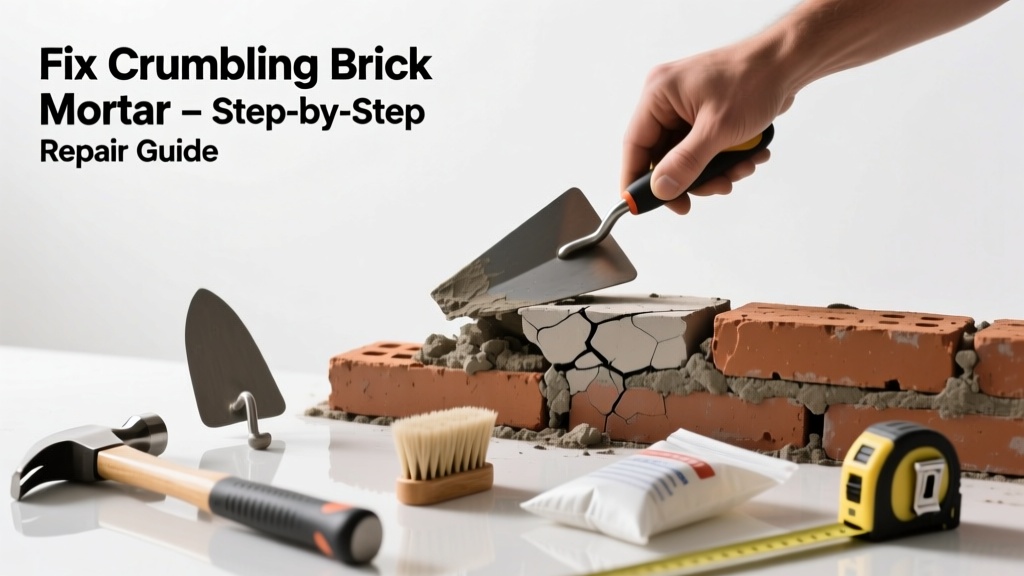
That powdery, chalky residue on your brick wall isn’t just ugly — it’s a red flag. When mortar crumbles under light pressure or flakes off in chunks, your masonry’s structural integrity is already compromised. Left unaddressed, even small mortar failures can lead to water infiltration, freeze-thaw spalling, and eventual brick displacement.
Quick Diagnosis
Mortar doesn’t fail randomly. Here are the most common root causes you’ll encounter:
- Efflorescence buildup masking deteriorated lime content
- Use of Portland-cement-rich mortar on historic soft brick (causing stress fractures)
- Chronic moisture exposure from poor roof overhangs or clogged gutters
- Freeze-thaw cycles widening micro-cracks in substandard repointing jobs
- Root intrusion from nearby shrubs or vines prying joints apart
Tools & Materials Needed
| Item | Purpose | Estimated Cost |
|---|---|---|
| Pointing trowel (4" stiff blade) | For precise mortar bedding and joint finishing | $12–$22 |
| Grinding wheel with diamond masonry blade | Cleanly removes failed mortar without damaging brick edges | $45–$85 |
| Type N mortar mix (1:1:6 lime:cement:sand) | Flexible, breathable blend ideal for most above-grade brickwork | $14–$28 per 80-lb bag |
| Soft-bristle masonry brush | Removes dust and debris before mortar application | $8–$15 |
| Jointer tool (concave or V-profile) | Compresses and shapes mortar for weather resistance | $6–$18 |
Step-by-Step Fix
Repair depends on severity. Start with the least invasive method and escalate only if needed:
- Surface consolidation (minor powdering): Apply a breathable silane-siloxane consolidant like Prosoco Joint & Seam Sealer. Let cure 48 hours before testing adhesion with a fingernail.
- Partial repointing (1–2 mm depth loss): Rake out loose material with a carbide-tipped grout rake, dampen bricks, then press in fresh Type N mortar using a pointing trowel. Tool joints flush or slightly recessed.
- Full-depth repointing (3+ mm loss or hollow-sounding joints): Grind out mortar to ¾" depth using a diamond blade. Mist bricks thoroughly, pack mortar in ⅓-depth layers, and tool within 20 minutes of final placement.
When to Call a Pro
DIY stops where safety and structural certainty begin. Call a certified mason if:
- You spot horizontal cracks wider than ⅛" running through multiple courses
- Bricks are bulging outward more than ½" from the wall plane
- The crumbling affects load-bearing walls — especially near lintels or foundations
- You’re working on chimneys taller than 15 feet or historic buildings built before 1930
According to the Insurance Institute for Business & Home Safety's 2023 report, 68% of premature mortar failure stems from improper material selection — not technique — making expert assessment critical for older structures.
Prevention Tips
Long-term success hinges on managing moisture and matching materials:
- Install drip edges on all horizontal brick ledges to divert runoff away from joints
- Trim vegetation within 18" of masonry to reduce humidity and root pressure
- Reapply breathable masonry sealer every 5–7 years — never use acrylic or silicone-based products
- Inspect mortar joints annually in spring and fall; catch powdering before it reaches 1/16" depth
Can I use bleach to clean crumbling mortar?
No. Bleach accelerates calcium leaching in lime-based mortars and degrades bond strength. Use a diluted vinegar solution (1:4 vinegar-to-water) for efflorescence, followed by thorough rinsing. Never pressure-wash — it forces water behind the brick veneer.
How deep should I grind out old mortar?
Minimum depth is ¾", but never exceed two-thirds the brick’s height. For standard 2¼"-tall bricks, that’s no deeper than 1½". Going deeper risks destabilizing the brick bed or exposing weak substrate.
Is mortar color-matching possible after repointing?
Yes — but only with pigment-matched sand. Bagged pre-mixes rarely match aged brickwork. Source local sand (e.g., Delaware River sand for Philadelphia brownstones) and blend with white Portland cement and hydrated lime for accuracy.
Can I repoint in cold weather?
Only if ambient temps stay above 40°F for 72 hours post-application and you use an antifreeze admixture like Daratard 17. Below 32°F, hydration halts and mortar won’t gain strength — leading to early failure.
Do I need to seal new mortar?
No — sealing traps moisture inside the wall assembly. Properly mixed and cured mortar cures by carbonation, not evaporation. Sealing interferes with this process and encourages spalling. Let it breathe.
What’s the difference between tuckpointing and repointing?
Repointing replaces failed mortar throughout the joint. Tuckpointing is a decorative technique using two-tone mortar to simulate fine joints — often misapplied as a fix. It offers zero structural benefit unless full-depth repointing happens first.
A well-executed mortar repair buys you 25–40 years of service — but only if you respect the chemistry of lime, the physics of moisture movement, and the history of your wall’s original construction. Skip shortcuts like hydraulic cement or caulk-based ‘mortar’; they’ll fail faster and cost more to undo later. For deeper guidance on matching historic mortar recipes, see our historic mortar mix guide. If your chimney shows similar symptoms, check our chimney mortar repair walkthrough — the stakes and techniques differ significantly.