Your breaker trips—and won’t stay reset. You flip it back on, hear a faint click, and watch it immediately snap off again. That’s not just inconvenient—it’s a warning sign your circuit is overloaded, damaged, or dangerously compromised.
Quick Diagnosis
Before grabbing tools, rule out the obvious causes:
- Overloaded circuit (too many devices drawing power)
- Faulty appliance plugged into the circuit
- Short circuit in wiring, outlet, or switch
- Ground fault (especially in bathrooms, kitchens, or outdoors)
- Worn-out or defective breaker (common in panels older than 25 years)
Tools & Materials Needed
| Item | Purpose | Estimated Cost |
|---|---|---|
| Non-contact voltage tester | Verifies no live current before inspection | $12–$25 |
| Insulated screwdriver set | Safely tighten terminal screws without shock risk | $18–$35 |
| Circuit tester (receptacle tester) | Confirms outlet wiring integrity and ground faults | $8–$15 |
| Flashlight with hands-free option | Illuminates panel interior and junction boxes safely | $10–$22 |
Step-by-Step Fix
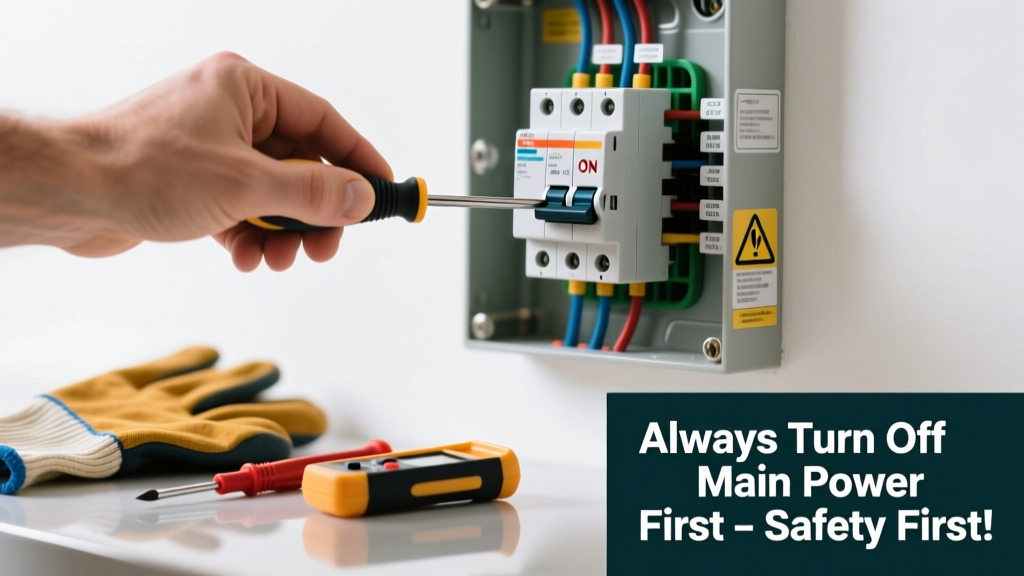
Work only with the main power OFF unless testing with non-contact tools. Never force a breaker into the ON position.
- Unplug everything on the affected circuit—then try resetting. If it holds, plug devices back in one at a time to isolate the culprit.
- Check outlets and switches on the circuit for burn marks, warmth, buzzing, or sizzling sounds. Use a receptacle tester on each—miswired or open-ground outlets can cause nuisance tripping.
- Inspect for moisture in outdoor, bathroom, or basement outlets. A single damp GFCI outlet can trip its upstream breaker—even if it’s not the GFCI itself.
- Tighten breaker terminals: With main power OFF, verify all wire connections at the breaker and neutral bar are snug (loose neutrals cause 90% of ‘phantom’ trips in older panels, per NEMA’s 2022 Panel Safety Bulletin).
When to Call a Pro
Stop immediately and call a licensed electrician if:
- The breaker feels hot to the touch—or emits a burning smell
- You see scorch marks, melted insulation, or discolored metal in the panel
- Resetting triggers sparks, popping sounds, or flickering lights elsewhere
- The same breaker trips repeatedly after confirming load is under 80% capacity
- Your panel is Federal Pacific (FPE), Zinsco, or Challenger—these carry documented failure risks (U.S. CPSC, 2021)
Prevention Tips
Breakers wear out. Most last 20–30 years—but frequent tripping accelerates fatigue. Install AFCI breakers in bedrooms and living areas to catch arc faults early. Label every circuit clearly so overloading is easier to spot. Replace panels older than 30 years—even if they “still work.” According to the National Fire Protection Association’s 2023 Electrical Fire Report, 42% of home electrical fires start in outdated panels or undersized circuits.
"A breaker that refuses to reset isn’t ‘being stubborn’—it’s doing its job. Forcing it bypasses critical safety protection." — Master Electrician Rosa Mendez, IBEW Local 25, 2022
Can a bad outlet cause a breaker not to reset?
Yes—especially if the outlet has a shorted hot-to-ground connection or internal arcing. Test every outlet on the circuit with a receptacle tester first. Replace any that show "open ground" or "hot/neutral reverse," even if they appear functional.
Why does my breaker reset but trip again instantly?
This almost always indicates a hard short or ground fault—not overload. It’s rarely the breaker itself. Start by disconnecting the load wire from the breaker (with main OFF) and attempt reset. If it holds, the fault is downstream—in wiring, a junction box, or a device.
Is it safe to replace a breaker myself?
Only if you’re experienced with panel work and have verified the main is fully de-energized. Even then, mismatched breakers (wrong brand, amperage, or series) can void UL listing and create fire risk. Always match manufacturer specs exactly—see our breaker replacement guide for compatibility charts.
Can weather cause a breaker to stop resetting?
Absolutely. Humidity can track across dusty bus bars or corroded terminals, creating leakage paths. This is common in garages, sheds, and coastal homes. Inspect for condensation inside the panel and clean with dry compressed air—not solvents or cloths.
What’s the difference between a tripped and a failed breaker?
A tripped breaker moves to the middle (TRIP) position and resets cleanly. A failed breaker may feel stiff, won’t move past middle, or resets but supplies no power downstream—confirmed with a multimeter reading 0V at the load terminal. Failed units must be replaced; see our how to test a circuit breaker walkthrough.
Will flipping the main breaker fix a stuck breaker?
Temporarily, yes—but it doesn’t solve the root cause. Power cycling clears residual magnetic lock in some thermal-magnetic breakers, but if the breaker trips again within seconds, the fault remains. Don’t rely on this as a fix—use it only as a diagnostic step before deeper inspection.
Fixing a stubborn breaker isn’t about brute force—it’s about listening to what the system is telling you. Most issues resolve with methodical isolation and simple corrections. But when physics, corrosion, or age take over, respect the limits of DIY. Your panel protects more than convenience—it safeguards lives. When in doubt, turn it off and call someone with the right license, tools, and insurance.