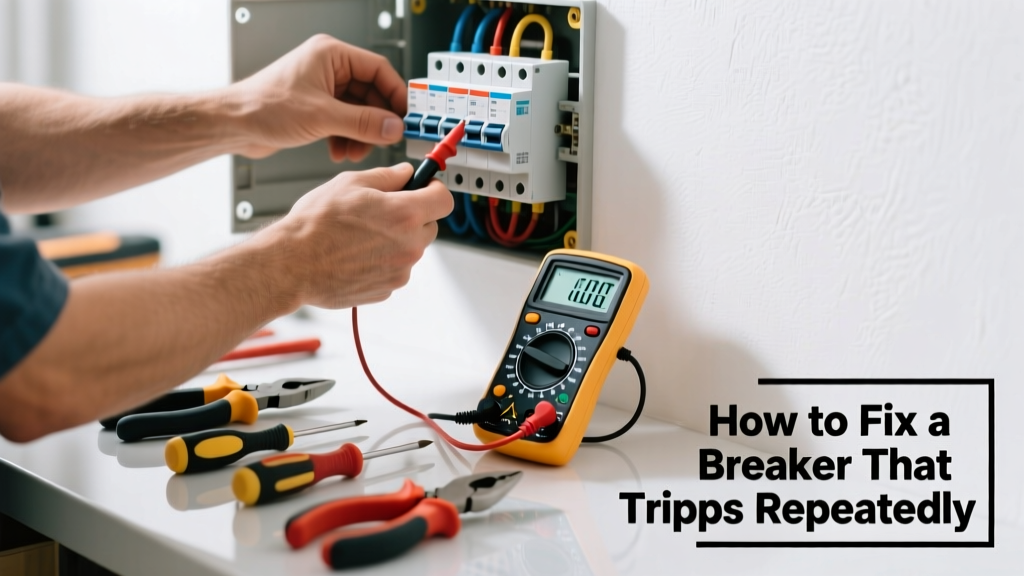
Your breaker trips again—five minutes after you reset it. You’ve unplugged everything, checked the outlet, and still, it clicks off with a sigh. This isn’t just annoying; it’s a warning sign your circuit is overloaded, damaged, or miswired.
Quick Diagnosis
Before grabbing tools, rule out the obvious:
- Overloaded circuit (too many high-wattage devices on one line)
- Faulty appliance plugged into the circuit
- Short circuit in wiring, outlet, or switch
- Ground fault (especially in kitchens, bathrooms, or outdoors)
- Aging or defective breaker (common in panels over 25 years old)
Tools & Materials Needed
| Item | Purpose | Estimated Cost |
|---|---|---|
| Digital multimeter | Test voltage, continuity, and ground faults | $25–$60 |
| Non-contact voltage tester | Safely confirm power is off before inspection | $12–$28 |
| Insulated screwdrivers (VDE-rated) | Secure connections without risking shock | $18–$35 |
| Circuit breaker finder | Identify which outlets/lights share the tripping circuit | $20–$45 |
Step-by-Step Fix
- Unplug everything on the affected circuit—then reset the breaker. If it holds, plug devices back in one at a time until it trips. The last device added is likely faulty.
- Check outlets and switches on the circuit: Remove faceplates and inspect for burn marks, melted plastic, or loose wires. Tighten terminal screws if loose—but only with power OFF and verified using a non-contact tester.
- Test for ground faults: Use your multimeter to check resistance between hot and ground wires at the first outlet on the circuit. Less than 1 MΩ suggests moisture or insulation breakdown—common behind refrigerators or in damp basements.
- Swap the breaker (only if identical amperage and panel-compatible): Turn main power OFF, remove the suspect breaker, and install a known-good replacement. Do not substitute a higher-amp breaker—it creates fire risk.
When to Call a Pro
Stop working and call a licensed electrician immediately if:
- You smell burning plastic or ozone near the panel or outlets
- The breaker feels hot to the touch or shows visible pitting or corrosion
- Tripping occurs even with all loads disconnected and the breaker replaced
- Your home has aluminum wiring (installed 1965–1973) or a Federal Pacific (FPE) or Zinsco panel—both carry documented failure risks
"Over 40% of electrical fires originate from faulty breakers or outdated panels, according to the U.S. Fire Administration's 2022 National Fire Incident Reporting System data."
Prevention Tips
Extend circuit life and reduce nuisance trips with these habits:
- Label your panel clearly—use a circuit map to avoid overloading any single leg
- Replace incandescent bulbs with LEDs to cut load by up to 85% per fixture
- Install AFCI/GFCI breakers where required by NEC 2023—especially for bedrooms and laundry rooms
- Have your panel inspected every 10 years if it’s older than 20 years
Why does my breaker trip only when I use the microwave and toaster at the same time?
This is classic circuit overload. Most kitchen countertop circuits are 20-amp, supplying ~2,400 watts. A microwave draws 1,200–1,500W and a toaster 800–1,200W—easily exceeding capacity. Try plugging one into a different circuit, or consider upgrading to dual 20-amp small-appliance branch circuits.
Can a tripping breaker damage my appliances?
Yes—repeated surges during trip/reset cycles stress compressor motors and power supplies. Sensitive electronics like gaming PCs or audio gear benefit from a UPS with surge protection. If your refrigerator trips the breaker weekly, test its compressor startup draw with a clamp meter—it may be failing.
Is it safe to replace a 15-amp breaker with a 20-amp one?
No—and it’s illegal under NEC 210.21(B)(1). A 15-amp breaker protects 14-gauge wire. Swapping it for 20-amp risks overheating and fire. Always match breaker amperage to wire gauge. For context, 14 AWG = 15A max; 12 AWG = 20A max.
What’s the difference between a short circuit and a ground fault?
A short circuit occurs when hot contacts bare neutral or another hot wire—causing massive current flow and instant trip. A ground fault happens when hot contacts bare ground (e.g., frayed cord touching metal box)—often tripping GFCI devices first. Both require immediate correction, but ground faults are more common in wet locations.
How often should I test my circuit breakers?
Annually—flip each breaker fully OFF then ON to exercise the mechanism. Also test GFCIs and AFCIs monthly using their built-in test buttons. According to the Electrical Safety Foundation International (ESFI, 2023), 22% of homes with untested GFCIs had units that failed to trip during emergency testing.
Will resetting the breaker repeatedly cause long-term damage?
Yes. Each trip wears internal contacts and weakens the bimetallic strip. Frequent cycling also increases arcing inside the panel. If a breaker trips more than 3 times in one day without load change, assume it’s failing—not the circuit.
A tripping breaker isn’t just an inconvenience—it’s your home’s electrical system speaking up. Address it methodically, respect the limits of DIY, and know when the safest fix is picking up the phone. For deeper issues like whole-panel evaluation or adding dedicated circuits, see our guide on electrical panel inspection essentials or how to install a dedicated circuit.