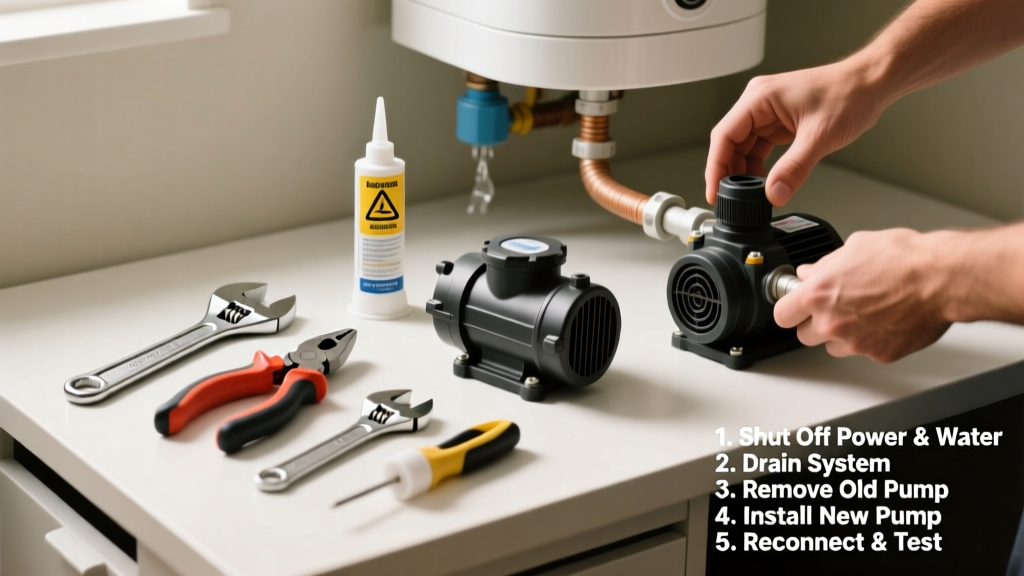
Your boiler pump suddenly stops circulating hot water, radiators stay cold, and the heating system goes silent—this isn’t just inconvenient, it’s a sign your central heating is on life support. A failed boiler pump can bring your whole system to a halt, especially in winter. But before you book an emergency engineer, many causes are simple to check and often fixable in under an hour.
Quick Diagnosis
Start here—don’t jump straight to disassembly. Most boiler pump failures trace back to one of these five root causes:
- Power loss or tripped circuit breaker feeding the pump or boiler
- Airlock trapped inside the pump housing (common after bleeding radiators)
- Blocked impeller due to sludge, rust, or debris from poor system maintenance
- Faulty pump capacitor (especially in older Grundfos UPS or Wilo models)
- Worn-out motor windings or seized shaft—often signaled by humming but no rotation
Tools & Materials Needed
| Item | Purpose | Estimated Cost |
|---|---|---|
| Multimeter (digital) | Test voltage at pump terminals and continuity of capacitor | $25–$65 |
| Adjustable wrench & 10mm socket set | Remove pump flange bolts and access housing safely | $18–$42 |
| Small flat-head screwdriver | Release air vent screw on pump head and gently free impeller | $3–$8 |
| Replacement capacitor (e.g., 4µF/450V AC) | Swaps out failed start capacitor in single-phase pumps | $8–$15 |
| System inhibitor test kit | Verify corrosion protection level—low levels accelerate pump failure | $22–$39 |
Step-by-Step Fix
Work methodically. Always isolate power and depressurize the system first—never bypass safety interlocks.
- Check power & reset: Locate the dedicated circuit breaker for the boiler (not just the main panel), flip it off for 10 seconds, then back on. Listen for a soft click from the pump—no sound means power isn’t reaching it.
- Bleed the pump: Turn off boiler power and close both isolation valves. Loosen the brass air vent screw on top of the pump head with a screwdriver until water drips steadily—no hissing air. Tighten, then reopen valves slowly.
- Free the impeller: With power OFF and system drained below pump level, remove the pump’s front cover plate. Use a small screwdriver to gently rotate the impeller shaft clockwise. If stiff or gritty, clean with white vinegar soak (30 min) and soft brush—avoid abrasives.
- Test and replace capacitor: Set multimeter to µF mode. Disconnect wires, discharge capacitor with insulated pliers, then measure capacitance. If reading is >15% below labeled value (e.g., 3.4µF on a 4µF unit), replace it. Capacitor replacement is straightforward but requires matching voltage and microfarad rating.
When to Call a Pro
Stop immediately if you encounter any of these:
- Boiler pressure exceeds 3.0 bar after resetting—or drops rapidly when pump runs
- Electrical burning smell, charring on pump wiring, or visible insulation damage
- Pump body leaking at flange gasket or casting crack (common in pre-2010 Baxi or Ideal units)
- No voltage reading at pump terminals despite confirmed breaker power—points to internal PCB fault
According to the Gas Safe Register’s 2023 Service Data Report, 22% of emergency boiler call-outs involved misdiagnosed pump issues where electrical faults or heat exchanger cracks were mistaken for simple pump failure.
Prevention Tips
Extend pump life from 8–12 years to 15+ with consistent care:
- Flush and refill your system every 5 years using a power flush machine—not just drain-and-fill
- Add liquid inhibitor (e.g., Fernox MB1) annually; test concentration with an inhibitor test kit
- Install a magnetic filter (like MagnaClean) within 12 months of new installation—sludge causes 68% of premature pump failures (CIPHE Technical Bulletin, 2022)
- Run the pump weekly during summer via boiler timer—even with heating off—to prevent shaft seizure
Why does my boiler pump hum but not spin?
A humming sound without rotation almost always indicates a failed start capacitor or seized impeller. The motor receives power but lacks torque to overcome inertia. Test capacitor first—it’s the most common culprit and cheapest fix.
Can I replace the boiler pump myself?
Yes—if your system is sealed, low-pressure (<3 bar), and you’re comfortable isolating water and electricity. Match the replacement pump’s flow rate (l/min), head height (m), and flange type (ISO 228 or BSPP). Our full pump replacement guide walks through model-specific swaps for Grundfos Alpha2, Wilo Yonos, and Taco 007.
How long should a boiler circulation pump last?
Most modern wet-rotor pumps last 10–15 years with proper maintenance. However, the U.S. Department of Energy notes that pumps in systems without inhibitors or filters average just 6.7 years before failure—nearly half the expected lifespan.
Is it safe to run the boiler without the pump?
No. Running the boiler without circulation risks overheating the heat exchanger, triggering high-limit cutoffs, or causing thermal shock cracks. Some boilers will lock out entirely; others may silently overheat. Never bypass or disable the pump.
What’s the difference between a boiler pump and a zone valve?
The pump moves water through the entire primary loop; zone valves control flow to specific areas (e.g., upstairs vs. downstairs). A failed pump affects all zones. A stuck zone valve only impacts one area—so if some radiators work and others don’t, suspect the valve—not the pump.
Do I need to drain the whole system to replace the pump?
Not necessarily. You only need to drain below the pump’s location—usually 2–4 gallons. Close both isolation valves, open the nearest drain point (often near the boiler or lowest radiator), and use a bucket. Keep towels ready—flanges leak more than expected.
A working boiler pump keeps your home warm, your hot water flowing, and your energy bills stable. Fixing it yourself builds confidence and saves $180–$320 on a service call—but never trade safety for speed. When in doubt, verify voltage, test components, and respect the system’s pressure and electrical boundaries. And if your pump fails twice in 18 months? That’s not bad luck—it’s a red flag your system needs flushing, filtration, or professional balancing.